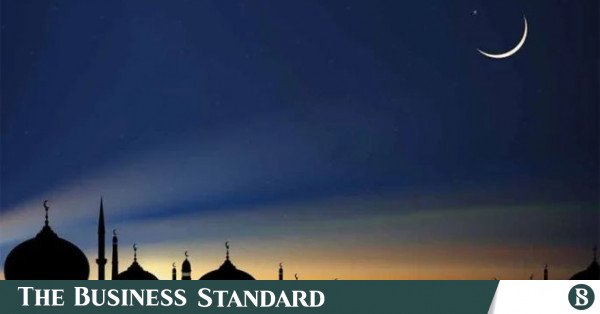
The holy Eid-ul-Fitr, one of the greatest religious festivals of the Muslims, will be celebrated in the country on Saturday as the moon of Shawwal month of 1447 Hijri was not sighted in the sky of Bangladesh today (19 March).
“The moon of Holy Shawwal month of 1447 Hijri was not sighted in the sky of the country today. The holy Eid-ul-Fitr will be celebrated on Saturday,” Religious Affairs Minister and National Moon Sighting Committee President Kazi Shah Mofazzal Houssain (Kaikobad) told reporters after the meeting of the National Moon Sighting Committee.
Earlier, a meeting of the National Moon Sighting Committee was held at the meeting room of Islamic Foundation at Baitul Mokarram National Mosque here this evening with Religious Affairs Minister and National Moon Sighting Committee President Kazi Shah Mofazzal Houssain in the chair.

The main jamaat of the Eid-ul-Fitr will be held at the National Eidgah on the High Court premises here at 8.30am.
Khatib of Baitul Mukarram National Mosque, Mufti Muhammad Abdul Malek, will lead the prayers at the National Eidgah. As an alternate imam, Islamic Foundation’s Mufassir Dr. Maulana Md. Abu Saleh Patwari will remain prepared.
The president and the prime minister will offer the Eid-ul-Fitr prayers in the main Jamaat at the National Eidgah here at 8:30am, State Minister for LGRD and Cooperatives Mir Shahe Alam told reporters after visiting the National Eidgah here this morning.
Dhaka South City Corporation (DSCC) Administrator Md Abdus Salam and senior officials concerned accompanied the state minister during the visit.
Besides, chief justice, cabinet members, judges of the Supreme Court, senior political leaders and high level civil and military officials will also say their prayers there.
The Eid jamaat at the National Eidgah will be held under the auspices of DSCC.
DSCC Administrator Abdus Salam said there are arrangements for about 35,000 people to offer prayers at the National Eidgah. There are also arrangements for women to offer prayers.
The city administrator said that police, RAB and other law enforcement agencies will be deployed to ensure overall security at the Eidgah. Besides, “Special Security Force (SSF) members are working for the security of VVIPs.
Meanwhile, the perimeter of the National Eidgah has been cordoned off. Rows of water taps have been newly installed for ablution.
There are two entrances to the National Eidgah. A separate gate has been made through the Supreme Court premises for the entry of VVIPs. The entrance for women has also been separated.
A total of five Eid congregations will be held sequentially at Baitul Mukarram National Mosque at 7am, 8am, 9am, 10am, and 10:45am.
Maulana Mizanur Rahman, Senior Pesh Imam of Baitul Mukarram National Mosque, will lead the first congregation; Mufti Muhibbullahil Baqi Nadvi, Pesh Imam of the mosque, will lead the second; Maulana Md. Zakir Hossain, Deputy Director of the Islamic Foundation, will lead the third; Maulana Zobayer Ahmed Al Azhari, Religious Instructor at the Imam Training Academy, will lead the fourth; and Mufti Maulana Mohammad Abdullah of the Islamic Foundation will lead the fifth and final congregation.
At that time, Maulana Shahidul Islam, Assistant Librarian of the Islamic Foundation, will remain prepared as an alternate imam.
A congregation of holy Eid-ul-Fitr will be held at 8:00am at the South Plaza of the Jatiya Sangsad Bhaban.
Members of Parliament, officials and staff of the JS Secretariat, and devotees from the surrounding areas will participate in the prayer, said a press release.
This year, a separate prayer arrangement has been made for women there.
All concerned are requested to be present on time and participate in the Eid jamaat.
Participants are also requested to come with full preparation for prayer, including having performed ablution (wudu).
Additionally, for security and order, participants are specially requested not to bring any bags or items other than prayer mats, mobile phones, and umbrellas if needed.
Eid-ul-Fitr is an Arabic word meaning “festival of breaking of the fast”.
The festival marks the end of the Muslim fasting month of Ramadan, the ninth month of the Islamic calendar.
Muslims abstain from eating and drinking from dawn to dusk during the holy month.
On the Eid day morning, usually, Muslim devotees gather at mosques and prayer venues to perform Eid prayers and greet each other.
The festival is celebrated by visiting residences of friends and relatives, hosting food parties and sharing sweets.
Children not only get new clothes and shoes, but also receive cash gifts called “Salami” from their elders, relatives and well-wishers.
The occasion is seen as a time of forgiveness and giving thanks to Almighty Allah for helping people to complete their month-long spiritual fasting.
Many Muslims distribute cash and food to the less fortunate ones.
About The Author