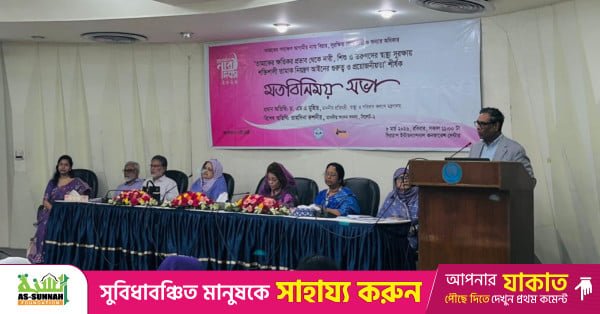
State Minister for Health and Family Welfare Dr MA Muhit speaks at a discussion meeting at the CIRDAP International Conference Center in the capital on 8 March 2026. Photo: TBS
“>

State Minister for Health and Family Welfare Dr MA Muhit speaks at a discussion meeting at the CIRDAP International Conference Center in the capital on 8 March 2026. Photo: TBS
State Minister for Health and Family Welfare Dr MA Muhit has stated that the approved tobacco control ordinance should be converted into law in order to protect public health.
Speaking at a discussion meeting, he emphasised that genuine development of a country is not possible if public health is overlooked.
Nari Maitree organised the event at the CIRDAP International Conference Center in the capital on the occasion of International Women’s Day today (8 March).

Special guests at the event included Member of Parliament for Sylhet-2 Tahsina Rushdir, Additional Secretary of the World Health Wing Sheikh Momena Moni, and former Director of the Directorate General of Health Services Professor Dr Shah Ali Akbar Ashrafi.
The meeting highlighted that according to the Tobacco Atlas 2025 of the World Health Organization, approximately 21.3 million people aged 15 years and above in Bangladesh use tobacco. Each year, nearly 200,000 people die from tobacco-related diseases, which translates to an average of around 546 deaths every day. Meanwhile, the economic loss caused by tobacco amounts to nearly Tk87,000 crore annually.
In this context, the meeting of the Advisory Council of the previous interim government on 24 December 2025 approved the ‘Smoking and Tobacco Products Usage (Control) (Amendment) Ordinance, 2025’ proposed by the Ministry of Health and Family Welfare.
Under the approved ordinance, the definition of “tobacco products” has been expanded to include nicotine pouches and any other nicotine products declared by the government from time to time, regardless of their name. It also prohibits the use of all tobacco products in public places and public transport, bans the use, production, and marketing of emerging tobacco products, and makes the provision of designated smoking areas subject to government directives.
Additionally, the ordinance expands the definitions and jurisdiction of “public place” and “public transport”, prohibits the display of tobacco products at points of sale as well as all forms of advertising, promotion, and sponsorship through the internet or any other medium, and introduces a provision requiring health warnings covering 75% of tobacco product packaging instead of the current 50%.
Dr Muhit said, “The tobacco control ordinance approved by the interim government is an important step toward reducing tobacco-related diseases and deaths. However, if we fail to convert it into law in the first session of parliament, the ordinance will lose its effectiveness. Therefore, out of responsibility toward public health, it is essential to enact it into law.”
MP Tahsina Rushdir said, “The harm caused by tobacco is not limited to individual health risks; it also has severe negative impacts on families, society, and the national economy.”
Referring to Tobacco Atlas 2025, she noted that more than 11% of women’s deaths in Bangladesh are caused by tobacco-related diseases.
She added that converting the approved ordinance into law would help protect future generations from the devastating health risks of tobacco.
Sheikh Momena Moni said, “Although the government earns around Tk40,000 crore in revenue from the tobacco sector each year, the economic loss due to treatment costs, loss of productivity, and premature deaths exceeds Tk87,000 crore.”
She noted that the previous interim government approved the tobacco control ordinance to prevent such massive losses and fatalities, reflecting the government’s strong commitment to protecting public health. She urged the newly elected government to maintain this position and support the law.
Dr Shah Ali Akbar Ashrafi said the approval of the tobacco control ordinance proposed by the Ministry of Health was “undoubtedly a positive step”.
He added that the responsibility now lies with the newly elected government to convert the ordinance into law, especially since the ruling party had committed to this issue in its election manifesto.
The meeting was chaired by Shaheen Akhter Dolly, executive director of Nari Maitree. Among others present were Masuma Alam, president of Nari Maitree, along with representatives from the Anti-Tobacco Mothers’ Forum, Teachers’ Forum, Journalists’ Forum, Youth Forum, and various civil society organisations.
About The Author