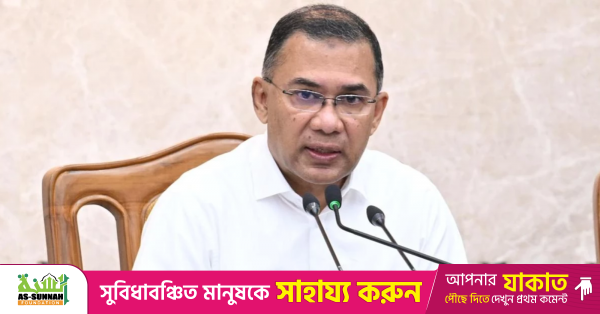
Prime Minister Tarique Rahman has pledged to gradually introduce free education up to the postgraduate level and expand opportunities for women in higher education, as part of his party’s election commitments.
In a statement marking International Women’s Day, he said the BNP aims to build a more inclusive and modern education system while ensuring greater safety for women.
“As part of our election commitments, our goal is to gradually introduce free education up to the postgraduate level, increase women’s participation in higher education, provide free school uniforms for girls, expand digital learning opportunities, and strengthen a modern education system,” he said.

Tarique, also the BNP chairman, emphasised that the government is giving the highest priority to ensuring women’s safety.
“We have taken a strong stance against cyberbullying and online harassment targeting women,” he said, adding that stronger measures are being implemented to protect women in both physical and digital spaces.
The statement reads, “8 March is International Women’s Day. On this occasion, I would like to extend my sincere greetings and congratulations to all women around the world. A country’s development can only be sustainable when women’s rights, education, health, safety, and participation are ensured. In this context, this year’s theme – Rights. Justice. Action. For ALL Women and Girls – is very meaningful and timely.”
He noted that women make up nearly half of the world’s population and that no country can achieve real development if women are kept outside the mainstream of government, politics, and decision-making.
“In particular, without women’s economic empowerment, it is not possible to achieve balanced development both at home and in society. In Bangladesh, women make up more than half of the population.”
The statement mentioned the proclaimer of independence, late president Ziaur Rahman, and the Mother of Democracy Khaleda Zia played “groundbreaking roles” in empowering women politically and economically.
During Zia’s tenure, a Women’s Affairs Division was established in 1976 under the President’s Secretariat. Later, in 1978, the Ministry of Women’s Affairs was formed, and in 1994, during the government of Khaleda Zia, it was transformed into the Ministry of Women and Children’s Affairs, it reads.
To strengthen women’s socio-economic empowerment, Khaleda Zia introduced free education for girls up to the 12th grade, said the statement.
“This was a revolutionary step in empowering women in Bangladesh. Continuing that legacy, the current government has introduced the family card, which will be issued in the name of the female head of the family to promote women’s economic empowerment. The government is committed to ensuring women’s active and meaningful participation in education, the economy, health, politics, and all areas of national life.”
The premier said, “We want to build a Bangladesh where women and men enjoy equal rights and opportunities. A Bangladesh where women can work with dignity, respect, and safety in their families, communities, and the nation. Let equality be our commitment, dignity our reality, and empowerment the foundation of our development.
“On this International Women’s Day, I wish every success to all programs and initiatives taken to honour and empower women.”
About The Author