Bangladesh and other climate-vulnerable countries must continue receiving international adaptation finance even after graduating from the least developed country (LDC) category, civil society organisations (CSOs) have urged ahead of the COP31 climate summit.
They have called for predictable, grant-based and highly concessional climate financing, warning that graduating from LDC status does not mean an end to climate vulnerability or the need for international assistance.
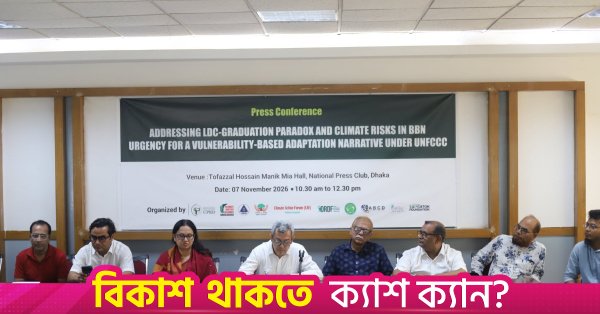
The demands were raised at a press conference organised by the Center for Participatory Research and Development (CPRD), in collaboration with the Climate Justice Alliance-Bangladesh (CJA-B) and several other civil society organisations, at the National Press Club in Dhaka today (7 November).

The event was held ahead of the 31st Conference of the Parties (COP31) to the United Nations Framework Convention on Climate Change (UNFCCC), scheduled to take place in Antalya, Türkiye, from 9 to 20 November.
The organisations also called for a coordinated regional position among Bangladesh, Bhutan and Nepal (BBN), arguing that the three countries face interconnected climate threats that demand joint advocacy and adaptation strategies.
Md Shamsuddoha, chief executive of CPRD and coordinator of CJA-B, said the economic progress achieved by the three countries had not necessarily reduced their exposure to climate risks or improved their capacity to withstand recurring climate shocks.
Although Bhutan has already graduated from LDC status and Bangladesh and Nepal are progressing through their respective graduation processes, all three remain highly vulnerable to climate change, he said.
He called for coordinated action by the governments and civil society organisations of the three countries at COP31 and in subsequent international climate negotiations.
Presenting the keynote paper, Sumaiya Binte Anwar, programme manager for research and advocacy at CPRD, called for a fundamental reassessment of international climate adaptation and financing frameworks.
She argued that climate vulnerability should be measured against countries’ actual and projected exposure to climate risks rather than conventional economic and development classifications.
Rabeya Begum, executive director of Shariatpur Development Society (SDS), said graduation from LDC status must not be mistaken for graduation from climate vulnerability.
She urged developed countries and multilateral climate finance institutions not to use economic progress as a pretext for withdrawing essential adaptation support.
Aminur Rasul, chair of Climate Action Forum, said the survival rights and adaptation needs of climate-vulnerable communities should not be subordinated to the mitigation priorities or economic interests of developed countries.
Nikhil Chandra, coordinator of Upokul O Sundarban Suraksha Andolon, emphasised that adaptation and mitigation must be pursued as complementary pillars of climate action.
He called for adequate international adaptation support that reflects developed countries’ historical responsibilities and the urgent needs of vulnerable nations.
Mir Mohammad Ali, assistant professor of aquaculture at Sher-e-Bangla Agricultural University, stressed the importance of stronger regional advocacy and closer engagement between governments and civil society to secure equitable climate finance.
Rafiqul Islam Azad, former president of Dhaka Reporters Unity, called for a clear distinction between economic graduation and climate vulnerability, urging the three countries to make grant-based adaptation finance a non-negotiable demand in international climate negotiations.
Shared climate risks require regional cooperation
The organisations said Bangladesh, Bhutan and Nepal are interconnected through a wider mountain-to-delta climate system, leaving them exposed to shared and cascading climate threats.
These include Himalayan glacier retreat, changing monsoon patterns, altered river flows, extreme rainfall, rising temperatures, sea-level rise and saltwater intrusion.
The resulting pressures are increasingly affecting livelihoods, infrastructure, climate-sensitive economic sectors and public finances across the region, they said.
Participants argued that these interconnected threats demand a vulnerability-based approach to adaptation financing rather than one determined solely by national income levels or LDC classification.
Three demands ahead of COP31
The press conference outlined three major policy priorities for Bangladesh, Bhutan and Nepal to pursue at COP31 and beyond.
First, the countries should put adaptation at the centre of international climate negotiations, ensuring that vulnerability, equity and human rights remain fundamental to global climate action. They also called for greater recognition of transboundary and cascading climate risks.
Second, they demanded a sustained financing mechanism to ensure predictable, accessible, grant-based and highly concessional adaptation funding regardless of a country’s LDC graduation status.
Third, they called for a common regional advocacy and negotiating agenda to address shared climate threats, strengthen adaptation measures and ensure transparent and accountable delivery of climate finance.
Other participants included Habibur Rahman of Swacheton Foundation, Md Anwar Hossain of Riverine People and Sheikh Nur Ataya Rabbi, programme manager for research and advocacy at CPRD, alongside climate experts, human rights advocates and civil society representatives.
About The Author