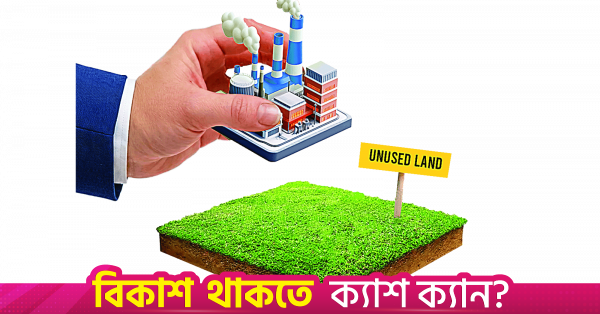
The government plans to scrap the restriction that requires unused land of closed state-owned factories to be reused only for the same industry, opening 10,306 acres of public assets to any viable commercial or manufacturing enterprise.
Formulated under Section 48 of the Invest Bangladesh Act 2026, the draft guidelines for commercialising loss-making state assets are entering their final stages of review.
Officials expect to hand over six to seven state factories to private investors between May and June next year in the first phase of the initiative.
The government has identified 44 closed and loss-making state-owned industrial enterprises under five state-owned corporations for potential revival.

Together, they hold around 10,306 acres of land, which will be gradually opened to private investors through transparent and competitive tenders once the policy takes effect.
New policy to widen land use
Under the existing approach, unused land belonging to a factory is generally expected to remain in the same type of industrial use. The proposed policy seeks to relax that restriction, allowing investors to propose other industries or commercial ventures based on a property’s location, infrastructure, and commercial potential and economic viability.
For example, land belonging to an old sugar mill would not necessarily have to be used for sugar production. However, the government could prioritise specific industries or sectors for individual projects, with such preferences specified in tender conditions and taken into account when evaluating bids.
Nahian Rahman Rochi, a member of Invest Bangladesh, told The Business Standard that the initiative will be guided by three principles: the optimal use of assets, fair and transparent competition, and a defined timeline for completing the process.
He said investment opportunities will be opened up to ensure the best use of these assets, while investors would be selected through tenders to guarantee transparency and equal opportunities.
Policy nearing finalisation
The latest draft was reviewed at a meeting at the Prime Minister’s Office on 17 October, chaired by the principal secretary to the PM. Representatives from relevant ministries and divisions, the Bangladesh Bank, the National Board of Revenue, and the Bangladesh Public Procurement Authority attended the meeting.
The participating ministries and agencies were asked to submit their final comments and observations within five working days. The draft is to be finalised incorporating the feedback, followed by legal scrutiny and the necessary approvals.
“We are now at the final stage of issuing the guidelines for commercialising loss-making state-owned assets and enterprises. Review covered the draft incorporating feedback from the public and relevant public- and private-sector stakeholders,” Rochi said.
“We expect to send the final version to the law ministry on Sunday for review and formal execution of the guidelines, following which we should be ready to begin the actual commercialisation process,” he told TBS yesterday.
The proposed policy provides for an eight-member Investment Transaction Coordination and Supervision Committee, to be chaired by the Invest Bangladesh chairman. The committee will play a key role in assessing assets, determining transaction structures, conducting tender procedures and recommending suitable investors.
Five corporations account for 44 enterprises
The 44 identified enterprises comprise 12 under the Bangladesh Textile Mills Corporation, four under the Bangladesh Steel and Engineering Corporation, 10 under the Bangladesh Chemical Industries Corporation, 13 under the Bangladesh Sugar and Food Industries Corporation, and five under the Bangladesh Jute Mills Corporation.
The government’s objective is to bring existing land, factories, electricity and gas connections, and other facilities back into productive use rather than incur fresh costs on land acquisition and industrial infrastructure.
To encourage long-term investment, management and land-use arrangements lasting 25-30 years or longer are also under consideration, depending on the nature of each project.
The assets cover a wide range of industries, including sugar, textiles, jute, paper, chemicals, engineering, leather, fertiliser and glass manufacturing.
Among the largest land holdings are 3,860.50 acres at Setabganj Sugar Mill in Dinajpur, 2,887.02 acres at Thakurgaon Sugar Mill and 501.78 acres at Karnaphuli Paper Mills in Rangamati.
A substantial portion of the 122.96 acres held by General Electric Manufacturing Company in North Patenga, Chattogram, is unused. The government sees potential for establishing a modern, environmentally friendly transformer manufacturing plant there.
Atlas Bangladesh Ltd in Tongi has 9.62 acres of land, around 64% of which is vacant. The site could offer scope to expand production to tap the growing electric motorcycle market.
Nearly 90 investment proposals received
On 20 June, a roadshow led by Prime Minister Tarique Rahman presented the 44 closed and loss-making state-owned industrial enterprises to domestic and foreign investors. The event highlighted several possible revival models, including public-private partnerships, joint ventures, long-term leases and strategic sales.
Around 50 proposals were received within the first 14–15 days after the initiative was launched. Subsequently, nearly 90 proposals were received from more than 14 companies and industrial groups, according to Invest Bangladesh.
However, these proposals will not result in the direct transfer of any factory or asset to the applicants. Fresh tenders will be invited after the policy is finalised, and those who submitted proposals earlier will also have to compete in the tender process.
Experts call for flexibility and safeguards
Abul Kasem Khan, chairperson of Business Initiative Leading Development (BUILD) and a former president of the Dhaka Chamber of Commerce and Industry, said tender conditions should be flexible enough to reflect business realities and the suitability of individual locations.
He said the government should assess the availability of gas, transport links and other infrastructure to determine which industries would be viable in particular areas. Investors could then be selected through competitive tenders based on their proposals.
Khondaker Golam Moazzem, president of Knowledge Hub Institute Trust, said safeguards are needed to prevent politically connected but unsuitable investors from obtaining the assets.
“Investor selection should take account of business experience, sector-specific expertise, financial capacity, access to investable funds and previous business performance. Experienced companies with a genuine interest in the relevant industries could also be invited to submit investment proposals,” he said.
About The Author