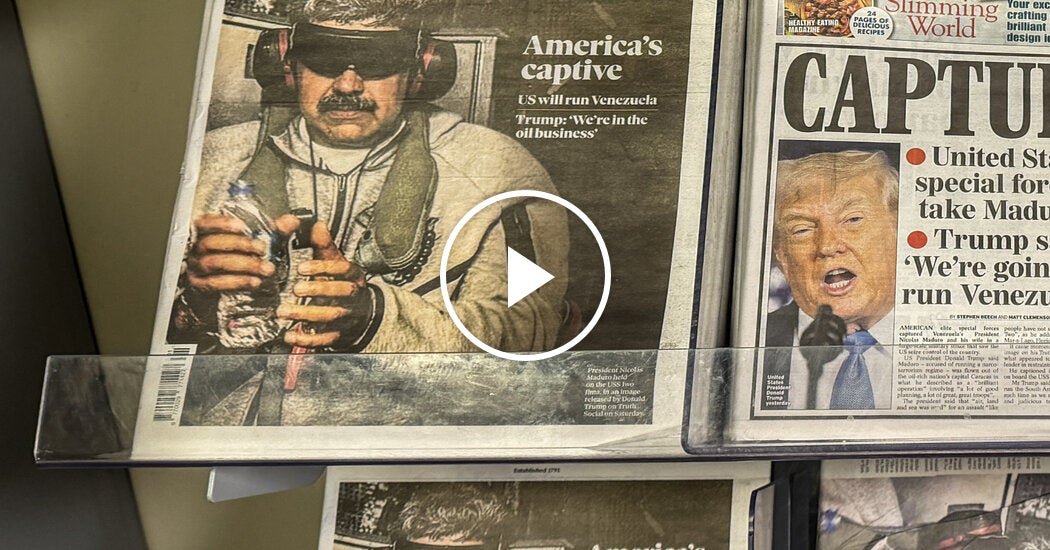
What is America doing in Venezuela? Over the weekend, on Jan. 3, the Trump administration launched an operation that ended with the capture of Nicolás Maduro, the president of Venezuela. Maduro — not a good person. Not a good guy. A repressive, brutal dictator who has made the lives of many, many people miserable. But there are a lot of brutal, repressive dictators in this world. Venezuela is not a leading source of America’s drug crisis. We have a fentanyl crisis, not a cocaine crisis. Venezuela’s oil reserves, which we should not be invading other countries for anyway, is not an easy source of future wealth or power for the United States. President Donald Trump ran for office promising fewer foreign entanglements. He wanted to be remembered as a peacemaker. What are we doing? We are going to run the country until such time as we can do a safe, proper and judicious transition. This was a profound gamble from an administration that, to a very large extent, ran for office this time promising an end to these kinds of gambles, criticizing those that previous presidents had made in the past. So what is the collection of arguments, views, interests, factions that led America to this point? And what comes after it? Joining me today is Jonathan Blitzer, who has covered immigration and the Trump administration and Central America for The New Yorker. He has profiled Stephen Miller and gone deep into the drug boat bombings. He’s also the author of the excellent book, “Everyone Who Is Gone Is Here: The United States, Central America and the Making of a Crisis.” As always, my email: ezrakleinshow@nytimes.com. Jonathan Blitzer, welcome to the show Thanks for having me. Who is Nicolás Maduro? He has suddenly become a household name in the United States. Who is he? How should we understand what he represents? Maduro has always been, to my mind, kind of a middling figure who attached himself to his predecessor, Hugo Chávez, who was a transformative, obviously highly controversial figure in Venezuela who nationalized the oil industry, who made improving the lives of the poor kind of central plank of his political agenda, but also consolidated power in all kinds of ways, flirted with violating the Constitution and so on. Maduro was essentially a member of that administration and became Chávez’s appointed successor when Chávez became sick with cancer and died. And so Maduro took power in 2013 and never had the charisma of Chávez. And almost immediately when he took office, you had things start to change the fortunes of the country. You had the price of oil drop. There was an economic crisis. You started to have an increase in inflation that got steadily worse in the 2010s. You started to have a series of domestic flare UPS of mass protests, which Maduro responded to by cracking down on the population and increasingly aggressive ways. This was in 2014, again in 2017. In 2015, the Venezuelan opposition won congressional elections and would seem could really bring Maduro to heel. And the response of Maduro and his inner circle was to essentially invalidate that victory of the opposition in Congress and to go on to try to neuter the power of the opposition. And what we saw in the years since was an increasingly brutal consolidation of power. So he’s someone who was always a kind of weak personal replacement to Chávez, who in some ways channeled all of Chávez’s darkest, most repressive urges and has basically been at the helm during a period where the country has really disintegrated in many ways. I mean, since 2014, you have close to eight million Venezuelans who have fled the country. That’s all been during Maduro’s time as leader. So Donald Trump has been talking about deposing Nicolas Maduro, the previous leader of Venezuela, since his first term. Why and why didn’t it happen then. I mean, the most interesting thing to those of us following Trump’s stance on this issue during his first term was that there were real Hawks and hardliners in his administration that first time who were pushing for more aggressive direct action in Venezuela and in the region. And the person who was uncomfortable moving forward was Trump. He was skeptical of the idea of putting boots on the ground. He was skeptical of the idea of overextending American involvement in the region. And so I think probably the most striking thing has been his change, the trajectory that he’s kept from Trump one to Trump two. But I think the issue, the Venezuela issue for him has always loomed large. Part of that is just purely political. The South Florida Republican Latino community, which is obviously very important to him and is important among a lot of his supporters and members of his administration, has always really been fixated on Venezuela. They see the Venezuelan regime as being the key to unlocking the kind of downfall of socialist regimes across the region in Cuba. Above all, also in Nicaragua. And so there’s always been a real appetite for high flying, saber rattling rhetoric on the issue. And Trump initially understood the kind of priority of Venezuela in those terms as a political imperative. But the idea that we did this for political support in Southern Florida, that doesn’t track for me, there have been too many players involved. Donald Trump is not running for reelection again, probably. What were the conceptions of American interests at play. I mean, there’s no question that oil is a huge interest for Trump and something that he’s always been fixated on. It’s bothered him, and it’s bothered people in his inner circle that Maduro’s predecessor, Hugo Chávez, nationalized large parts of the country’s oil sector and essentially forced out American and international companies in the 2000. And so there’s been this idea, for one thing, that American capitalist interests have been dispossessed, that it’s a matter of recouping what was lost. There is a sense of opportunity there. And I also think that he’s someone who I do think has grand designs for asserting American influence in the region as a reflection of his political power. And so I think the Venezuela issue has always been an opportunity for him to do that on a big international stage, to really be the kind of bully that he’s wanted to be and to threaten others in the region. Tell me about the oil and the geopolitics of oil side of this. Because that does seem to have been quite compelling to Trump himself. And the thing that I’ve heard is that inside the administration, there was, from the very start of the current term, a tension. On the one hand, the hardliners like Rubio and that broader delegation of Rubio aligned members of Congress wanting the administration to take increasingly aggressive action against Venezuela, roll back, for example, some easing of the sanctions done during the Biden administration. The Biden administration created a special exception for Chevron to continue to do some measure of business in Venezuela. And it seems like at a certain point, the threat was made to Trump that these members of Congress would block or drag their feet on the so-called big beautiful bill, his big domestic spending bill, if he didn’t chart a harder course against Venezuela. So in one sense, he was responsive to all of those things and conscious of the need for everyone to be in lockstep, particularly around that big domestic spending bill. At the same time, he was very concerned about the idea of Chevron losing its foothold at a time when a lot of observers will point out that the US hard line against Venezuela has allowed other countries, Russia, Iran to China to establish increasing influence both in Venezuela and over the Venezuelan oil industry. And so there was this plan to try to manage both things. And I actually think in some ways the aggression that we’ve seen is an outgrowth of the administration trying to square that particular circle. So, so Trump, ostensibly acceded to the demands made by hard line anti-maduro Republicans in Congress to continue to keep these sanctions to try to roll back some of the Biden administration allowances on Chevron’s activity in the region. And then by the time that Bill had passed, by the end of July, you have the White House signing this kind of legal memorandum to essentially justify or at least set in motion, the start of these boat bombings. I think Trump thinks very, very actively about the oil issue. What’s unclear to me is what he’s hearing from advisors about the difficulty of propping the Venezuelan oil industry back up. I mean, the big problem has been Venezuela is responsible for less than 1 percent of the world’s oil. It’s producing half of what it used to produce per day in the 90s. And so reestablishing the industry is going to require huge amounts. I’ve seen things like $60 billion of investment roughly over a long period of time and a place where we don’t know its long term stability Yeah, right. We don’t know what Venezuela is going to look like after this in five years and 10. I mean, the record of this we depose the leader we don’t like. Everything’s going to be stable and aligned to American interests for the foreseeable future is not great. And these oil companies, by the way, American oil companies are extraordinarily risk averse. I mean, it’s not lost on them that, first of all, the Iraq example is looming large in their mind, but also all of these questions that you and I can’t yet answer and that no one really can answer about of the long term American plan for Venezuela all militate against these companies getting involved in the oil sector right now, given the unpredictability of what’s ahead. You’ve talked about this in some of your reporting and other reporting. I’ve read, as in part as Stephen Miller theory, that there is an effort to establish might call it deterrence, but fear among every leader in the Western hemisphere, and that Venezuela was for a variety of reasons. We’ll get into the best example to use that when we talk about Venezuela, we’re not really just talking about Venezuela. We’re talking about making an example of Venezuela such that every other leader in Latin America acts differently when Trump rattles his saber in the future. No, that’s exactly right. I mean, that’s always been the case with Venezuela. When we talk about Venezuela, we’re never just talking about Venezuela. One former Trump official said to me at the stern of the boat bombings late last year that insofar as any foreign government was looking at those bombings and scratching their heads and wondering, what is the message here. Is this going to come around for us. Well, mission accomplished. If the idea is to scare everyone and to make everyone feel that Trump is crazy enough to do anything, then his actions are achieving some desired effect. The interesting thing about Miller’s involvement in this is, as someone who covered the administration during the first Trump term and profiled Stephen Miller and spent a lot of time trying to understand Miller’s role in the government then and now, he was not someone who was anywhere near this issue during Trump, one which is unsurprising to those who know Stephen Miller. As Trump’s immigration advisor, a hardliner on domestic issues. What I think has changed, and what’s been interesting to see this go around is how Miller has inserted himself into this space. When this current administration took shape and you saw someone like Marco Rubio as Secretary of State I think it stood to reason that the administration was going to take a series of very aggressive actions in the region and specifically vis a vis Venezuela, because Rubio has always been both when he was a Senator and obviously now a really ideological player in this space, someone who has always seen the Maduro regime as illegitimate, which he’s not wrong to particularly after Maduro lost the 2024 election and declared himself the winner. But going back years and years, Rubio has always had an ax to grind with the Cuban government. He’s always been among the hardest line Republicans on these issues, although he’s particularly well versed in them. And so he’s a kind of complicated player in all of this. Unsurprising that a Trump administration, with Rubio as Secretary of State, would be angling for regime change in Venezuela. What I think has surprised me is the degree to which Miller, putting his thumb on the scale for intervention changed the development of the administration’s position in the late summer of last year. Miller is chiefly obsessed with immigration. And so, to someone like Miller, the situation in Venezuela is responsible for a huge influx of Venezuelan migrants that really exploded during the years of the Biden administration. So, again, not surprising that he would be interested in the region in that way. But another thing that I think he’s always really fantasized about was, using increasingly broad military style powers for the president to crack down on immigration enforcement in the United States. And the Venezuela issue represents a kind of nexus for him into that way of thinking. One of the first things the administration did in 2025 was invoke the Alien Enemies Act, an extremely obscure, 18th century law that basically has only ever been invoked during wartime. The United States, obviously, at the start of 2025, was not in any war. And yet the logic that Miller put forward and the administration adopted was to say that mass migration represented a kind of hostile foreign invasion. And that happened primarily that was defined primarily in terms of Venezuela. And so a lot of the most aggressive immigration actions taken in the United States were taken over the last year and a half, in reference to Maduro, in reference to the idea that he posed some hostile threat to the United States. And in fact, the whole premise of Miller’s thinking was that if we bomb these boats and if the Venezuelan government reacts harshly, then we can make some kind of claim that we are in a state of open hostility with this country and therefore need to take more dramatic action within the country. So you have 600,000 Venezuelans living in the United States with temporary protected status, which is exactly that a temporary provisional status. You have at least 100,000 other Venezuelans who came into the United States during the Biden years through a parole program, which was always going to leave them in a precarious position, because that was just a program designed to get them into the country lawfully. They would then have to apply for some more lasting status. Those people are living in an intense limbo right now. A lot of their work authorizations have been canceled. So I think the Venezuelan population in the United States has always been a very ripe target. And it should be said of Miller, maybe it no longer needs being said. He’s smart. The Venezuelan population is really rich in millerite terms to be exploited because there are people who’ve arrived recently, in the last couple of years who were on these the legal fringes, with status that will eventually expire. And the last thing I’ll say is something that I was guilty of dismissing a bit during the Biden years, Republicans, I found myself in conversations with congressional Republicans during the Biden years who spoke very seriously about the idea of the US bombing fentanyl labs in Mexico. And I kind of rolled my eyes and thought it was a lark and just a bit of high flying rhetoric, while they were in the opposition, the political opposition. It’s something that Trump had openly spoken about during Trump’s first term, and they were basically brought to heel by the various kind of establishment players, the Department of Defense, very specifically the Secretary of Defense. And I think that gets to something I want to talk a little bit about because we’re bringing the staffing here Yeah And every administration action is in an emergent property of the people around the president and the president himself. Tell me just a little bit about the difference between the kind of staffing coalitions here in Trump won and Trump 2 and the way those conversations ended up playing out. I mean, I think that’s everything. I think you’re right to identify that. I mean, the one response I get from everyone who’d been involved in this issue during Trump one, which ironically includes people who ideologically are more predisposed to interventionism and regime change than some of the current players. Is that in Trump one, there was this constant sense that O.K, key elements of the Defense Department are going to say, look, we can’t do this. One person was saying to me yesterday, a former high ranking State Department official during Trump, one said to me, Trump and the more hawkish members of his cabinet were told the first go around. This has never been done before. That was a refrain that particularly bothered a lot of the real Trump loyalists, that they were told, no, you can’t do this thing. You want to do this transformative thing. It’s just not done. And that was taken as a kind of taunt and a challenge to some degree, certainly for someone like Miller. Miller but I think that was the bottom line. And I think interestingly, in the current configuration of his advisors, there is no one who could impose a meaningful check on Trump’s worst impulses or on Miller’s worst impulses. And the one person who kind of represents a more whatever establishment, grounded type voice happens to be one of the most ideological people in the administration. That is Marco Rubio on this particular issue. That said, interestingly, at the start of the current administration, Miller brought up this idea of bombing fentanyl labs in Mexico. It was something that brought together all of his kind of pet projects and ideological and frankly, racial obsessions. The idea that the Mexican government was allowing for cartels to export people and drugs into the United States. And he was essentially told can’t. Why would we do this. This would be counterproductive. In all of these ways. We actually have a pretty strong working relationship with the current Mexican administration. It’s not a relationship the Mexican government wants to tout particularly, but they’re doing everything we want them to do. They’ve helped us with drug interdiction. They’ve helped us increase enforcement along the border, all of these kind of traditional things that the Mexican government has actually taken a very active role in doing behind the scenes. Why would we openly provoke them. They’re our largest trading partner. There would just be kind of catastrophic downstream consequences if we were to take this kind of action there. And so even in the current administration, that message was sent to someone like Miller. His response essentially was, O.K, well, let’s find somewhere else to bomb. But I want to hold on this for a minute because they didn’t just find somewhere else to bomb, they found something else to bomb. And this has been one of the strangest dimensions of the arguments around Venezuela, of the high profile bombing of the drug boats. America has a profound found fentanyl problem and fentanyl comes from, among other places, China, and Mexico. And fentanyl is very, very hard to stop because it is such a potent, synthesized, concentrated molecule that you can make an amount you could carry in pockets that can kill huge numbers of Americans and does kill huge numbers of Americans. Meanwhile, they appear to have moved to bombing, cocaine smuggling. And I’m not saying cocaine is great, but it was not a major issue in either the 2020 or 2024 election that America has a huge cocaine problem. So there has been this weird movement from we have this big fentanyl problem. We need to do something about it, we’re bombing these boats that are allegedly smuggling cocaine Yeah and it’s perplexing Yeah I mean, it’s perplexing if you try to disentangle it logically. I mean, it is extraordinarily cynical. And someone had told me, the Defense Department that quite literally the rationale was what we want to do something the phrase they all loved use is kinetic. We want to do something kinetic. We want to do something that’s never been done before. We want to show that Trump is stronger and more serious than any of his predecessors. We’ll literally pick a different target. The bombing of those boats in the Caribbean and the Pacific are exactly that. I mean, to your point, the president comes out and says, this is an act of self-defense. Drug overdoses are up. There are hundreds of thousands of Americans who’ve died or actually fell over the or recently. That’s true. That’s true. But drug overdoses are high in a genuine, yes, disastrous problem. But from fentanyl primarily percent. And as everyone points out, I mean, if you look at Coast Guard data and all of that, none of this is coming through the Caribbean. And what’s more, the cocaine that’s coming through the Caribbean and the Eastern part of the Pacific tends to have as its destination European cities, not American ones. And so I don’t think there was any serious substantive point behind selecting these targets as a matter of curbing the drug trade. I think it had a lot more to do with asserting a New raw power and sending a broader message. But I think, yeah, it’s utterly perplexing. It’s in many ways nonsensical, I have to say. Trump’s pardoning of Juan Orlando Hernandez the Honduran ex-president who was convicted, who was charged and convicted in almost precisely the same way, obviously, short of this kind of military intervention to extract Juan Orlando from Honduras in the way that Maduro was extracted from Venezuela. But there was someone who was charged in the Southern District of New York is now being held in Brooklyn. The people who the people at the Department of Justice who worked on those charging documents. And those investigations go back to Trump’s first term. One of the most prominent players in that investigation in the Southern District of New York, was a guy named Emil Bove, who now, was a prosecutor in that division during Trump won and then eventually became Trump’s personal lawyer, then served at a high level during Trump’s at the start of Trump’s second term in the Department of Justice, and has since been nominated and confirmed as an appellate court judge. He was the person who was largely involved in helping prepare that research, showing how Juan Orlando Hernandez had been involved in the drug trade. There wasn’t a lot of controversy around the charges brought against him, and nevertheless, Trump at the end of November, in a move that, frankly, is inexplicable really in every sense. I still don’t understand how that happened. You don’t either. You’re telling me that you don’t have an explanation. I mean, the explanation as I see it, I mean, there is what Trump himself said, which this was a Biden frame up because technically, Juan Orlando was convicted and sentenced during the Biden years. Again, that flies in the face of everything we know about how the case against Hernandez was. Orlando Hernandez was built during the first Trump administration. Juan Orlando, at a certain point wrote an obsequious letter to Trump that Roger Stone delivered to him, basically comparing both of them to victims of American justice run amok. None of these things justify the pardoning of Juan Orlando, and least of all at a time when the current administration is saying, above all, that the reason why it has ousted Maduro from power and brought him to the United States for trial is because he’s a narco terrorist. These are exactly the same charges brought against Juan Orlando Hernandez. And so, I mean, it pretty much voids any pretense that American interests right now in Venezuela have to do with stemming the drug trade. But that it was the randomness of how the administration shifted from a not illegitimate concern about fentanyl. Labs in parts of Mexico, say, to the indiscriminate bombing of small drug boats in the Caribbean is really, I think, a product of a political calculation above all. Well, you what they want to do is something kinetic, which is the Orwellian way that violence gets described in military action. It seems to me what they wanted to do was something that was spectacle, that there is a certain amount of governing or propagandizing or signal sending through spectacle and the release of the drone videos that. Then you see the eradication and killing of these people on these boats that they were looking for something that was televisual. They were looking for something that worked as vertical video on X. I mean, the photos of the makeshift situation room at Mar a Lago during this operation. And they have a huge screen showing x with a search for Venezuela on it. The whole thing seems so built around spectacle. Maduro I mean, the photos, the release of him that I mean, I think you have to see this as this might have actually been one of your pieces or certainly in somebody’s piece that I read in preparing for this. But propaganda through force Yeah no, it’s exactly it was a phrase used by a former Trump administration official in describing this. No, you’re absolutely right. It’s also worth pointing out, what was happening in the United States at the time, at the start of these boat bombings. There was also, an increased militarization in American cities related to this immigration crackdown in Angeles, in Chicago. And, one thing that a number of officials have made the point to me about, and I think it’s well taken is part of the general logic here. And as you say, it’s visual. It’s kind of atmospheric is making military action a daily presence in American life in every sense. So this was all happening simultaneously, I think the strangeness to my mind about how Venezuela emerges as this particular target that serves all of these different political ends primarily, is that there were different factions within the Trump administration that actually had different views on how the United States should engage with Venezuela. It’s a genuinely complicated question. I mean, you have a repressive, dictatorial president who does have ties to the drug trade, there’s no question who refused to recognize a Democratic election. Who’s done all of these, obviously, horrific crimes. How do you engage with him. There are long standing sanctions. Those sanctions seem to be immiserating the population but haven’t really dislodged Maduro from power. Previous diplomatic efforts have all run up against just the bottom line that Maduro would never negotiate his own ouster. That’s always been a kind of diplomatic catch in any broader design for the region. And so, there was an element within the Trump administration early on that favored a more conciliatory approach. It was epitomized by Ric Grenell, UN special envoy, who flew down to Caracas, met with Maduro, achieved some small successes, for example, got the Venezuelan government to release Americans held in Venezuelan prisons, convinced the Venezuelan government to start accepting deportation flights from the United States. So there were these kind of incremental, I don’t know what you would call them, achievements or gains made from that more conciliatory approach. But someone like Grenell was quickly outgunned by the combination of Rubio and his ideological vision for the region and regime change, and then people like Miller who brought to the issue these other concerns. And so it’s kind of a weird confluence of the different interests of people at play, such that this becomes a kind of a natural target. And the one Throughline, I would say, given the kind of differences among the various actors involved inside the administration, was the feeling that at the end of the day, what would the fallout actually be for the administration if it started to take increasingly aggressive action against Venezuela. Maduro is an international pariah. It’s not a country that’s contiguous with the United States in the way that Mexico is. There was a feeling of how I mean, not to make this sound too simple, but I have to say, I’ve been struck in some of my conversations with people on the inside describing what the thinking was, boil down to this sense of can this really hurt us that badly. Like, this is a kind of a perfect theater for us to experiment in these ways, because the blowback won’t be as substantial as it would be elsewhere in today’s super competitive business environment. The edge goes to those who push harder, move faster and level up every tool in their arsenal. T-Mobile knows all about that. They’re now the best network, according to the experts at Ookla speedtest, and they’re using that network to launch super mobile, the first and only business plan to combine Intelligent Performance, built in security and seamless satellite coverage. That’s your business, super-charged. Learn more at t-mobile.com. Seamless coverage compatible device in most outdoor areas in the US, where you can see the best network based on analysis by Ookla speedtest intelligence data one 2025. So the Trump administration, I think, has described what they think could go right here, which is that you have a pliant government in Venezuela that does what we want them to do, which leads to more oil exports, which leads to fewer migrant outflows. Seems like a tall order. But what could go wrong here. If we’re looking back in a couple of years and this looks like a signal catastrophe. What happened. I would say there are two ways of grouping the categories of what could go wrong, because there’s just a vast amount of things that could go wrong. The first would be, let’s say that Maduro has been removed, and now the administration has elevated a hardliner in Delcy Rodríguez to this New role as interim president. In this world where the US now basically begs off or drifts away, you have a regime in Venezuela that is even harder line that’s been backed into a corner, that’s going to crack down in, I think, even New ways on the Venezuelan population that’s there. And I think what you’ve effectively done is you’ve really neutered the political opposition in the country. I mean, after years of the Venezuelan opposition really trying to assert itself and trying to build a kind of popular mandate, it’s always been a problem for the Venezuelan opposition, a finding a way of continuing to seem relevant to Venezuela. The Venezuelan people when even after they win elections, the government just refuses to recognize those results and everyone goes back to the status quo. The Venezuelan opposition leader just won the Nobel Peace Prize, dedicated it to Donald Trump, and Trump has just dismissed her, dismissed her and saying she doesn’t have the juice to run the country Yeah, and I think that was the biggest concern for people who have been following the opposition in particular. That was always the concern for María Corina Machado, the Nobel laureate and leader of the Venezuelan opposition, an incredibly charismatic figure who wasn’t the candidate who stood for election in 2024. She had been barred from running for office. Instead, it was someone she backed, a diplomat, a kind of older, statelier diplomat who I think won in large part because of Machado’s advocacy for him and her presence and her courage. And I think there was always this concern that her per particular gambit, has been. The only way to really meaningfully get rid of Maduro is to depend on the direct foreign intervention of the United States. If you put all of stock in the idea that the Americans are going to come dislodge the regime and usher in some Democratic restoration, when Trump doesn’t do that are discredited and you are marginalized, which seems to be what’s happening. So that’s the first order of bad outcomes is exactly this, that the administration, in some form or another persists. The hardliners continue to exert major influence in the country relatively unchecked. There’s further domestic crackdowns, and the Venezuelan opposition, such as it is now kind of completely at sea. The other universe of possibilities is that there is a power vacuum that there’s a careful kind of precarious balance to how the current situation is persisting where you have a group of armed vigilante groups known as colectivos, who have essentially operated at the behest of the regime but are in some ways free agents. You have elements of the military who are very paranoid about their standing, who have access, obviously, to weapons, to drugs, to money. You have a contingent of Colombian rebels operating along the border. You have the potential for an immense amount of uncontrolled violence and intense ongoing factionalism that if you remove one piece from this equation, all hell will break loose. So these are just tamer summaries of some of the possibilities. But the potential outcomes could be quite grave. I have to say frankly, I don’t know what’s coming. I mean, I don’t know what it means for the current administration to say, as it has in explicit terms, that if the now, acting president Delcy Rodríguez doesn’t do what we want her to do, she’ll suffer a fate worse than Maduro. I mean, it’s hard to imagine any government, least of all a government full of chavistas that have consolidated all of this power for now, decades, just acceding to that idea that they’re just puppets of an American administration. Certainly, when it comes to American intervention in the region, there are 1,000 cautionary tales of what it means for the United States to have this kind of prolonged involvement in the country. And what’s more, to take this kind of aggressive military action. I mean, needless to say, we haven’t talked about the fact that there wasn’t congressional authorization for this. I mean, the incredible violation of international law. Exactly I mean, you take your pick. I mean, but there was a bad guy, right. He’s a genuinely bad guy. Yes there are a lot of bad guys leading countries. Yes as Donald Trump has said before, he’s exchanged love letters with Kim Jong. And so there is something very I feel like when you get into these kinds of debates, I mean, I don’t want to defend Nicolas Maduro. On the other hand, this is clearly not he is bad is clearly not a standard that we are applying across the world. And if we did start applying that, I mean, America truly, as a world’s policeman going in, I mean, should we go arrest the leader of Saudi Arabia for killing a journalist who’s writing for the Washington Post and packing him up with a bone saw, at least allegedly. Well, and this is your point, too, about history of American involvement in the wider region in Latin America, in the United States, government propped up some of the worst actors for decades. We’re negotiating with Putin right now. Exactly I want to get at a bigger picture point that reflects the oil, the drugs, the socialist leader of Venezuela and the Marco Rubio domino theory about Cuba. And there’s this feels like a war or an operation, whatever you want to call it out of the 80s, out of a time when the big drug is cocaine, out of a time when the global economy is dependent on oil, as opposed to moving to renewable energy supply chains, which China is racing ahead of us on. And Trump is devastating in America when there’s more fear that socialism might be on the rise and be an attractive ideology to people. Nobody was looking at Venezuela as a successful country that might inspire a lot of imitators, that I can run through the constellation of arguments being made in favor of this, but they all have this quality of being. Adjacent to reality as it is now. Like there’s an energy argument, but the energy argument is the one that would have made sense in the 80s, not the one nobody thinks that first, we are a huge energy exporter at this point. America is not dependent on others. We do not have an energy independence problem. And to the extent we do have a problem with the future, it is that China is wrecking us right now on things like the solar supply chain, and the expectation is not that, the future will be won by whoever has access to the deepest oil reserves. Again, fentanyl, not cocaine, is the drug problem. There just isn’t a huge problem with socialist strongmen taking power all over Latin America. I mean, it’s a disaster for the Venezuelan people. But that’s a somewhat different issue from at least the American perspective. There just seems to be something slightly out of time about it. I know it’s a great observation. I mean, the 80s overlay is particularly striking to me, too, when you think about also immigration policies coming out of this administration. I mean, the hostility to immigrants in general in many ways is an attempt to rewrite some of the policies written in the 1980s. The 1980 Refugee Act. That’s been all but gutted. I mean, the idea of asylum, refugee practice gone. One of the great ironies to me, in Trump’s New view of alliances in the region is his alliance with Nayib Bukele, the authoritarian president of El Salvador. I’m thinking, particularly, among other things, about how when the administration first invoked the Alien Enemies Act, it sent a group of some 250 Venezuelans accused, really, in almost every case without basis or evidence of belonging to this Venezuelan gang, to Aragua, to a notoriously brutal Salvadoran prison. The Salvadoran government got $5 million to hold them for an indefinite period of time. They were brutally tortured. They were held incommunicado. To someone like me, who spends a lot of time thinking about the long sweep of American foreign policy and immigration policy and how they’re intertwined over time. It was incredibly striking to see after years, particularly during the first Trump term of villainizing immigrants, on the basis that many of the Central American immigrants who had arrived in the United States in recent years were somehow members of the Salvadoran gang. MS 13, which, never mind that it began in the United States, was a kind of scourge that defined the region. And the early 2000 and led to large numbers of people showing up at the border during the first Trump administration. Now, you had Venezuelans being accused by the government of belonging to a Venezuelan gang. The target had just changed. And now the ally in prosecuting that case, just as it had been in the 80s, was a hard line Salvadoran regime in the region that I think in some ways Trump really wants to emulate. I mean, in some senses, it’s ridiculous to suggest that the president of El Salvador right now is a model for Trump, given just his kind of unrivaled power on the world stage. But one of the things that the Salvadoran government has done in recent years has been to basically suspend the Constitution and run the country for month to month in what’s been called a state of exception. That is almost exactly what the Trump administration fantasizes about in ways, both literal and figurative. So I think in terms of why that kind of mode of thinking still seems to appeal to Trump and to some of his hardline ideologues. I can see it as a throwback to an era of American interventionism. Under unbridled demonstrations of force and power. There’s been reporting about the fact that Maduro, as a kind of an attempt to placate the administration, basically offered his country’s oil up to the administration. The administration refused it, which, again, raises the question of this being more about a show of force. It’s a very strange thing. But I think you’re right. I think a lot of the ideological thinking around this has a kind of hoary, 80s era element. And if you poke it a little bit further, particularly in the context of Venezuela and this domino theory, almost in reverse of if you topple a socialist regime in the region, then others will fall. You really start to see the radicalism of this old hardline Rubio position on Cuba, which he has not really budged on in his time in public office. He has always been utterly hardline and stubborn on the question of needing to overthrow the Cuban government. And again, that’s a very old world, backwards looking. I mean, this is not to defend the abuses of the Cuban government, which are obscene, really, in every sense. But again, it is a mode of thinking that is, as you say, it’s very dated. How do you understand who is now running Venezuela. And to the degree that we have been perfectly clear, I mean, what at least Trump and Rubio agree on in their somewhat different statements. Is it the acting president of Venezuela has to do what we want her to do. What do we want her to do Yeah again. I mean, not to swing and miss on you. I don’t exactly know what the US expectation is for Delcy Rodríguez, the interim president. Have you done a lot of planning about I mean, about how to run Venezuela Yeah it does not seem to me to be the case. Delcy Rodríguez, the acting president of Venezuela, is a strange person for the US to elevate. Delcy Rodríguez is someone who, before Maduro was in power, was basically a middling government bureaucrat during the regime of Chávez. Her fortunes changed when Maduro came to office. Her brother became the chief political strategist for Maduro, and she with him, started to have an increasingly active role in overseeing his government. So at a certain point, she was in charge of the foreign ministry. Then she became in charge of the economy and eventually took on the oil portfolio was widely regarded as someone who was politically ruthless, someone who was a true believer and one of the most loyal and ideological members of the regime. Her father had been tortured and killed at the hands of a pro-us Venezuelan administration, and it’s been said that she’s always harbored a sense of aggrievement and victimhood as a result of that. And she is, for all of her ruthlessness, also known to have managed somewhat competently under the circumstances. In trying, given this terrible hand, the country’s been dealt economically to stabilize inflation, try to increase oil production. But she’s someone who is deeply implicated in all of the gravest misdeeds of the administration of the regime. And so, for example, her brother was the person responsible basically for forcing through the fraudulent election of 2024. So she is basically at the center of all of the most controversial elements of the Maduro regime and its actions. And naturally, during Trump’s first term was actually sanctioned for this by the Trump administration. Amazing how things work out Yeah, yeah. As one former Trump administration official told me, if your whole logic has been that Maduro is an illegitimate president and that his regime is illegitimate, what does it mean to remove him and then replace him with his number two, someone who is implicated in every misdeed of the Maduro regime. I know that there is a complicated problem, the administration has to solve, and this has always been on the table, and was always one of the reasons why the United States shouldn’t have gotten involved as precipitously as it has. And that is it’s not clear the best way forward without Maduro. I mean, the Venezuelan opposition won national elections in 2024, but the country is still in the stranglehold of the regime and the military and the opposition figures who won that 2024 election and who now have this prominent role on the international stage, make very uncomfortable the existing powers in the country. And so there’s always going to be this question of whether or not the Venezuelan opposition can coexist with the hard line elements of the military that remain acting in the country and don’t want any of their interests touched. So that was always going to be a conundrum under any circumstance if the current leadership was removed. And so the logic seems to be that in picking someone like Delcy Rodríguez to be the kind of interim figure that calms the nerves of the key players in the military and the government, the interior minister, the head of the armed forces. But those guys aren’t naive. I mean, those guys certainly see what course this puts them on. And particularly when you have the administration now being explicit about the fact that if Rodríguez does anything that the administration doesn’t like, they’ll remove her. I mean, I guess the thinking seems to that will spook people, maybe into agreeing to leave the country, but that’s never really been the case. Very, very unclear what the broader calculus is here. In today’s super competitive business environment, the edge goes to those who push harder, move faster, and level up every tool in their arsenal. T-Mobile knows all about that. They’re now the best network, according to the experts at Ookla speedtest, and they’re using that network to launch super mobile, the first and only business plan to combine Intelligent Performance, built in security and seamless satellite coverage. That’s your business supercharged. Learn more at Super mobilcom coverage. Compatible device. In most outdoor areas in the US, where you can see the best network based on analysis by Ookla speedtest intelligence data one 2025. It all just reminds me a lot of Iraq and in this particular way. And I’m not saying that these countries are not the same. They do not have the same internal divisions. I’m not saying it will go the same way. I have read over the past however many years a number of books trying to reconstruct how we ended up, how America ended up on this completely optional chosen war in Iraq. And one of the things you see when you begin to try to answer that question, just why. Like why did we end up doing that. Is there was no single answer. What there were a bunch of factions that each had their own reason for wanting this done that as a accumulation. It was enough to push the decision making over the finish line. The people who hated Saddam Hussein for humanitarian reasons, the people who really did believe in WMDs, the people who wanted the oil, the people who wanted to export democracy, the people who wanted to show the world that America was back and you couldn’t mess with us. And you kept stacking these up George W Bush’s like this guy tried to kill my dad and no one of them was good enough, but all of them together just created enough pressure that it ended up happening. And this has that strange emergent quality to me where invading Venezuela for the oil is stupid because we don’t need oil at the moment and oil prices are low and we shouldn’t invade countries for oil anyway. And the global energy system is moving over, and it’s just like nobody would have said that makes sense. Invading Venezuela because Maduro is bad. Well, there are a lot of bad leaders around the world, and that’s against international law. Anyway, we can go to the UN and try to get a Security Council resolution. But invading Venezuela, because we have a drug problem, our drug problem just isn’t cocaine. It just isn’t invading Venezuela because we’re trying to destabilize the supporter of Cuba. Again, that’s absurd. But is Marco Rubio’s position in part like every single one of these, is so far beneath the level, it seems to me, that would lead to America deposing the leader of another country with truly unpredictable results, with also no effort to manufacture consensus in the country, no significant post-war planning or post. What if the whole thing just doesn’t work. It just has that quality of you almost can’t track back. You can track back how we got here, but no thread is clear enough to also then explain what level of commitment or even what level, what governing interests we are going to have in the aftermath. In a way that just makes me very nervous. I’m not. Again, I’m not saying it goes away. Iraq did, but it just reminds me of in that respect. Well, and I think to come back to a point you made earlier, I think it’s all very well taken. And I also think it’s just so much the product of the personalities involved. And in some ways, that’s the scariest prospect here is that it’s the happenstance confluence of just individual positions or predispositions of particular people. None of whom, I think it’s fair to say, are people of a high degree of integrity. And we’re talking about someone like Pete Hegseth, whose primary concern, as I understand it in this configuration, is to get on Miller’s good side so that conditions maybe his acquiescence to Miller’s harder line in a way that a previous Secretary of Defense would draw a line and say, no, you’ve got Rubio with this age old ideological obsession that aligns with a kind of jaundiced view that Trump has of the world that hearkens back to the 80s, but at the same time also represents a misunderstanding of recent developments. One former Trump administration official, I asked this question to just the other day, this person had been involved in a lot of decision making around Venezuela in the first Trump term. And I said, what’s changed. I mean, Trump initially was reticent to get involved in this kind of direct, overt way. Now, obviously, he’s delighting in it. How do you explain that shift. The only thing I see that’s changed is that there was a rationale in the first Trump term that we needed to establish democracy or support democracy in the region. Now, that’s not even on the table. There isn’t even a gesture made in that direction. And the person went on to enumerate, basically the fact that some recent developments that all occurred during the Biden years and that were obsessions for Trump in a certain sense, can seem to be aligned with the Venezuela issue, the rise in overdose deaths. Again, to your point, that’s fentanyl. That is not cocaine, but it doesn’t matter in the kind of rough, whatever it is logic of the current administration. There’s the idea of the immigration problem. Again, to your point, sure. There are large numbers of Venezuelans who have arrived in the United States in recent years, but an intervention like this does not curb the immigration issue at all. In fact, if anything, it unleashes another dimension of it. And then the last thing was, I’m trying to remember what the last thing was, but you’re hearing what I’m saying. I mean, there are all these kind of very notional ideas that Trump has kind of latched onto. And they’re kind of I do think, reflect a kind of warped vision of what’s happening in the region. But there was also supposed to be an idea pushing the other direction. We keep talking about Trump and what Trump wants, but something that Trump said in his often contradictory but nevertheless repetitive way across the campaign. Something we were told about him was that he doesn’t want more wars, doesn’t want more foreign entanglements. He ran in 2016 as an opponent of the Iraq war. We can argue about whether or not he actually was when that was happening, but he certainly ran as a critic of it in 2016. And one thing we were endlessly told by MAGA aligned figures in this period was that. Well, the good thing about Donald Trump is that if he’s in office, he’s not going to waste American blood treasure uncertainty on going off on adventures in other countries where we don’t know how they’ll end up. And so the bulwark on this was supposed to be a kind of MAGA isolationism. What happened to that Yeah, I don’t know that this is a meaningful response, per. But there is, to my mind, a kind of hermetic logic to the MAGA view of things and to Trump’s view of things in particular. And, and it’s a little bit the idea that, action has to be taken to continue to prop up some of the lies and some of the talking points that have come to define, Trump’s most visible public positions. So if you’re always talking about the fact that know immigrants are criminals and that specifically Venezuelan immigrants are members of a violent gang, and that violent gang is invading the country and it’s invading the country at the hands of a foreign dictator who’s trying to sow Discord and instability through immigration. Then if you follow that through to its logical conclusion, if we put the word logical in scare quotes, you have something like this kind of direct confrontation with Maduro and eventually his ouster. The fact that there were no lives lost among American soldiers in this operation, I think, contributes to the sense inside the administration. This was a resounding success. And while there is a kind of because we know these things are judged simply the moment you capture the. But again, I’m trying, I try to put myself in the position of the country. No, no, I mean, it’s truly mind bending. I mean, there’s no way around it. But I think that for someone whose whole political brand seems to be built on the idea of his strength and that we’re returning to an era of the Monroe Doctrine, you just say quickly what the Monroe Doctrine is. The Monroe Doctrine from the 1800s is the idea that any foreign involvement in the Western hemisphere will prompt American reprisals or action that this is the United States is in charge of the Western hemisphere and that it will act accordingly. And that gave rise to a series of American interventions in the region. And this view that the US is the kind of police force for the Western hemisphere. And to your question like that seems to fly in the face of this MAGA idea of the importance of isolationism and avoidance of international conflicts, et cetera. But I think so much of it also speaks to this issue of presidential power and this idea of unapologetic muscle flexing and so on. I mean, again, I’m casting about for explanations for a series of actions that I don’t think have logical or substantive explanation. But I’m trying to imagine what the thinking is in the White House, where they’re embarking on a project that is extraordinarily complicated, and there have been a number of off ramps. I mean, I expected this the boat bombings, the intercepting oil ships. I expected that to continue for several months more before there was direct military action on the ground in Venezuela. I was surprised by the suddenness of this, not necessarily by the outcome because the administration has been explicit about always wanting to do this thing. But there I half expected all along that there’d be some way of drawing down this kind of conflict and declaring victory and moving on to the next thing. But that’s clearly not how these guys think. How much do you buy there being a wag the dog dimension to this. So Trump is down in the polls. The 2025 elections were across the board horrendous for Republicans. Anybody reading punditry over the New Year was reading piece after piece about the weakening, the shrinking of Donald Trump. The Trump era is already beginning to end. You’re already seeing the fractures in MAGA, that there has been an overwhelming narrative that Trump is a lame duck of some and that he has lost control of the agenda. There’s affordability and he doesn’t have an affordability plan. Do you, given that this is something they have actually signaled they want to do. To what degree do you buy the argument. I’ve seen people making that among what is happening here is simply Trump attempting to reassert control as the forceful actor of history. This is his affordability agenda because in theory, one day oil will be cheaper that this is his we are he’s now talking about Greenland again. Maybe you can’t pass much in Congress, but maybe you can take territory and show that the world is under your thumb. Do you buy that. I don’t quite frankly. I mean, I keep going back to the idea of propaganda through force, which is the phrase, the phrase of a former Trump administration official who put this in a kind of political context I thought was helpful, which is there’s always got to be some ongoing conflict where the president gets to demonstrate his power, his sense of control, his authority. And in that sense, I do think this is tailor made for him in this moment, a kind of issue that he gets to bang the drum on. He gets to say that the Venezuelan government is now taking orders from us. He gets to say that this guy, who he’s talked about ad nauseam for being a horrible person, Maduro, is finally out. My understanding of what the administration has done in Venezuela is that it was not an outgrowth, a kind of idle outgrowth of this sense of well, we need to do something to revive our brand. I think this is something that’s been brewing for a while. And I think to your earlier point, I think it was a bunch of different things that finally aligned at the right moment that allowed for the situation to escalate as quickly as it did. So I do think that this was already set in motion, but I think it’s a very useful political prop for the president. Of course, I hear myself saying this, and I’m aghast at the idea that this kind of intervention is a quote unquote prop. But I do think that for the administration, it is useful in that sense. I certainly think they view it that way. And that is our final question. What are three books you’d recommend to the audience. Three books. My first would be a novel called “The Known World” by Edward P. Jones, about antebellum Virginia, one of the most astonishing novels I’ve ever read. One of my favorite American novels. I cannot recommend it highly enough. My second recommendation is a memoir by Carolyn Forché called “What You Have Heard Is True.” When she was 27, she was living in El Salvador at the start of what became the Salvadoran Civil War. And it’s a reflection on what that period was like for her. It’s incredibly haunting and beautiful and very much relevant to the current conversation. And my last recommendation would be “The Spy and the Traitor” by Ben Macintyre from several years back, about a Soviet double agent who was working for the K.G.B. but became a double agent for British intelligence during the Cold War. Absolutely astonishing. True story that reads like fiction. Jonathan Blitzer, thank you very much. Thanks again for having me.
About The Author