Experts and business leaders call for stronger cooperation in energy, trade and investment as geopolitical tensions and supply chain disruptions reshape global commerce.
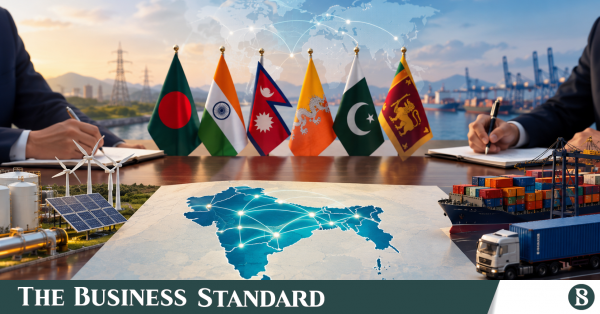
Representational Image. Photo: AI-generated
“>

Representational Image. Photo: AI-generated
South Asian countries need stronger regional partnerships in energy, trade and investment to cushion the impact of geopolitical tensions and disruptions to global supply chains, experts and business leaders said yesterday (4 October).
They said the US-China trade war, Israel-Iran conflict, Russia-Ukraine war and weakened capacity of the World Trade Organization (WTO) have pushed global trade to a critical juncture, making regional cooperation increasingly important.
The disruptions have also exposed South Asian countries to energy supply risks and higher import costs, they said.

“We can build a regional power hub involving Bangladesh, India, Nepal and Bhutan so that we can face global disruptions in trade,” said Dibya Mani Rajbhandari, a former member of parliament of Nepal.
He was speaking at a roundtable titled “Rewiring Global Trade”, held on the sidelines of the three-day Bay of Bengal Conversation 2026, organised by the Centre for Governance Studies (CGS) at Pan Pacific Sonargaon Hotel in Dhaka.
Rajbhandari also called for greater cooperation among South Asian countries in trade and investment to mitigate the impact of geopolitical tensions.
The session was moderated by Suthikorn Kingkaew, adviser to the KBU Research Institute of Thailand.
Calls to revive regional cooperation
Showkat Aziz Russell, president of the Bangladesh Textile Mills Association (BTMA), called for reviving the activities of the South Asian Association for Regional Cooperation (SAARC) to strengthen regional cooperation in trade, investment and energy.
“Trade in the SAARC region should be a win-win situation so that all countries can benefit equally,” he said, adding that a lack of warm relations among member states has constrained the region’s potential.
Anwar-ul Alam Chowdhury (Parvez), president of the Bangladesh Chamber of Industries, said Bangladesh has an opportunity to expand trade following the signing of a trade agreement with the United States.
However, he warned that Bangladesh could struggle to fully benefit from the agreement if the US imposes restrictions on the use of Chinese-imported inputs.
“Bangladesh should sign trade agreements with different major trading partners,” he said.
Diversification requires greater capacity
Nicolas Weeks, ambassador of Sweden to Bangladesh, said Bangladesh has significant potential in renewable energy, while Sweden and the European Union can contribute technology to support the country’s transition.
He also stressed the need to diversify Bangladesh’s export base beyond the garment sector.
“The EU can very much be a part of the journey that Bangladesh goes towards diversification of export,” he said, stressing the importance of reducing excessive dependence on a single sector.
Weeks said around 44% of Bangladesh’s exports go to the European Union, with Sweden accounting for a significant share indirectly through garment companies such as H&M and IKEA.
Smruti S Pattanaik, research fellow at India’s Manohar Parrikar Institute for Defence Studies and Analysis, said industrial diversification could not happen overnight.
South Asian countries need to build domestic and regional capacity in strategic industries such as magnets and batteries, she said, noting that China had developed its capacity in these sectors over many years.
Nikolaos Margaropoulos, president of the World Federation of Consuls (FICAC), said the challenge was often not finding opportunities but connecting the right people and building confidence among them.
Technology now provides businesses with extensive information about markets, but stronger networks are needed to turn those opportunities into actual trade and investment, he said.
Imran Karim, chairman of Confidence Power & Energy, Bangladesh, and Sriparna Pathak, professor at O.P. Jindal Global University in India, also spoke at the discussion.
About The Author