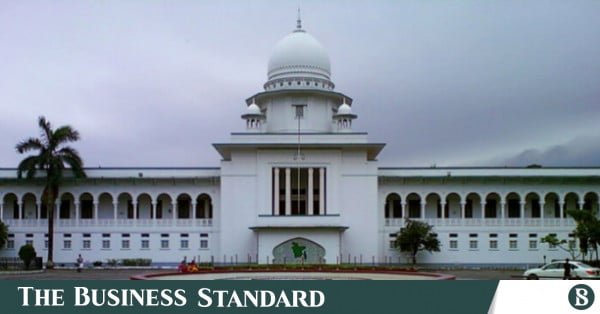
The High Court has issued a rule asking why the inaction of relevant authorities over national identity card fraud and false identity use in connection with a transgender wedding ceremony at Dhakeshwari National Temple in July should not be declared unlawful.
A High Court bench comprising Justice KM Kamrul Kader and Justice Fatema Anwar issued the rule today (29 September) following a writ petition filed on 30 August by Supreme Court lawyer Ishrat Hasan on behalf of advocate Mohammad Mesbah Uddin Chowdhury.
The rule also asks why authorities should not be directed to investigate the allegations, take legal action against those responsible and adopt measures to prevent recurrence of similar incidents.

Named as respondents in the writ are the secretaries of the Home Ministry’s Public Security Division, the Ministry of Religious Affairs and the Law and Justice Division, along with the Inspector General of Police, the Dhaka Metropolitan Police Commissioner, the Deputy Commissioner of Lalbagh Division and the Officer-in-Charge of Chawkbazar Police Station.
Advocate Mohammad Ahsan appeared for the petitioner at the hearing.
According to the writ, a wedding ceremony was held at Dhakeshwari National Temple on 10 July in which Tasnuva Anan Shishir was presented as the bride. The event was subsequently reported in various media as Bangladesh’s first “transgender wedding.”
The petitioner contends that existing Bangladeshi law makes no provision for marriage between two biological males, nor for recognising a self-identified transgender person as female for the purpose of marriage.
The writ further alleges that the NID submitted to temple authorities at the time of the wedding actually belongs to one Md Zahidul Islam.
The petitioner claimed that the card was fabricated by using Zahidul Islam’s NID number while substituting a different name, photograph, parents’ names and date of birth.
The writ also cited a 2023 health ministry letter stating that Bangladesh has no law or provision recognising gender reassignment.
Lawyer Ishrat Hasan told media the case centres not only on the wedding itself but on serious allegations of NID fraud.
“Someone else’s NID number was used to create a forged identity card. At the same time, a marital status with no legal recognition under Bangladeshi law was presented in a social and institutional setting,” she said.
“We sought investigation of these allegations, legal action against those responsible and effective administrative steps to prevent recurrence. The court has now issued a rule,” she also said.
About The Author