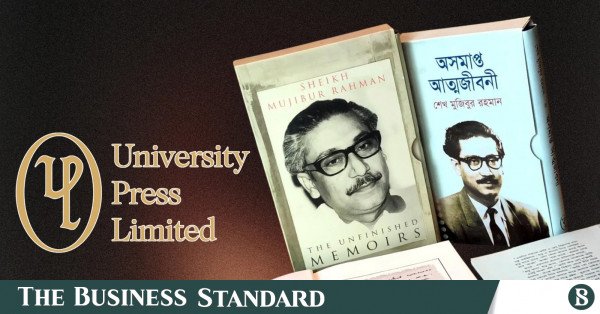
SF: Their comments came after UPL said it “stands by every book” it publishes following an incident at its Banglabazar showroom over the sale of “The Unfinished Memoirs”
Illustration: TBS
“>

Illustration: TBS
Academics have raised concerns over alleged pressure to stop the sale of Sheikh Mujibur Rahman’s autobiography “The Unfinished Memoirs”, saying attempts to suppress differing views through force could create a climate of fear and ultimately trigger further conflict.
Talking to The Business Standard today (29 September), Prof Tariq Manzoor of Dhaka University’s (DU) Bangla Department said that problems arise when one section of society or the state seeks to completely dismiss another.
File photo of Prof Tariq Manzoor of Dhaka University (DU) Bangla Department. Photo: Collected
“>

File photo of Prof Tariq Manzoor of Dhaka University (DU) Bangla Department. Photo: Collected
“We saw during the previous regime that even after making everything ‘Mujib-centric’, Sheikh Mujibur Rahman could not be made more prominent to the new generation. Even then, we saw one-sided views and power become all-pervasive, while other views or dissenting opinions were suppressed by making them punishable,” he said.

“If the same formula is now used to suppress opposing views through force, it will eventually lead to an explosion,” he added.
Manzoor said no book, including “The Unfinished Memoirs”, should be banned except under highly sensitive circumstances.
“No section of society or the state can take steps to forcibly stop the sale of a book. In the case of history books, ‘historical truth’ may differ depending on political parties or groups, but that cannot become a reason to cancel a book,” he said.
Meanwhile, DU Anthropology Department teacher and analyst Prof Zobaida Nasrin said it had not been made clear under which law such actions were being taken.
File photo of DU Anthropology Department teacher and analyst Prof Dr Zobaida Nasreen. Photo: Collected
“>

File photo of DU Anthropology Department teacher and analyst Prof Dr Zobaida Nasreen. Photo: Collected
“Has ‘Joy Bangla’ been banned? Has the display of photographs of Sheikh Mujibur Rahman or the publication of his books been banned? None of these things has happened. So under which law are these actions being taken? That is one issue,” she told TBS.
“Secondly, Sheikh Mujibur Rahman is a figure associated with our Liberation War. The Liberation War was fought under his leadership and the country became independent. So threats against such books also create concerns for other publishers who have published books on the Liberation War or historical issues related to it,” she said.
“Thirdly, during Sheikh Hasina’s tenure, the publication of various books was stopped, and publishers’ stalls at the book fair were closed. There were protests against those actions, and eventually the Awami League government had to leave office.
“In this government too, we are seeing such incidents, but the government has not clarified under which law or why these actions are being taken. Rather, we are seeing intimidation creating threats to people’s freedom of expression and political activities,” Nasrin said.
She said the incident could have a major impact on publishing houses, writing and freedom of expression, creating a climate of fear and intimidation across all three areas.
“At the same time, it is also very important to ask who is objecting to the sale of The Unfinished Memoirs and why. Is the objection being made because of political differences, or is it coming from those opposed to the Liberation War? If anyone raises an objection, will the government take it into consideration, and why should it?
“Why should the government take up an objection simply because it comes from an opposing side? That is a very important question,” she said.
UPL says it ‘stands by every book’ it publishes
Their comments came after University Press Limited (UPL) said it “stands by every book” it publishes following yesterday’s (28 September) incident at its Banglabazar showroom over the sale of “The Unfinished Memoirs”.
In a statement published today on its verified Facebook page, UPL said some individuals behaved aggressively at the showroom around 5:30pm yesterday, claiming that “The Unfinished Memoirs” was banned and demanding the sale of the book be stopped.
The individuals pulled down the shop’s shutter and subjected two UPL sales employees to harassment. The employees were later taken to the Faridabad police outpost and detained for a while before being released, according to the publisher and police.
UPL said its representatives informed those questioning the sale that the book was not banned.
“A book can only be banned by following a specific process, informing all concerned and taking legal steps. We are not aware of anything of this sort having happened in the case of this book,” the publisher said.
It added that if the government or a court takes any such action, UPL would comply with the law.
“We believe the incident is extremely shameful and unfortunate for our nation,” UPL said.
UPL says it has faced pressure under successive govts
The publisher said it had faced pressure over books under almost every government, with objections raised by governments, individuals and institutions over various publications.
UPL said that during the previous government, the Dhaka University Syndicate had asked it to apologise for one of its publications. It also said it had faced repeated pressure over books by Moudud Ahmed.
The publisher said it had also published a book by Prof Asif Nazrul on the Ganges Water Sharing Treaty during a “highly unfavourable period”, based on the opinions of its reviewers.
It added that UPL had faced government harassment after refusing to publish some manuscripts.
“As a publisher, we have tried our best to ignore these pressures,” UPL said, adding that its commitment to professional standards had resulted in commercial losses on several occasions, but it had never compromised its fundamental publishing standards.
UPL said its manuscripts are independently reviewed, and books are published based on the assessments and opinions of the reviewers.
“This confidence is the foundation of our self-respect, and with its strength, UPL has never withdrawn any book under pressure,” it said.
The publisher also noted that advertisements for “The Unfinished Memoirs” continue to appear on its page.
It said it had recently published a book by Barrister Abdur Razzaq on the history of Jamaat-e-Islami after expert reviewers found that it contained material of significant importance to Bangladesh’s history.
Call for protection of academic freedom
UPL said “The Unfinished Memoirs” is an important book in the history of Bangladesh, containing necessary context on the creation of the country and the origins of the 1971 Liberation War.
“UPL publishes every book with responsibility,” the statement said. “If this book is duly banned by a responsible authority, UPL will act in accordance with the law.”
However, the publisher said that as an academic publisher, it believed intervention in the publication and marketing of books that do not incite criminal offences was harmful to the overall development of knowledge and culture.
UPL recalled that during the previous government, it had protested against the decision to shut Adarsha Prakashan’s stall at the Ekushey Book Fair without formally banning its three books under the law.
“Interference in the space for free thought and academic freedom is against the interests of the development of the state and society,” UPL said.
The publisher urged the government and all concerned to refrain from interfering in free thought and academic freedom and to prevent such interference.
It also called on writers, readers, teachers, journalists, publishers, political leaders with democratic aspirations, members of the government and others to stand against what it described as an attack on academic publishing.
UPL further urged the state and society to take firm action against any illegal activities that could establish a culture of intimidation in the publishing industry.
About The Author