PM’s information adviser Zahed says there is scope to revise the draft and address concerns.
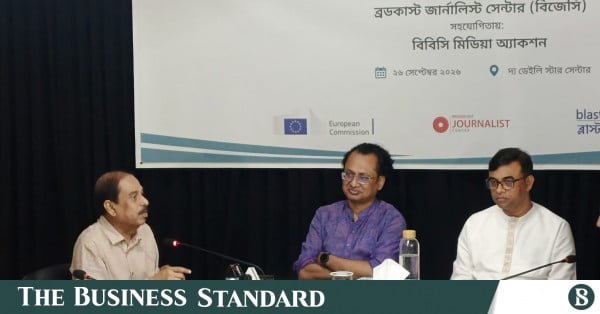
PM’s Information Adviser Dr Zahed Ur Rahman, journalists, human rights activists and academics attend a discussion on proposed amendments to the Cyber Security Act in Dhaka on 26 September 2026. Photo: TBS
“>

PM’s Information Adviser Dr Zahed Ur Rahman, journalists, human rights activists and academics attend a discussion on proposed amendments to the Cyber Security Act in Dhaka on 26 September 2026. Photo: TBS
Journalists, human rights activists and academics have raised concerns over proposed amendments to the Cyber Security Act, particularly provisions concerning misinformation and disinformation, defamation, arrest without a warrant and content removal.
The concerns were raised at a discussion organised by the Broadcast Journalist Center (BJC) in Dhaka today (26 September).
Participants included Newspapers Owners Association of Bangladesh (Noab) President Matiur Rahman Chowdhury, The Daily Star Editor and Publisher Mahfuz Anam, Bangladesh Legal Aid and Services Trust (BLAST) Executive Director Barrister Sara Hossain, National Press Club President Hasan Hafiz, Jagannath University Assistant Professor of Mass Communication and Journalism Rahat Minhaz and ULAB Professor Suman Rahman.

BJC called for a review of several provisions in the proposed law, particularly Section 26(A), saying the draft should clearly define how the truthfulness of alleged rumours or unverified information would be determined and when reporting by journalists, researchers or citizens could constitute an offence.
BJC Executive Member Milton Anwar said unverified information should not be broadly criminalised and that greater transparency in government information, fact-checking and responsible journalism should instead be strengthened.
The organisation also proposed removing the provisions on “defamation” and “humiliation” from Section 25, which deals with the protection of women and children.
It called for written reasons and notice before content is removed, along with an opportunity for independent judicial review.
Concerns over press freedom
Noab President Matiur Rahman Chowdhury said the proposed law could become more restrictive and create obstacles to reporting the truth.
“This law will further encourage self-censorship. No one can be made responsible through legislation,” he said.
“A law is necessary, but if there is such a law, there will be no freedom,” he added.
Mahfuz Anam said legislation is necessary to tackle cybercrime, but safeguards must ensure that efforts to prevent crime do not undermine freedom of expression.
He also suggested considering separate provisions for journalists, writers and cartoonists.
BJC Trustee Board Chairman Fahim Ahmed said legislation should not be framed in a way that could expose a future BNP government to allegations of suppressing the media or behaving in an authoritarian manner.
“We want a law, but we do not want a regulatory law. We do not want a law that ties our hands and feet,” he said.
He also called for effective measures to address misinformation and disorder on social media.
BLAST Executive Director Sara Hossain said the proposed amendments could create new risks to human rights. She said defamation should not be a criminal offence and expressed concern over powers to make arrests without warrants.
ULAB Professor Suman Rahman said combining elements of three different laws was creating complications. He warned that adding the fear of imprisonment and legal harassment to economic uncertainty could further discourage students from pursuing journalism as a profession.
Adviser says draft can still be revised
As chief guest, Prime Minister’s Information and Broadcasting Adviser Dr Zahed Ur Rahman said the proposed law had not yet been passed, leaving scope for amendments and further discussions with stakeholders.
On misinformation and disinformation, he said Bangladesh had examples of rumours being used to trigger communal violence, making legal measures necessary to tackle harmful misinformation.
However, he acknowledged questions remained over how the law would be enforced and how its definitions and scope would be determined.
Addressing concerns over content-blocking powers, Zahed said he did not dismiss public fears about the authority to remove content immediately, while noting that some emergencies may require swift action.
He said a provision allowing authorities to provide reasons within three days after blocking content had been removed from the draft and an appeals mechanism had instead been included. He added that the issue could be discussed further with stakeholders.
Saying the current government would not use the proposed law in the same way as the previous Awami League government, he said, “If this law is passed unchanged on paper, this government will not become the Hasina government.”
Zahed said policies were also needed to address emerging forms of online journalism and information dissemination alongside measures to combat cybercrime.
He said the government should take concerns raised by the media and citizens into account when monitoring the implementation of the law.
He also said the media and civil society would have a responsibility to present evidence of any misuse of the law to the public and the government after its enactment.
About The Author