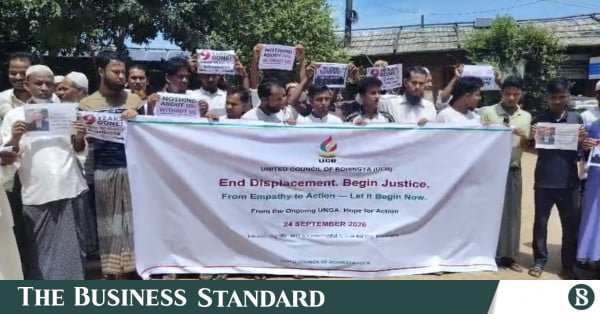
The organisation says nearly nine years of displacement is too long and urges the international community to create safe, voluntary, dignified and sustainable conditions for Rohingyas to return to Myanmar.
The United Council of Rohingya holds a human chain and rally in front of its temporary office at Jamtoli Camp-15 in Ukhiya, Cox’s Bazar, on 24 September 2026. Photo: TBS
“>

The United Council of Rohingya holds a human chain and rally in front of its temporary office at Jamtoli Camp-15 in Ukhiya, Cox’s Bazar, on 24 September 2026. Photo: TBS
The United Council of Rohingya (UCR) has called for a clear, credible and time-bound roadmap for the safe, voluntary, dignified and sustainable repatriation of Rohingyas to Myanmar, saying nearly nine years of displacement in Bangladesh is too long.
The organisation made the call at a human chain and rally held in front of its temporary office at Jamtoli Camp-15 in Ukhiya, Cox’s Bazar, today (24 September), ahead of the ongoing 81st United Nations General Assembly.
UCR leaders said the international community had expressed solidarity with Rohingyas for years, but effective steps to resolve the crisis remained insufficient. They said the focus must now shift from promises and expressions of sympathy to a specific and credible roadmap for repatriation.

The organisation’s call came a day after Prime Minister Tarique Rahman urged the international community to develop a clear and credible roadmap for the early, safe, voluntary, dignified and sustainable repatriation of Rohingyas at a high-level event on the crisis at the UN headquarters in New York.
The UCR said the Rohingya crisis originated in Myanmar and that its sustainable solution must therefore be found there.
It called for an end to violence and persecution and demanded guarantees of citizenship rights, security, freedom of movement and dignified living conditions for Rohingyas in their homeland.
The organisation also called for international accountability for violence and persecution against Rohingyas, urging stronger engagement with international justice mechanisms, including the International Court of Justice and the International Criminal Court.
UCR founding president Maulvi Said Ullah said Rohingyas had depended on international support while living in the camps for years and that the time had come for a concrete decision about their future.
“Rohingyas cannot remain confined to the camps indefinitely,” he said.
Rohingya leader Master Md Soib said Myanmar must create conditions that allow Rohingyas to return safely and with dignity, rather than relying only on discussions about repatriation.
Rohingya leader Mohammad Rafiq said the international community had repeatedly spoken about the right of Rohingyas to return, but they remained in the camps.
“We need a specific and time-bound roadmap for repatriation through the United Nations,” he said.
Rohingya women’s leader Sajida Begum said prolonged displacement had created various challenges for Rohingya women and that the crisis would persist unless conditions were created for a safe and dignified return.
Camp-15 resident Nuruzzama said Rohingyas were grateful to Bangladesh for providing shelter but wanted to return to their homeland and reunite with their families.
“We want to return to our own country. We want arrangements for a safe return,” she said.
Rohingya leader Md Saleh said prolonged displacement was depriving successive generations of education, healthcare and other basic needs, threatening their future.
Rohingya leader Anwar Hossain urged Prime Minister Tarique Rahman to raise the issue before world leaders at the UN General Assembly, saying Rohingyas lacked direct participation in the proceedings.
Another Rohingya, Nur Alam, said the crisis had regional and global implications and that repatriation was essential for a lasting solution.
The organisation called on the United Nations, regional actors, member states and the wider international community to take coordinated steps to resolve the crisis, while continuing humanitarian assistance for Rohingyas in Bangladesh and ensuring justice and accountability. The UCR said Rohingyas did not want to remain refugees indefinitely and wanted to return to their homeland with security, freedom and dignity.
About The Author