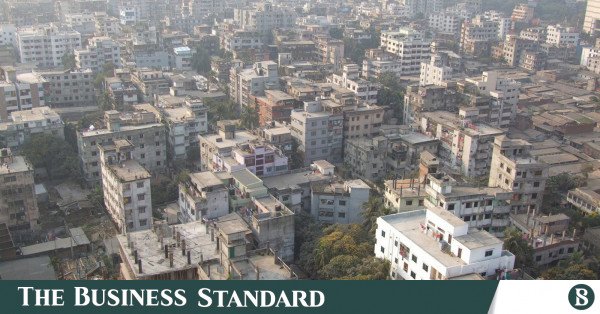
Dhaka, the highest-ranked Bangladeshi city, fell 33 places to 515th from 482nd in 2025.
Infographic: TBS
“>

Infographic: TBS
Dhaka and seven other Bangladeshi cities have slipped in Oxford Economics’ 2026 Global Cities Index, with weak environmental and governance performance weighing on their overall standings.
Published on 16 September, the index ranks 1,000 cities across 163 countries based on five categories – Economics, Human Capital, Quality of Life, Environment and Governance.
Dhaka, the highest-ranked Bangladeshi city, fell 33 places to 515th from 482nd in 2025. Rajshahi recorded the steepest decline, dropping 66 places to 779th, while Chattogram fell 14 places to 763rd. Khulna ranked 811th, Sylhet 834th and Mymensingh 895th.
Bogura, the only Bangladeshi city in the bottom 100, fell 32 places to 926th. Cumilla was the only one to retain its previous position at 883rd.

Prof Adil Mohammed Khan, executive director of the Institute for Planning and Development and professor of Urban and Regional Planning at Jahangirnagar University, said the poor environmental performance reflected conditions visible across the country.
“Air, water and soil quality are measurable indicators, and we are performing very poorly on these fronts,” he said, adding that pollution was not limited to Dhaka but was also evident in other cities and rural areas.
He said Chattogram had deteriorated significantly over the past 10-15 years, citing rising pollution and the urban heat island effect. Infrastructure such as flyovers had done little to improve the city’s liveability or environmental quality, he said.
On governance, Adil said indicators such as transparency, accountability and public service quality were less visible but directly affected people’s daily experiences, including delays and difficulties in obtaining birth registration or correcting NID information.
All eight Bangladeshi cities received the same governance rank of 903rd because the category is assessed at the national level. Oxford Economics defines governance as institutional strength and civic effectiveness.
Category-wise performance
Environment was among Bangladesh’s weakest categories. Sylhet ranked highest among the eight at 735th, while all others ranked below 800.
Dhaka performed relatively better in Economics, ranking 286th globally, followed by Chattogram at 702nd and Mymensingh at 734th. The category considers GDP size and growth, stability, GDP per capita, employment growth, economic diversity and population growth.
In Human Capital, Dhaka ranked 178th, followed by Khulna at 541st and Rajshahi at 599th. The category covers education and business environments and demographic trends.
Rajshahi led the Bangladeshi cities in Quality of Life at 542nd, followed by Khulna at 612th and Chattogram at 653rd. The category measures wellbeing, financial and health outcomes and access to amenities.
Dhaka was also ranked the world’s third least liveable city in the Economist Intelligence Unit’s 2026 Global Liveability Index.
Global picture
New York, London, Paris, Seattle and San Francisco occupied the top five positions. Oxford Economics said New York and London remained at the top because of their economic scale and strong labour markets, while Paris performed particularly well on quality-of-life measures.
The bottom five were Sokoto in Nigeria, Sultanpur in India, Weinan and Guigang in China, and Port-au-Prince in Haiti.
In South Asia, Delhi was the highest-ranked city at 268th, followed by Bengaluru at 311th, Mumbai at 330th, Chennai at 381st and Hyderabad at 421st. Dhaka ranked 13th in the region.
About The Author