Highlights:
- Bangladesh bought eight aquatic weed harvesters for around Tk50 crore
- Large machines struggle with shallow, narrow city waterways
- Chattogram’s Tk6 crore harvester remains unused after failed deployment
- Other cities report technical, manpower, transport and water-depth constraints
- Questions have emerged over local suitability assessments before procurement
- Officials and rights groups are calling for procurement investigations
The Local Government Division bought eight aquatic weed harvesters from Germany in 2022 for around Tk50 crore, with one each allocated to Dhaka North, Dhaka South, Chattogram, Rajshahi, Khulna, Sylhet, Rangpur, and Mymensingh city corporations.
However, their large size, the shallow and narrow waterways in many cities, and a lack of transport, lifting facilities and trained operators have restricted their deployment. Some city authorities have also questioned whether the machines are suitable for the water bodies they were intended to clean.

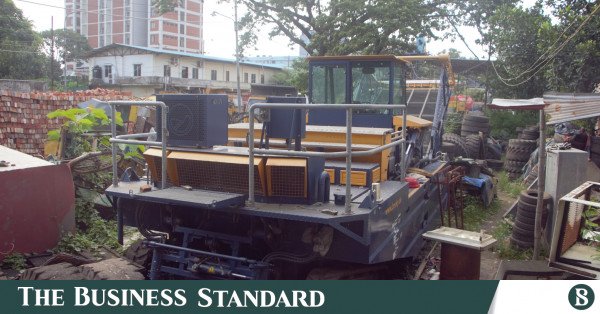
For instance, in Chattogram, the harvester procured for around Tk6 crore remains unused at the City Corporation’s Sagarika workshop, years after it was purchased to remove water hyacinth and floating waste.
City corporation officials said the machine is too large for many of the city’s canals and requires deeper water and access facilities that are unavailable at most sites.
The machine was tested in a pond on 7 August 2022, but officials struggled to retrieve it after the demonstration. The city corporation subsequently declined to accept the machine, saying it was unsuitable for the city’s shallow and narrow canals.
The supplier later left the machine at the workshop in mid-March 2025. City officials said representatives of the supplier also failed to deploy it in any of the city’s canals. The machine has yet to be formally accepted by the city corporation.
Too large for city canals
Nasir Uddin Rifat, executive engineer (mechanical) of the city corporation, told TBS the machine requires at least seven feet of water to operate, but Chattogram’s canals generally do not have that depth.
“The machine is large, compared to the infrastructure structure of our cities, leaving little room to manoeuvre in our canals,” he added.
Nasir said guide walls along many canals also make it difficult to lower and retrieve the machine. The city corporation does not have the large crane and trailer needed to move it between sites, while trained operators and technical expertise are also lacking, he added.
Chief Conservancy Officer Captain Ikhtiar Uddin Ahmed Chowdhury said he had not signed the acceptance documents because the city corporation had not been shown how to use the machine effectively. He also corroborated Nasir Uddin Rifat’s concern.
Shahriar Khaled, adviser to the city corporation on waterlogging and canals, said water hyacinth was not a major problem in most Chattogram canals.
“There is very little water hyacinth in the city’s canals. The small amount found in a few places can be removed manually,” he said.
He said large harvesters could be useful in deeper water bodies with extensive water hyacinth or floating waste, such as Kaptai.
“In Chattogram, we need excavators, vacuum vehicles and adequate transport facilities more than a harvester,” he added.
Tk50cr fleet sees mixed results
TBS found that several other harvesters from the Tk50 crore procurement are also facing operational constraints, although some cities have been able to use them.
Dhaka North City Corporation Deputy Chief Waste Management Officer Md Mofizur Rahman Bhuiyan said polythene, plastic, gas pipes and insufficient water depth limited where its machine could operate. It is, however, being used in some parts of Gulshan.
Dhaka South City Corporation Chief Waste Management Officer Air Commodore Md Mahbubur Rahman Talukder said technical issues were preventing proper use of its machine.
Khulna City Corporation has been using its harvester since receiving it, including in the Mayur River, Chief Waste Management Officer Anisur Rahman said.
Although there is no dedicated manpower, the city corporation operates the machine using its own staff, he added.
Sylhet has also used its machine, including at Khojarkhola pond in South Surma’s Ward 25 and another pond in Ward 10.
Chief Waste Management Officer Mohammad Eklim Abdeen said its size limited where it could be deployed. “It has to be transported by trailer, so it cannot be taken through narrow roads. It would have been easier to use if it were somewhat smaller.”
Mymensingh City Corporation received its machine around 2023 and used it in one of the city’s canals, Waste Management Officer Md Mohabbat Ali said. However, low water levels have prevented its use elsewhere.
Rangpur City Corporation Executive Engineer (Mechanical) Md Sazzadur Rahman said the city received its machine around one and a half years ago but had yet to use it due to a lack of training and trained manpower.
Rajshahi City Corporation Chief Conservancy Officer Sheikh Md Mamun, meanwhile, said the city corporation had not received such a machine.
Was local suitability assessed?
The mixed experience across the intended recipient cities has raised questions over whether local conditions were adequately assessed before the harvesters were procured and allocated, including water depth, waterway width, access and operating capacity.
Mahbuba Ireen, who was then a desk officer at the Local Government Division’s City Corporation-1 wing, told TBS that a separate committee had been formed to evaluate the harvesters.
“Desk officers are not members of procurement committees. As far as I know, a separate committee was formed for the weed harvesters, and it was responsible for evaluating the machines,” she said.
She said her role was limited to processing correspondence and other administrative work, and she was not directly involved in the initial procurement process.
Mahbuba said an overseas inspection could not be carried out because of the Covid-19 pandemic. A post-landing inspection was conducted after the machines reached the port, followed by another committee to examine whether they could be accepted.
“As far as I remember, that committee had not accepted the machine at the time,” she said.
Asked whether any feasibility or facility study had been conducted before procurement, she said she was not involved at that stage and could not confirm it.
Calls for investigation
Akhtar Kabir Chowdhury, secretary of Shushashoner Jonno Nagorik (SHUJAN) in Chattogram, said the procurement should be investigated if the city corporation had neither asked for the harvester nor had suitable conditions to use it.
“If the city corporation had no need for such a machine, the question is: whose demand led to its purchase?” he said.
He called for scrutiny of the process through which the eight harvesters costing around Tk50 crore were procured.
Chattogram Mayor Shahadat Hossain also questioned why money had been spent on equipment that could not be used locally.
“The machine given to us cannot be used in any of our canals,” he said. “The question is why so much public money was spent on equipment without properly assessing whether it could be used here.”
The city corporation has proposed a Tk289 crore project for equipment needed to clean drains and canals and manage waste. The revised project remains pending approval.
The mayor said the city corporation could not realistically finance such equipment through loans, as most municipal services do not generate revenue.
He also called for an investigation into procurement decisions involving equipment that remained unused or ineffective.
About The Author