BNP will come to power and Bangladesh will not become champion in corruption, that is also not possible. she says.
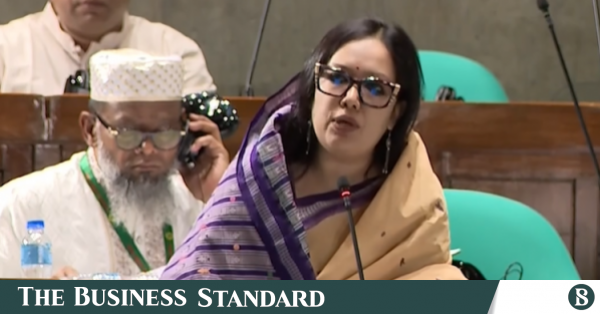
Rumeen Farhana speaks in parliament on 2 April 2026. Photo: Screengrab/File
“>

Rumeen Farhana speaks in parliament on 2 April 2026. Photo: Screengrab/File
Brahmanbaria-2 lawmaker Rumeen Farhana has criticised the BNP government’s record on loan defaults, saying the party’s return to power has historically been accompanied by crises, corruption and rising loan defaults.
“Every government has a certain character. BNP will come to power and there will be no gas and electricity crisis, that cannot happen. BNP will come to power and there will be no fertiliser crisis, and poor farmers will not loot fertiliser factories – that cannot happen either,” she said.
“BNP will come to power and Bangladesh will not become champion in corruption, that is also not possible. BNP will come to power and Bangladesh will not achieve the highest position in loan defaults for the first time, that cannot happen either,” she added.

She made the remarks while taking part in the discussion on the Bank Resolution Bill in parliament today (9 September).
Her comments triggered a commotion in the chamber, prompting Deputy Speaker Barrister Kayser Kamal to issue repeated rulings.
Rumeen then said, “So, BNP coming to power means becoming number one in loan defaults, having more than Tk6 lakh crore in defaulted loans, and so on.”
Government lawmakers shouted from their seats following the remarks.
Referring to the disruption, Rumeen said, “Such an intolerant parliament! It seems we have gone right back to the Awami League era. Not bad! When we used to say these things to the Awami League, they would also create a commotion. Now they are behaving the same way; rather, even worse.”
She then spoke about a provision of the Bank Resolution Bill.
The independent lawmaker said, “Anyway, Section 18A has been added to this law. It was said that 18A would not be kept, but it is still there.”
Explaining why the provision remained, she said, “The reason is that most lawmakers in this parliament are known as loan defaulters. Filing writ petitions in the High Court before an election to remove their names from the list – these are our old practices.”
She added, “Before the election, they quickly remove the name from the list of loan defaulters, and once the election is over…”
No lawmaker responded to Rumeen Farhana’s remarks on the issue.
Opposition Leader Shafiqur Rahman, however, said it was essential to uphold every lawmaker’s right to speak in parliament and ensure that fellow lawmakers were allowed to hear what was being said.
“If a lawmaker makes any objectionable or unparliamentary remarks, the speaker can issue a ruling, or the relevant minister can respond. But completely drowning out or stopping a speech goes against parliamentary practice,” he said.
Shafiqur urged the speaker to take immediate and effective measures to protect freedom of expression in parliament and maintain transparency in parliamentary proceedings.
“An MP has stood up to speak. From your position, you have given him or her the opportunity to speak. Some of the things he or she says may not be appropriate, while some may be important. But we could not hear anything. Everything was lost in the commotion,” he said.
He questioned whether the lawmaker had actually been able to exercise the right to speak and how the remarks could be properly recorded in the parliamentary proceedings if members could not hear them.
NCP lawmaker Akhter Hossain then thanked Finance Minister Amir Khosru Mahmud Chowdhury for removing Section 18A from the Bank Resolution Bill.
He said the opposition had demanded the removal of the provision and that its removal would prevent S Alam Group from returning to ownership of banks.
Government Chief Whip Nurul Islam Moni then urged all lawmakers to participate in the discussion with a positive attitude.
Finance Minister Amir Khosru Mahmud Chowdhury eventually moved the bill in parliament.
He did not comment on the substance of the discussion and said of the commotion, “I did not understand what happened and how it happened.”
About The Author