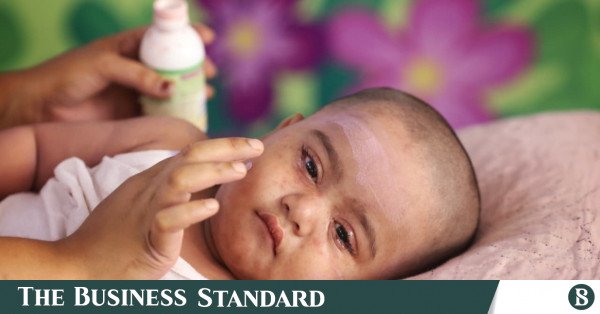
Nearly six months into the measles outbreak, infections and deaths in Bangladesh show no sign of declining. The combined number of confirmed and suspected measles-related deaths has now reached nearly 1,000.
Experts say measles control is no longer a priority for the government, warning that the situation could become more complicated and damage Bangladesh’s image internationally if the trend continues.
According to them, the infection has now spread among children of almost all age groups. They say the outbreak cannot be brought under control without extending evidence-based vaccination to at least age 15, strengthening microplanning at the field level and increasing community-level surveillance.

The Directorate General of Health Services (DGHS), however, said it has a plan to expand the age range for measles vaccination, although no final decision has been made yet.
Meanwhile, three more children died from measles and measles-like symptoms in the 24 hours to 8am today (6 September), taking Bangladesh’s combined tally of confirmed and suspected measles-related deaths to 994.
Since 15 March, a total of 1,44,168 patients with suspected measles have been hospitalised across the country, of whom 1,38,772 have recovered, according to DGHS.
‘Infection has spread among children of all ages’
Epidemiologist Prof Mahmudur Rahman, chair of the National Verification Committee for Measles and Rubella Elimination, told TBS that there is currently no sign of measles cases declining because the infection has spread among children of almost all age groups.
He said evidence-based interventions are now needed. Authorities must scientifically analyse which areas and age groups are being affected most and conduct additional vaccination campaigns in those areas.
“In my view, vaccination should be extended beyond age five to at least 15 years,” he said.
Dr Mahmudur also said simply supplying vaccines would not be enough. Extensive public awareness campaigns are needed to encourage mothers to take their children to vaccination centres.
He said particular attention should also be given to quickly identifying and isolating children under six months of age when they develop fever.
He alleged that measles has largely disappeared from the government’s list of priorities.
“In the past, infections would decline rapidly after campaigns. That is not happening this time. There is no discussion, no special measures – only news reports are being published, but no effective initiatives are visible,” he said.
‘Epidemic can’t be contained without community involvement’
Public health expert Dr Mohammad Mushtuq Husain said the strategy for controlling measles should focus on the community rather than hospitals or intensive care units.
“Without community involvement, it is not possible to identify, prevent or isolate patients. Bringing patients to ICUs cannot reduce deaths,” he said.
He said door-to-door vaccination may be appropriate during an emergency, but in the long term, authorities must return to the conventional microplanning approach used under the expanded programme on immunisation (EPI).
“This means preparing a list of every child, determining who needs vaccination and informing families in advance about the vaccination centre nearest to their homes,” he said.
“Scattered vaccination will never achieve 95% coverage. There is no place in modern public health for a ‘whatever happens, happens’ approach,” he said.
According to Dr Mushtuq, children aged five to 15 must also be brought under the vaccination programme, as children in this age group are also being infected.
‘Continued neglect could damage image’
Dr Mushtuq warned that failure to give adequate attention to measles could make the situation more complicated and damage Bangladesh’s image internationally.
He said that although measles outbreaks are occurring in various countries around the world, they are not experiencing death rates as high as Bangladesh’s. “This indicates a failure in patient management and outbreak control,” he said.
Plan to expand vaccination age range, no decision yet
Dr Halimur Rashid, director of the disease control branch of the DGHS, said there is a plan to expand the age range for vaccination, but no decision has yet been made.
SM Ziauddin Hyder, special assistant to the prime minister on health affairs, told TBS that the government had brought children aged six months to five years under the vaccination programme within four weeks of the outbreak.
“Although we later found that around 40 lakh children in this age group had been left out of vaccination, a crash programme was subsequently taken up to bring those children under the vaccination programme,” he said.
“If the National Technical Advisory Committee (NTAC) recommends it, we will also bring children aged five to 10 or 15 years under the vaccination programme,” he added.
After a measles outbreak emerged in the country in mid-March this year, the government launched an emergency measles-rubella vaccination programme on 5 April.
By the scheduled end of the first phase on 20 May, 1 crore 84 lakh children aged six to 59 months had been vaccinated, exceeding the target of 1 crore 8 lakh.
The government later acknowledged that the target for the measles vaccination programme had been set too low. As a result, a mop-up campaign was launched towards the end of July to identify and vaccinate children who had been missed.
As of today, around 1 crore 97 lakh 21 thousand children were vaccinated under the campaign.
The initiative, however, has not been sufficient. Compared with July, all three indicators – measles cases, hospitalisations and deaths – increased again in August.
DGHS data show that the number of measles cases rose to 32,934 in August from 31,327 in July. The daily average number of cases also increased from 1,010 to 1,062.
A total of 27,458 measles patients were hospitalised in August, compared with 26,360 in July. The daily average number of hospitalisations also increased from 850 to 886.
Deaths also increased. A total of 136 people died from measles in August, 17 more than the 119 deaths recorded in July.
About The Author