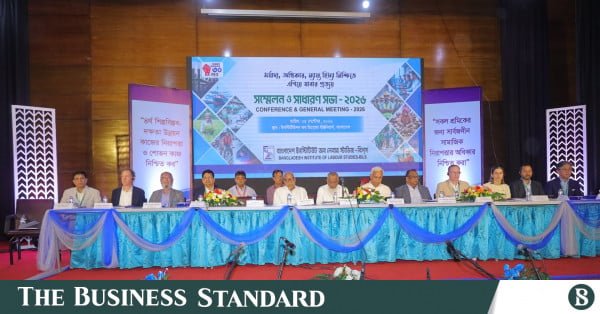
Fair wages, dignity and workers’ rights should be treated as fundamental citizen rights rather than demands, speakers said at the 10th biennial conference and general meeting of the Bangladesh Institute of Labour Studies (BILS) in Dhaka today (5 September).
They also called for greater institutional recognition of workers, stronger social dialogue, increased participation of women and young workers in trade unions, and a safer and more inclusive labour market.
The conference, titled ‘A Pledge to Move Forward to Ensure Dignity, Rights and Fair Share’, was held at the Institution of Diploma Engineers, Bangladesh in Kakrail, according to a BILS press release.

The event brought together BILS members, representatives of local and international labour organisations, government officials, employers and development partners.
Dr Mahdi Amin, adviser to the prime minister on education, primary and mass education, expatriates’ welfare and overseas employment, and labour and employment, said fair wages should not be treated as a demand but as a basic citizen right.
“Fair wages are not a matter of demand; they are part of citizens’ rights,” he said, adding that the elected government representing around 75 million working people was prepared to ensure it.
He stressed the need for safe workplaces, decent work, fair wages, skills development through technology, stability in industries, trust and accountability between employers and workers, and inclusive development.
Women and Children Affairs and Social Welfare Minister Professor Dr AZM Zahid Hossain also stressed workplace safety and the need to build an inclusive Bangladesh.
He said a large number of workers remain employed in the informal sector and lack institutional recognition.
“Proper recognition and institutional inclusion of every worker are necessary to improve the world of work,” he said.
Speakers at the event expressed concern over workplace safety and workers’ wages.
Advocate Shamsur Rahman Shimul Biswas, a lawmaker and central coordinator of the Bangladesh Jatiotabadi Sramik Dal, highlighted workers’ contribution to economic stability.
“Workers in every sector are keeping Bangladesh’s economy running,” he said.
Ruben Korevaar, policy adviser at Mondiaal FNV, stressed the importance of women’s leadership in Bangladesh’s trade union movement.
Lotte Ellegaard, head of the Asia office of the Danish Trade Union Development Agency, called for stronger tripartite dialogue and social consultation.
She said effective social dialogue requires coordination and unity among all stakeholders.
Janna van der Linden, deputy ambassador of the Netherlands to Bangladesh, said sustainable development would become possible when workers were able to participate in bargaining, discussions and dialogue in their own voice.
The opening session was chaired by BILS Chairman Mujibur Rahman Bhuiyan, while BILS Secretary General and Prime Minister’s Adviser on Political and Agricultural Affairs Nazrul Islam Khan delivered the welcome and opening remarks.
Other speakers included Labour and Employment Secretary Abdur Rahman Tarfadar, NGO Affairs Bureau Director General Dr Mohammad Zakaria, ILO Bangladesh Country Director Max Tuenn, Japan International Labour Foundation President Yasunobu Aihara, Bangladesh Employers’ Federation Additional Secretary General Md Saidul Islam and ActionAid Bangladesh Country Director Farah Kabir, among others.
Following the opening session, Minister AZM Zahid Hossain inaugurated the Bir Muktijoddha Nazrul Islam Khan Information Centre and BILS Library.
BILS Executive Director Syed Sultan Uddin Ahmed delivered the vote of thanks, while BILS Advisory Council member Farida Akhter read out a condolence resolution.
About The Author