According to the Department of Social Services, Bangladesh has 36.34 lakh people with disabilities, including nearly 500,000 visually impaired people.
Yellow tactile paving designed to guide visually impaired pedestrians is obstructed by an advertising frame, electric poles and other encroachments on a footpath in Kalabagan, Dhaka. The photo was taken recently. Photo: Rajib Dhar
“>

Yellow tactile paving designed to guide visually impaired pedestrians is obstructed by an advertising frame, electric poles and other encroachments on a footpath in Kalabagan, Dhaka. The photo was taken recently. Photo: Rajib Dhar
Walking alone from Dhaka College towards the busy New Market with a white cane, visually impaired student Mohammad Wadudur Rahman Rahul could not find any tactile paving to guide him.
He also could not determine the depth of a puddle on the broken footpath. His foot got stuck, tearing his shoe and injuring his foot as soon as he stepped on the puddle. Though his injury was minor, the incident hinted at how unsafe Dhaka’s footpaths remain for the visually impaired.
Not just missing pavements, these yellow tiles on many footpaths are obstructed in ways with electric poles and other establishments that pose difficulties to all pedestrians including the visually impaired.

“Dhaka’s roads and footpaths are not suitable for people like us. The footpaths around Dhaka College and New Market are particularly risky. There is no tactile paving in many places, while most footpaths are broken and uneven,” said Rahul, a postgraduate student of political science at Dhaka College.
Another visually impaired Dhaka College student, Abdur Razzak, said he had faced similar problems since enrolling in 2018.
“Once, while travelling to Azimpur, I could not detect a drain because the footpath was either absent or broken. I fell into it,” he said.
According to the Department of Social Services, Bangladesh has 36.34 lakh people with disabilities, including nearly 500,000 visually impaired people.
The Rights and Protection of Persons with Disabilities Act, 2013, requires public facilities to ensure accessibility for people with disabilities. Yet, tactile paving installed across parts of Dhaka often fails to serve its intended purpose.
Yellow tactile paving designed to guide visually impaired pedestrians is obstructed by an advertising frame, electric poles and other encroachments on footpaths along Kazi Nazrul Islam Avenue in Dhaka. The photo was taken recently. Photo: Rajib Dhar
“>

Yellow tactile paving designed to guide visually impaired pedestrians is obstructed by an advertising frame, electric poles and other encroachments on footpaths along Kazi Nazrul Islam Avenue in Dhaka. The photo was taken recently. Photo: Rajib Dhar
Tactile paving missing or obstructed
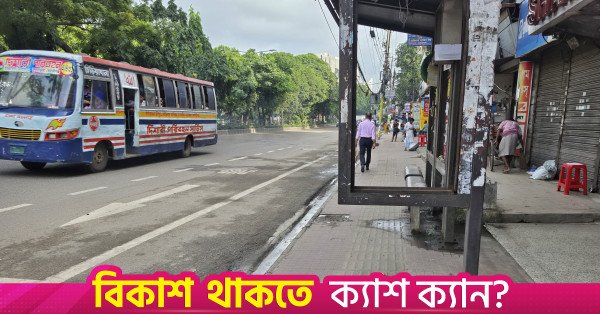
A visit to footpaths in Shahbagh, Dhaka University, Nilkhet, Katabon, Science Lab, Farmgate, Mirpur-10, Mohakhali, Banani and Gulshan revealed tactile paving missing in some areas, damaged in others, or obstructed by utility poles, manholes, metal barriers and hawkers.
Tactile paving is available in parts of Shahbagh, Dhaka University and Nilkhet. But along the main road from Shahbagh through Katabon to Science Lab, there is virtually no such facility. Many footpaths there are occupied by tea stalls, food vendors and temporary businesses.
Some new tactile strips have been installed along parts of the Farmgate-Mirpur-10 corridor following metro rail-related development.
In Farmgate, metal poles have been placed along tactile paving to prevent motorcycles from using the footpath, creating another obstacle for visually impaired pedestrians.
In Mohakhali, Banani and Gulshan, tactile paving is often interrupted by electric poles, lamp posts, manholes and uneven concrete surfaces. Some tiles have also broken or become detached.
Low public awareness
The problem is not limited to infrastructure. Public awareness about tactile paving is also poor.
A pedestrian walking over tactile paving in Tejgaon said he had never realised that the specially designed tiles were intended to help visually impaired people.
Agargaon resident Abdullah Al Mamun said he was aware of tactile paving but often saw it abruptly ending, with no properly designed transition to the road.
“Even ordinary pedestrians face many obstacles. If development takes place, it should be designed for everyone,” he said.
Law exists, implementation absent
Sources from the Dhaka South and North city corporations said installation of tactile paving began in Dhaka in 2015. The initiative followed the 2013 disability rights law, which requires accessible public infrastructure.
However, poor planning, inadequate maintenance and encroachment have turned many tactile pathways into little more than symbolic infrastructure.
Md Saidul Haque, executive director of the Blind Education and Rehabilitation Development Organisation, said urban planning and road improvement projects had largely failed to adequately address the mobility needs of visually impaired people.
“Open manholes, uneven drains, high steps instead of ramps and metal barriers installed to stop motorcycles create regular accident risks for visually impaired people,” he told TBS.
“Installing tactile tiles alone does not fulfil the responsibility. Without regular maintenance, hawkers, obstacles, garbage and animal waste accumulate on footpaths, making tactile pathways unusable,” he said.
Urban planner and Bangladesh Institute of Planners President Adil Muhammed Khan said even able-bodied people struggle to navigate Dhaka, making the challenges for visually impaired residents obvious.
“Tactile paving has been installed in many places, but it often ends abruptly or loses its functionality because of encroachment and other obstacles,” he said.
Dhaka North Supervising Engineer Faruk Hasan Md Al Masud said not all footpaths use the same construction materials. Installing identical tactile strips everywhere is also difficult because tiles are easily damaged and replacement materials are not always available.
Dhaka South Chief Engineer Nur Azizur Rahman said guidelines require disability-friendly ramps at buildings, bus stops and footpaths, but most Dhaka footpaths are too narrow.
Encroachment, damaged tiles and limited funds for immediate repairs further complicate efforts, he said, adding that actual budget allocations are often much lower than what is required, with a large portion spent on salaries, maintenance and administrative costs.
About The Author