67 directly elected MPs urge withdrawal of the proposed amendment allowing reserved-seat MPs to oversee development activities in general constituencies.
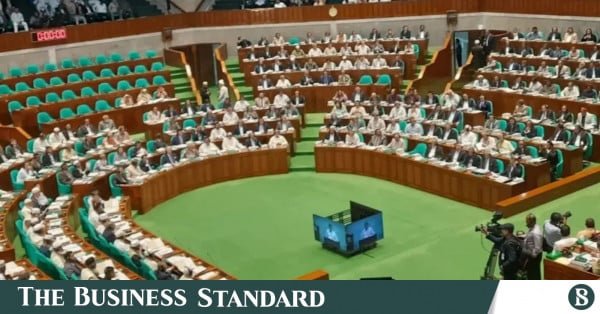
Parliament. File Photo: UNB
“>

Parliament. File Photo: UNB
Sixty-seven directly elected MPs have described the government’s initiative to assign reserved women MPs to oversee or coordinate development activities in their constituencies as unconstitutional and illegal.
They have sent a written objection to the Speaker, urging the withdrawal of the draft amendment to the Jatiya Sangsad (Reserved Women’s Seats) Election Act, 2004, which the government is currently finalising.
The letter, sent to the Speaker on 20 August, was signed by Opposition Leader Md Shafiqur Rahman (Dhaka-15), Md Abdus Sattar (Nilphamari-1), Alfaruk Abdul Latif (Nilphamari-2) and Obaidullah Salafi (Nilphamari-3), among others.

Ahead of the third session of the 13th parliament, which began at 3pm today (27 August), Dhaka-5 MP Md Kamal Hossain shared the letter on his Facebook page.
Dhaka-4 MP Syed Zainul Abedin told TBS today that the opposition leader would raise the issue in parliament.
Constitutional arguments
The MPs said the government has recently drafted an amendment to assign reserved women MPs responsibilities for overseeing and coordinating development activities in general parliamentary constituencies.
However, they argued that the initiative conflicts with various provisions of the Constitution and several Supreme Court rulings.
According to the letter, Articles 65(2), 65(3), 121 and 124 of the Constitution provide specific geographical boundaries and voter lists only for the 300 directly elected constituencies.
The 50 reserved seats are filled through proportional representation and do not have any specific geographical areas, they said.
Citing a High Court ruling related to the 14th Amendment, the MPs said the election and functions of reserved-seat women MPs have no connection with any specific geographical area or its boundaries.
They also cited Articles 7(1) and 11 of the Constitution, which establish the people as the source of all state power and provide for effective public participation through elected representatives.
Assigning reserved-seat MPs responsibilities in constituencies represented by directly elected MPs would create “dual rule” in those areas, they argued.
They said such an arrangement would also conflict with the Supreme Court’s judgment in the Kudrat-E-Elahi Panir v Bangladesh case and undermine the Constitution’s basic structure.
International examples
The letter cited India, Pakistan, Tanzania, Uganda, Kenya, New Zealand and Rwanda as examples, claiming that reserved women MPs in none of these countries have legal authority to oversee or coordinate development activities in constituencies represented by directly elected MPs.
Proposed legal amendment
According to Law Ministry sources, the government is in the process of amending the Jatiya Sangsad (Reserved Women’s Seats) Election Act, 2004, by adding a new Section 26A.
Under the proposed provision, political parties would be able to assign their reserved women MPs responsibility for development activities in one or more general constituencies and notify the Speaker.
The initiative comes after the government recently assigned reserved-seat MPs to oversee development activities in constituencies represented by opposition and other directly elected MPs.
Several reserved-seat MPs have since visited different constituencies to oversee development activities, triggering political disputes and coordination problems at the grassroots level.
Opposition MPs had also raised objections to the arrangement during the previous parliamentary session, saying such powers would interfere with the independence of directly elected MPs and undermine the separation of powers.
About The Author