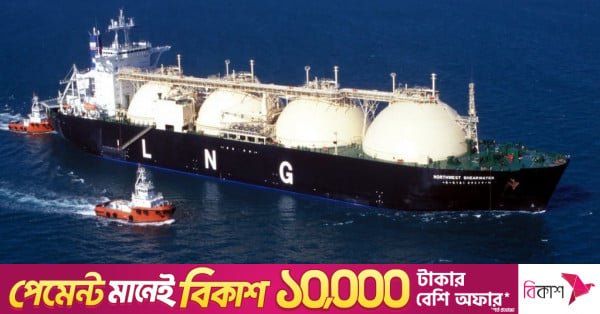
LNG imports cost Bangladesh $3.8 billion in 2025, compared with $3 billion the previous year. These imports cover one-fourth of the country’s total gas supply.
Infographics: TBS
“>

Infographics: TBS
With Bangladesh’s gas reserves set to run dry by 2031, the country began importing costly liquefied natural gas (LNG) in 2018-19 to partially bridge the demand gap. But this stopgap has become another headache – geopolitical conflicts have made imports uncertain and prices prohibitively high.
LNG imports have never resolved the gas crisis as they have never covered total gas demand. Increasing LNG import capacity requires further investment in infrastructure.
LNG imports cost Bangladesh $3.8 billion in 2025, compared with $3 billion the previous year. These imports cover one-fourth of the country’s total gas supply.
According to an estimate by the Institute for Energy Economics and Financial Analysis (IEEFA), the import cost could rise to $8.5 billion by 2029-30.

And when Bangladesh completely runs out of domestic gas, it may have to spend $12-$15 billion a year to meet even part of its demand. Even then, there will continue to be a significant gas supply shortfall.
Besides LNG, Bangladesh imports oil, coal and other petroleum products, costing another $8.2 billion in FY25. Therefore, increased reliance on LNG would put significant financial pressure on Bangladesh.
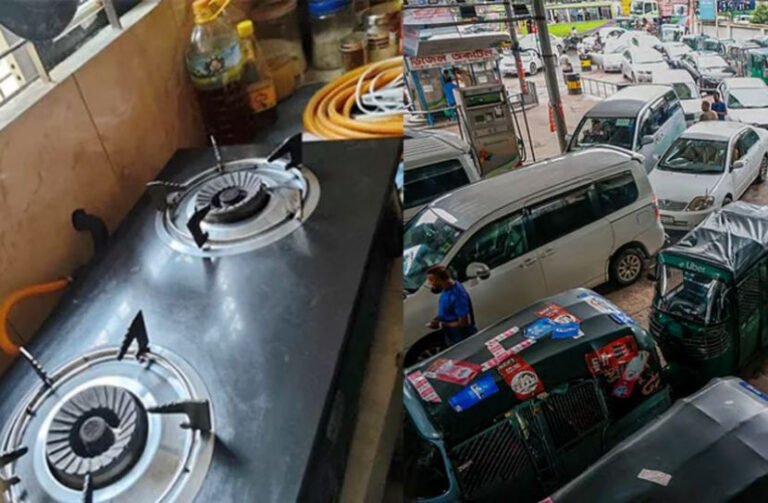
Bangladesh currently needs more than 4,000 million cubic feet per day (mmcfd) of gas. Against this demand, the country supplies around 2,600-2,700mmcfd. Of this, around 700mmcfd comes from imported LNG.
All the while, the government has never planned to cap gas allocation for industrial, commercial or domestic consumers.
Since 2010, the government has restricted and even stopped providing new gas connections, but never devised a plan to cap gas consumption. When Bangladesh started importing LNG in 2018-19, it began providing new gas connections to industries.
Big names such as City Group made huge investments to set up gas-based industries. They never received adequate supplies, and their investments suffered.
We have neither surplus gas nor even enough baseline supply. The country has not discovered any large gas fields since 1998. Small discoveries would not rescue the nation. Even if a major discovery is made through new initiatives, it is unlikely to come into operation before 2031.
Then again, Bangladesh cannot afford to meet all its gas demand by importing LNG.
The reality demands that Bangladesh immediately cap gas consumption – especially by industries that use gas to run boilers and generate electricity. It also requires a phase-out plan for all gas-based industries in the medium and long term.
But if we stop relying on gas, how would industries operate – especially those already built around gas? The answer is electricity and technologies such as heat pumps. A heat pump is a smart device that uses electricity to move heat from one place to another instead of burning fuel.
Lessons from other countries
Bangladesh should look to Europe, which is finding solutions to its gas crisis, and learn from its actions.
When Russia cut off piped natural gas supplies to the European Union (EU) following its invasion of Ukraine in 2022, Europe’s response was fast and structural: accelerating renewables, electrification, reducing natural gas demand and improving energy efficiency.
The result was striking: the EU reduced the share of Russian gas in its imports from 45% in 2022 to just 12% in 2025, according to European Commission data. This transformation now underpins its ambition to make Europe the world’s first “electro-powered” continent.
The European Commission unveiled an electrification action plan in July that aims to increase electrification from the current 23% of energy use to 46% by 2040, cutting its fossil fuel imports by €260 billion a year.
France is doubling its electrification budget to €10 billion a year through 2030 and banning gas boilers in new buildings from next year.
Pakistan no longer faces a shortage of electricity generation but must now invest in energy storage and a more flexible power grid to manage the rapid growth of rooftop solar, Power Minister Awais Leghari said on 4 August.
Can Bangladesh switch completely from gas to electricity?
Europe’s crisis management offers a crucial playbook: short-term import mechanisms can buy time, but long-term economic survival requires dismantling our grid’s dependence on natural gas before domestic wells run completely dry.
Electricity can be produced from multiple sources: gas, coal, nuclear, wind, solar, hydrogen and hydro.
We even import power from India and, to a lesser extent, Nepal. Bangladesh’s experience in this regard has proved much more reliable and cost-effective than importing LNG.
But moving towards power-based solutions will not be smooth – especially when 41% of the country’s gas is consumed by power plants, many of which already remain idle because of gas shortages.
A Bloomberg report argued that countries investing early in electrification are not merely cutting emissions – they are reducing their exposure to increasingly volatile fossil fuel markets.
Energy expert Shafiqul Alam said, “The government is not yet thinking about an alternative solution. We have to move from gas to electricity as a solution. In the long run, your export earnings will not cover the cost of LNG imports.”
He added that importing power from India, Nepal and Bhutan was much more practical in terms of reliability and cost. He noted that renewable power sells for 3-5 rupees per unit in India, which is very cheap.
“By maintaining good relations with our neighbours, Bangladesh can tap this area as well,” Shafiqul said.
Bangladesh already has some good policies in place to facilitate the switch to power-based solutions. The present government has announced that it will install 10,000MW of renewable power capacity over the next few years. Given that large-scale energy storage systems are being introduced to ensure round-the-clock availability of renewable power, this is the right direction for Bangladesh.
Bangladesh’s renewable energy journey is still in its infancy, with just 1,822.68MW, or 5.61%, of its installed electricity generation capacity of 32,473MW coming from renewable sources.
The Rooppur Nuclear Power Plant is expected to add more than 1,000MW to the national grid from December this year, while its two units will eventually supply 2,400MW of stable, low-carbon baseload electricity – enough to meet more than 10% of Bangladesh’s electricity demand. Rooppur will have a lifespan of more than 60 years, or about three times that of conventional power plants.
About The Author