Police are reviewing possible links between concerns raised in a recent UN report and individuals or networks already under surveillance.
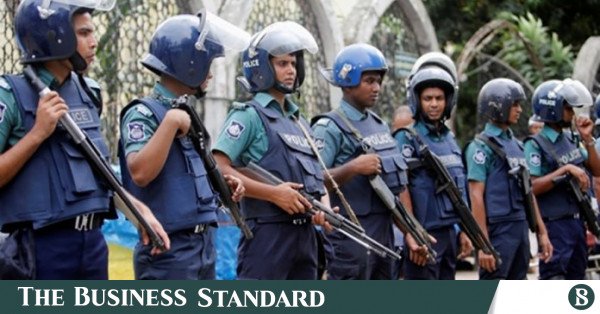
File photo of policemen on duty. Photo: Collected
“>

File photo of policemen on duty. Photo: Collected
Bangladesh’s law enforcement agencies have stepped up surveillance after a recent UN report warned that Al-Qaeda in the Indian Subcontinent (AQIS) was attempting to establish covert networks, or “cells”, using Bangladesh, although police say the report is not being treated as evidence of an active AQIS presence in the country.
According to sources at the Police Headquarters, the force had decided to review the UN report in full before making any formal comment. Relevant units have been asked to examine whether the concerns raised in the report have any links to individuals, groups or networks operating inside Bangladesh.
Law enforcement agencies are treating the assessment as a serious international warning rather than conclusive evidence that AQIS has an organised operational structure in Bangladesh.

Investigators are also considering whether any connection exists between the report and recent incidents involving the recovery of explosives or homemade bombs and the arrest of suspected militants in different parts of the country.
The concerns were outlined in the 38th report of the UN Security Council’s Analytical Support and Sanctions Monitoring Team, published on 10 August, which warned of growing terrorist threats in South Asia and described attempts by AQIS to build covert safe havens and networks using Bangladesh as a matter of concern.
Relevant units are reviewing the report to examine whether individuals already under surveillance for alleged militant links, those accused of involvement with banned organisations, or any newly emerging organised networks have any connection to the concerns raised by the UN.
However, no law enforcement agency has so far officially stated that AQIS has an active organisational structure in Bangladesh.
Contacted after the UN report was published, Counter Terrorism and Transnational Crime (CTTC) chief Mohammad Shamsul Haque declined to comment.
CTTC Joint Commissioner Munshi Shahabuddin referred queries to the Dhaka Metropolitan Police’s media wing.
Attempts to reach Anti-Terrorism Unit (ATU) chief Additional IGP Rezaul Karim were unsuccessful.
Possible restructuring under discussion
The UN assessment has also revived discussions on Bangladesh’s counterterrorism framework.
A senior DMP official, speaking on condition of anonymity, said authorities were considering integrating the CTTC unit with the police’s Anti-Terrorism Unit instead of maintaining them as separate entities.
The proposal remains at the discussion stage but could bring counterterrorism operations, intelligence analysis and research under a single framework, the official added.
The UN assessment comes at a time when homemade bombs have been recovered and suspected militants arrested in several parts of the country over the past year.
Law enforcement officials said there is no basis to conclude that these incidents are linked to the same organisation or ideology, but investigators examine whether any international militant group or organisational direction is involved.
Speaking on condition of anonymity, a retired major general and security analyst said some individuals inspired by the ideologies of Al-Qaeda or the Islamic State (IS) may be active in Bangladesh, although many avoid publicly identifying themselves with any organisation.
The security analyst said such groups can operate through sleeper cells and may seek to become active when conditions appear favourable.
Strengthening intelligence surveillance, monitoring online activity and improving information-sharing among agencies are therefore essential to prevent AQIS or any other international militant group from expanding its network in Bangladesh, the security analyst added.
The UN report also stated Al-Qaeda and IS are seeking to develop chemical and biological weapons capabilities.
It noted that technological limitations have so far prevented significant progress, but warned that the spread of related information through online extremist platforms remains a concern.
About The Author