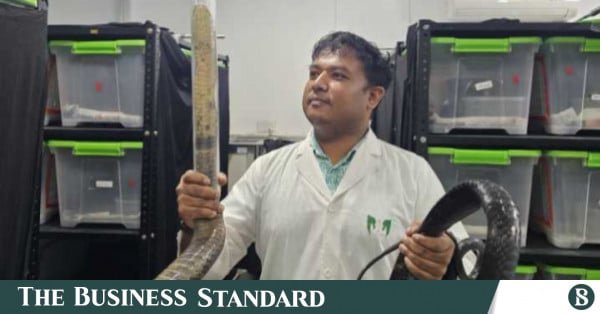
The adult male king cobra was rescued from Chattogram University after straying into a populated area and underwent treatment for parasite infestation before being declared fit for release.
12 Foot King Cobra. Photo: Courtesy.
“>

12 Foot King Cobra. Photo: Courtesy.
A nearly 12-foot-long adult king cobra rescued from the Chattogram University campus is set to be released back into its natural habitat after more than three months of treatment, rehabilitation and observation.
Mohammad Noman, research associate at the Venom Research Centre of Chattogram Medical College, told The Business Standard that the snake was rescued after it strayed into a populated area near the university several months ago.
Following the rescue, specialists identified it as an adult male king cobra. As the centre was already housing another male king cobra rescued from the same area, it decided to rehabilitate the newly rescued snake and return it to the wild rather than keep it in captivity.

Noman said the snake was heavily infested with ticks and other external parasites when it arrived at the centre.
“After treatment, we waited for its first successful shedding cycle. It has now completed moulting without complications, confirming that it has recovered and is fit for release,” he said.
According to Noman, the snake is estimated to be three to four years old and measures nearly 12 feet in length.
He added that the centre currently houses another male and a female king cobra of similar size and plans to launch a breeding programme as part of its conservation efforts.
Noman said the hilly forests surrounding Chattogram University provide suitable habitat for king cobras and are believed to support several breeding pairs.
“My responsibility was to treat and rehabilitate the snake. It has now been handed over to the relevant authorities for release into a suitable habitat. The sooner a healthy wild animal is returned to nature, the better,” he said.
The Venom Resource Centre said rehabilitating rescued wildlife and returning it to its natural habitat is a key component of biodiversity conservation, noting that apex predators such as king cobras play a vital role in maintaining the ecological balance of forest ecosystems.
About The Author