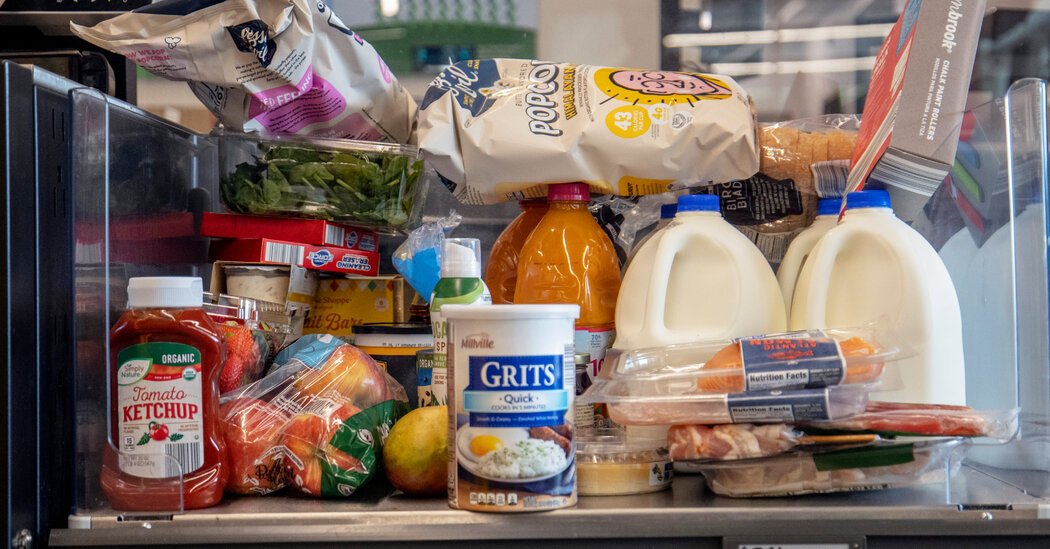


If one national concern defined the first half of 2026, it was affordability. As the war in Iran continued and inflation accelerated, many Americans struggled to buy basics — and groceries topped the list.
Two years ago, we asked 27 people to send us a month’s worth of grocery receipts and then analyzed their shopping habits. As those same shoppers contend with soaring costs, now seemed like a good time to check back in. Over two weeks in April, 20 of the 27 people once again sent in their receipts. We combed through their purchases to see which items have ballooned in price and how shoppers are dealing with these shifts.
Some are ditching name brands for store brands, while others are stocking their freezers with whatever is on sale. And more than one shopper said they rely on store-bought rotisserie chicken, that ever-affordable staple, at times like these.
Breaking a Couple of Eggs
A confluence of factors sent egg prices soaring in 2024 and into 2025. This year, our shoppers are paying less, on average, but in some parts of the country, prices never fell to pre-2024 numbers. The cheapest dozen eggs found among our shoppers this year were in Mount Pleasant, S.C., at $1.87, compared with $2.05 two years prior. The most expensive eggs were in Anchorage at $11.69.; in 2024, those same pasture-raised eggs were $9.79.
Paula Craft, 68, Bigfork, Mont.
| Butter | $4.50 | ↑ $5.49 |
| Milk (gallon) | $4.59 | ↑ $5.58 |
| Lemon | $0.79 | $0.79 |
As a retiree who lives with her husband only, Paula Craft never thought she’d need a Costco card. “It felt wasteful,” she said. But with inflation driving up the price of meat, produce and dairy — coupled with her rural setting, 30 miles from the nearest grocery store — she’s changed her tune. She signed up for a Costco membership last year.
She now buys most of her staples — meat, nuts and coffee beans — in bulk, then vacuum seals and stores them in a chest freezer. Those purchases supplement the fruits and vegetables she grows in her garden — though with the price of seeds and fertilizer, she lamented, even gardening has become more expensive.
Tosha Connors, 44, Mt. Pleasant, S.C.
| Organic ground beef | $5.49, $6.19/pound | ↑ $7.47/pound |
| Tropicana orange juice | $3.94 (52 ounces) | ↑ $3.87 (46 ounces) |
| Eggs (dozen) | $2.78 | ↓ $1.87 |
| Green grapes | 2.28/pound | ↓ $2.27 |
Tosha Connors’s biggest life change in the past two years? “Three boys who need part-time jobs just to feed themselves,” she joked. Protein-filled foods like steak and peanut butter have become necessities for her children, who are now 5, 8 and 11 and going through growth spurts.
She has also noticed “shrinkflation” — a decrease in quantity with no change in price — for items like orange juice and potato chips. She relies more on affordable, filling staples like a whole rotisserie chicken and limits luxuries like wine and chocolate chip cookies. Even still, the sticker shock is real. “When they ring it all up, I barely have anything in my cart and I am like, ‘What on earth did I just buy?’” she said.
Ballin’ on a Berry Budget
The average amount spent on all berries in 2024 was $4.47. In 2026, that number rose to $5.53. Two years ago, the most frequently purchased berries among our shoppers were strawberries. This year, they bought raspberries more often — the only berry in which the average price was less in 2026 ($4.27) than it was in 2024 ($5.57).
Alan Young, 82, Hilo, Hawaii
| Bananas | $1.99/pound | $1.89/pound; $2.19/pound |
| Coffee Mate creamer | $7.99 | ↑ $8.89 |
| Häagen-Dazs ice cream | $4.29 | ↑ $4.99 |
| La Croix | $4.19 | $3.67 (on sale, retails for $4.39) |
Though the government has made cuts to federal food assistance, Alan Young — who receives benefits from the Supplemental Nutrition Assistance Program — was relieved to see a few months ago that the government had modestly increased his and his partner’s monthly allocation to account for inflation.
Still, he said, fewer stores and bakeries accept SNAP than they did two years ago. “I have to think about whether I want it, or whether I can really afford it” he said of his shopping. For Mr. Young, though, ice cream and chocolate are always worth the price.
What’s the Beef
In 2024, beef made up one-third of our shoppers’ raw meat purchases. This year, shoppers bought significantly less: Only 20 percent of meat purchases were of items like ground beef, chuck shoulder steak and strip steak. The amount of chicken they bought increased, from 41.9 percent of meat purchases two years ago to 47.5 percent in 2026.
Does not include purchases of sausage, deli or processed meats.
Clifford Reiss, 78, Riverview, Fla.
| Bacon Caesar salad kit | $3.50 | $3.50 |
| Lactaid milk | $6.59 | ↑ $6.99 |
| Yellow onion (1 pound) | $1.29 | ↑ $1.99 |
| Chobani yogurt four-pack | $4.99 | ↑ $5.49 |
Clifford Reiss’s longtime penchant for coupon-cutting and sale-seeking has come in handy during this period of rising prices: He’s been able to keep his grocery budget more or less the same.
But his habits have shifted a little. He makes fewer trips to the store to save on gas, which has grown more expensive since the Iran War started. He even wears a weight-lifting belt at the store so he can carry more and heavier items without hurting himself. And he limits the amount of snacks he buys, like plantain chips and matzo, as his wife is on a GLP-1 drug and they are trying to eat healthier.
Mindy Huskins, 35, Delaware City, Del.
| McCain frozen French fries | $3.65 | ↑ $4.69 |
| Green onions (1 bunch) | $1.10 | ↑ $2.49 |
| Butter | $5.28 | ↑ $6.29 |
Two years ago, Mindy Huskins was raising two toddlers and had recently begun taking a GLP-1 for diabetes and weight loss. Those children are now preschoolers, and her wife has since started taking a GLP-1, too. Although they buy less food because of the medication, “it is still more expensive,” Ms. Huskins said. She used to spend no more than $200 on groceries. “I would say $200 is now the minimum.”
Gone are the days of apple sauce pouches, which are too expensive, and highly perishable produce like celery, which she can’t use up quickly enough. Those have been replaced with snack-sized packs of cheese and crackers that she and her wife can pack into lunchboxes or eat instead of large meals. But there have been frustrating realizations: “It is more expensive to buy in smaller quantities as opposed to getting a big Costco-sized version.”
Go Big Haul or Go Home
Many have parted ways with the smaller, more frequent shop in favor of larger, more expensive hauls. In 2024, the average receipt total was $66.13, compared with $72.31 this year, and the median price of a trip to the grocery store two years ago was $42.72, compared with $49.70 in 2026.
About The Author