Dhaka sought Rome’s support on post-LDC market access, legal migration pathways and resolving the status of Bangladeshi workers in Italy.
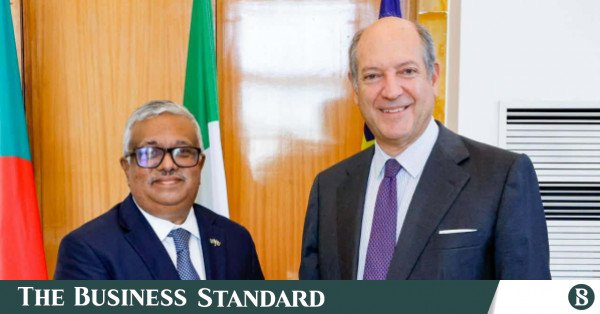
Foreign Secretary Asad Alam Siam – Ambassador Riccardo Guariglia
“>

Foreign Secretary Asad Alam Siam – Ambassador Riccardo Guariglia
Bangladesh and Italy reviewed their bilateral relations and explored ways to expand cooperation in trade, investment, migration, skills development and other priority sectors during the third round of political consultations held in Rome today (4 August).
The Bangladesh delegation was led by Foreign Secretary Asad Alam Siam, while Ambassador Riccardo Guariglia, secretary-general of Italy’s Ministry of Foreign Affairs and International Cooperation, headed the Italian side.
According to a statement issued by the Ministry of Foreign Affairs, both sides expressed satisfaction with the growing depth of bilateral relations and reaffirmed their commitment to strengthening cooperation across a wide range of sectors.

Bangladesh thanked Italy for its support during the country’s democratic transition and reform initiatives and reiterated its commitment to deepening bilateral cooperation in line with its development and strategic priorities.
On the economic front, the two sides discussed measures to boost bilateral trade, encourage investment and joint ventures, and explore new opportunities for sustainable economic cooperation.
Bangladesh highlighted its recent reform initiatives aimed at improving the investment climate and sought Italy’s support at the United Nations General Assembly for deferring the country’s graduation from the Least Developed Country (LDC) category.
The Bangladesh side also stressed the importance of ensuring continued access to the European market after LDC graduation through mechanisms such as a Bangladesh-European Union Free Trade Agreement (FTA) and an Investment Protection Agreement (IPA).
Dhaka requested Italy’s political and technical support for Bangladesh-EU FTA negotiations and called for an early review of the automatic safeguard threshold for textile and ready-made garment exports under the EU’s new Generalised Scheme of Preferences (GSP) regulation.
Migration and skills development also featured prominently in the discussions.
Bangladesh appreciated Italy for hosting a large Bangladeshi community and urged Rome to operationalise the “Talent Partnership” initiative to facilitate greater legal labour mobility from Bangladesh.
The Bangladesh delegation highlighted measures taken to curb irregular migration and sought expanded opportunities for legal migration under the 2025 Memorandum of Understanding on Migration and Mobility. It also requested Italian support for language and skills training for prospective migrant workers.
Dhaka further raised the issue of several hundred Bangladeshi workers who entered Italy legally during 2022 and 2023 but are now facing difficulties renewing their residence permits or changing employers because their original sponsors are no longer reachable. Bangladesh requested Italy to consider regularising their status.
The two sides also discussed expanding cooperation in culture, education, defence, technology, agriculture, energy, infrastructure, climate change and food security.
They exchanged views on regional and global developments and cooperation in multilateral forums. Bangladesh sought greater political and humanitarian support from Italy for achieving a durable solution to the Rohingya crisis.
Both countries agreed to hold the next round of political consultations in Dhaka next year on a mutually convenient date.
Later in the day, Foreign Secretary Asad Alam Siam met Matthew Hollingworth, assistant executive director of the World Food Programme (WFP), to discuss humanitarian assistance for forcibly displaced Myanmar nationals, food security, anticipatory action, resilience building, school feeding and nutrition programmes in Bangladesh.
About The Author