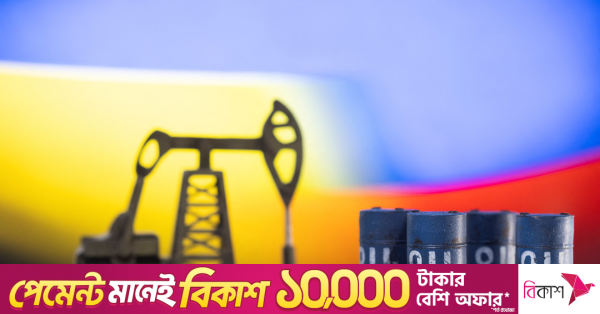
The fuel will be imported under G2G agreements from six state-owned foreign suppliers to meet domestic demand during the first half of the fiscal year.
Representational Photo: Reuters
“>

Representational Photo: Reuters
Highlights:
- Cabinet committee approves Tk16,089cr refined fuel imports
- Six state-owned foreign suppliers to provide petroleum products
- Fuel to be procured under government-to-government agreements
- Committee also clears infrastructure and power-related procurement proposals
- Beza projects and fertiliser warehouse contracts receive approval
The government has approved the import of refined petroleum products worth Tk16,089 crore for the July-December period of the current fiscal year under government-to-government (G2G) agreements with six state-owned foreign suppliers.
The decision was taken at the 33rd meeting of the Cabinet Committee on Government Purchase, chaired by Finance Minister Amir Khosru Mahmud Chowdhury at the Secretariat today (29 July).

According to the Cabinet Division, the Power, Energy and Mineral Resources Division submitted the proposal based on predetermined premiums, import volumes and prevailing international reference prices, which the committee approved.
The six state-owned suppliers are the UAE’s ENOC, China’s PetroChina and Unipec, India’s Indian Oil Corporation Limited (IOCL), Thailand’s OQT and Indonesia’s BSP.
Bangladesh imports a significant portion of its refined petroleum products each year to meet domestic demand for diesel, furnace oil and other fuels used in electricity generation, transport, industry and agriculture. The Bangladesh Petroleum Corporation (BPC) has long sourced these products from state-owned oil companies through G2G arrangements.
The committee also approved several other procurement proposals.
It endorsed a Tk126 crore proposal under the Local Government Engineering Department’s (LGED) Resilient Infrastructure for Adaptation and Vulnerability Reduction (RIVER) (First Revised) project to build 15 government primary school-cum-flood shelters in Bogura.
The World Bank and the Bangladesh government are jointly financing the project. The contract has been recommended for The Civil Engineers Limited (lead partner) and Messrs Ahad Builders (TCEL-AB JV).
Another proposal approved was the construction of a 10,000 tonnes fertiliser buffer warehouse in Lakshmipur at a cost of Tk49.14 crore under the Ministry of Industries’ Construction of 34 Buffer Warehouses for Fertiliser Storage and Distribution Nationwide (First Revised) project. The contract has been recommended for Messrs MBL-REL JV.
The committee also approved a revised levelised tariff for electricity purchased from the Ashuganj 450MW Combined Cycle (North) Power Plant operated by Ashuganj Power Station Company Limited.
Under the revised tariff, the levelised electricity price has been set at 4.0945 US cents per kilowatt-hour, equivalent to Tk5.0281 per unit. The calculation is based on an 84.6% plant load factor, a 12% discount factor, a 6% return on equity, an exchange rate of Tk122.80 per US dollar and a gas price of Tk438.91 per 1,000 standard cubic feet.
The committee also approved three procurement proposals submitted by the Bangladesh Economic Zones Authority (Beza).
These include a Tk123.34 crore contract awarded to Monico Limited for road network construction in sub-zones 6, 7, 11 and 18 of the National Special Economic Zone (NSEZ) in Mirsarai, Chattogram.
It also approved a Tk211.79 crore contract for implementing the Power Network (Package No WD-4A-BSMSN-Beza) project, which has been recommended for Reverie Power and Automation Engineering Limited.
In addition, the committee approved an extension and cost variation for consultancy services under the National Special Economic Zone Development (First Revised) project.
Under the revised proposal, the consultancy contract value has been increased from Tk83.14 crore to Tk89.85 crore, while the contract period has been extended from 31 December 2025 to 31 December 2027.
The consultancy services are being provided by a joint venture comprising South Korea’s Cheil Engineering Co Ltd, Yooshin Engineering Corporation and Bangladesh’s Engineering and Planning Consultants Ltd.
About The Author