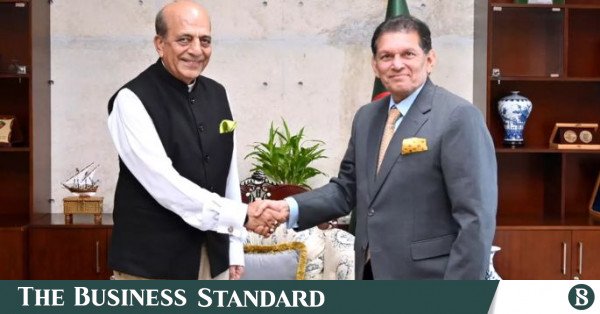
Foreign Minister Dr Khalilur Rahman today (29 July) emphasised the need to address the “some irritations” that exist in Bangladesh-India relations, noting that the government is currently reviewing the invitation extended by India to Prime Minister Tarique Rahman.
“We did not talk about any specific issue. There are some irritations. He knows it. I know it, too. It is very important to resolve them. Everyone understands that need,” he told reporters at the Ministry of Foreign Affairs following a courtesy meeting with Indian High Commissioner to Bangladesh Dinesh Trivedi.
India, which will host the 18th BRICS Summit in New Delhi on September 12-13, has invited Prime Minister Tarique Rahman to attend the event, which will focus on global cooperation, trade, and sustainable development.

“We are reviewing it now. We will take a decision and inform you immediately,” Dr Khalilur said when asked about Bangladesh’s response to the invitation.
India’s BRICS chairship is guided by the theme, “Building for Resilience, Innovation, Cooperation and Sustainability,” reflecting the people-centric and humanity-first approach articulated by Indian Prime Minister Narendra Modi at the 2025 Rio Summit.
The 17th BRICS Summit was held on July 6-7, 2025, in Rio de Janeiro, Brazil, under the theme, “Strengthening Global South Cooperation for a More Inclusive and Sustainable Governance.”
The BRICS member countries are Brazil, China, Egypt, Ethiopia, India, Indonesia, Iran, Russia, Saudi Arabia, South Africa, and the UAE. Its partner countries are Belarus, Bolivia, Cuba, Kazakhstan, Malaysia, Nigeria, Thailand, Uganda, Uzbekistan, and Vietnam.
“We did not discuss any issues in detail. That is normal because we have time for that. However, regarding the resetting of relations between the two countries, we have said this before, and we both agree on this issue,” the Foreign Minister said.
He said Bangladesh and India would move their bilateral relations forward on the basis of sovereign equality, with due consideration for their mutual interests and Bangladesh’s national interests.
The Foreign Minister said they did not hold lengthy discussions on any specific issue, focusing instead on improving overall bilateral relations.
Responding to a question, Dr Khalilur said the Prime Minister had received multiple international invitations and noted that he would travel to New York to attend the UN General Assembly.
“We have to look at everything as a whole,” he said.
Describing the meeting as a courtesy call, the Foreign Minister said there would be opportunities to discuss specific issues in greater detail in the future.
Dr Khalilur also said he had met Indian External Affairs Minister Dr S. Jaishankar in Manila, the Philippines, who was aware of his meeting with the Indian High Commissioner.
“We both expressed the hope that, in the coming days, both sides will work to further strengthen our relations,” he said.
In a separate briefing, High Commissioner Trivedi said there is no problem that cannot be resolved and once the Prime Minister of Bangladesh visits India, things will move forward constructively.
“I am looking forward to everything positively- we had a great meeting filled with immense positivity,” he told reporters while responding to a question after separate meetings with Foreign Minister Dr Khalilur and State Minister for Foreign Affairs Shama Obaed Islam at the Ministry.
Asked about the two separate invitations to the Prime Minister of Bangladesh from the Indian side, the High Commissioner said that is the prerogative of the Prime Minister.
“From our end, I can assure you that we are looking forward to welcoming the Prime Minister of Bangladesh to India. We are very hopeful that this visit will take place in the near future,” he said.
On pending bilateral issues – Teesta and renewal of Ganges Water Treaty, the High Commissioner said, “Today’s meeting was primarily a courtesy call, and it carried the warmth expected of one.
However, there is no issue that cannot be sorted out through mutual understanding. Ultimately, at the end of the day, it is about people. Whatever is beneficial for both democracies and their citizens will be prioritised.”
Regarding treaty renewals, both India and Bangladesh have active working groups, he said.
“These working groups will certainly meet and deliberate. As I mentioned, there is no problem that cannot be resolved. The working groups will actively do their part, and once the Prime Minister visits India, things will move forward constructively,” said the High Commissioner.
He said they had a remarkably good meeting which is a very positive step forward. “The meetings held in an exceptionally warm environment.”
“I can tell you that historically, culturally, and even in sports – such as cricket – our connections run deep. We discussed all these aspects,” said the High Commissioner.
“This relationship is truly historical. We share not only our borders, but also our history, culture, and aspirations.”
“I am looking forward to a relationship whose very foundation rests on mutual, people-to-people benefits for both nations. This is just the beginning, and I am confident we will continue to engage more deeply with each other moving forward,” said the High Commissioner.
Deputy High Commissioner Pawan Badhe, officials of the High Commission were also present.
On June 25, the High Commissioner presented his credentials to the President of Bangladesh, and conveyed greetings from the government and people of India and reaffirmed India’s commitment to further strengthening the multifaceted Bangladesh-India partnership for the mutual benefit of the peoples of the two sovereign countries.
About The Author