The project will be implemented by December 2028 under the Health Education and Family Welfare Division.
Infographics: TBS
“>

Infographics: TBS
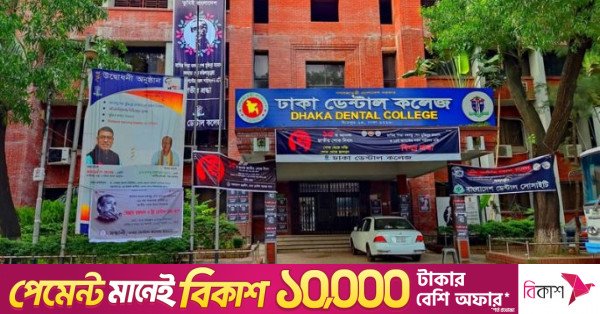
The government has planned a Tk547.23 crore project to address the longstanding accommodation shortage, classroom deficit and infrastructure constraints at Dhaka Dental College, the country’s only government dental college.
According to the Health Engineering Department and Planning Commission, the three-year project aims to modernise infrastructure, improve the academic environment for undergraduate students, postgraduate doctors and faculty members, and enhance oral healthcare services.
Titled “Infrastructure Development of Dhaka Dental College,” the project will be implemented by December 2028 under the Health Education and Family Welfare Division.
It includes construction of new buildings and procurement of 24,727 medical equipment and 11,632 pieces of furniture.

The proposal has been sent to the Planning Commission, whose Project Evaluation Committee (PEC) will review it today. If approved at the inter-ministerial meeting, it will be placed before Ecnec (Executive Committee of the National Economic Council) for final approval.
Infrastructure fails to keep pace
Established in 1961 and relocated to Mirpur-14 in 2000, Dhaka Dental College has failed to expand its infrastructure despite rising enrolment and growing demand for modern dental education.
The college faces an acute student accommodation shortage and lacks the air-conditioned gallery classrooms and tutorial rooms required under Bangladesh Medical and Dental Council (BMDC) standards, disrupting academic activities.
To address this, the project proposes a new academic building, separate 10-storey male and female dormitories, a principal’s residence, and a multipurpose building for postgraduate doctors and faculty members at Mirpur. The multipurpose building will replace an old structure at the Sobhanbag campus.
‘Infrastructure now a necessity’
Professor Humayun Kabir, former principal of Dhaka Dental College, told The Business Standard the institution lacks the infrastructure, academic facilities, research capacity and support services needed to become an internationally recognised dental education institution.
The college has around 700 students and admits about 110 local and 25 foreign students annually, but infrastructure has not kept pace with enrolment, he said. Although established in 1961, it remains the country’s only full-fledged government dental college, making upgraded infrastructure essential for international-standard education, healthcare and research.
“If implemented, the project will benefit students, teachers, doctors and patients. The college hospital also lacks adequate residential facilities for doctors. The new buildings and hostels will significantly ease the accommodation crisis and help transform the institution into an international-standard centre for dental education, treatment and research,” Kabir said.
Principal Dr Md Abdul Awal told The Business Standard the project would benefit both dental students and patients.
Planning Commission raises questions
However, the Planning Commission has raised several questions in the working paper prepared for the PEC meeting.
The commission sought detailed justifications for the proposed Tk192.46 crore expenditure on non-residential buildings, Tk184.91 crore on residential buildings and Tk109.8 crore on electrical works. It also asked for explanations of the estimated costs for lifts, furniture and medical equipment.
The commission further asked for justification for allocating Tk73.56 crore to construct the 10-storey male dormitory and Tk109 crore for the female dormitory, and whether these facilities would fully resolve the college’s accommodation shortage.
It has also sought clarification on the facilities to be included in the multipurpose building and principal’s residence, the project’s expected social and economic benefits, employment generation, anticipated returns on investment, compliance with government procurement rules, and whether the feasibility study was published following consultations with relevant stakeholders.
About The Author