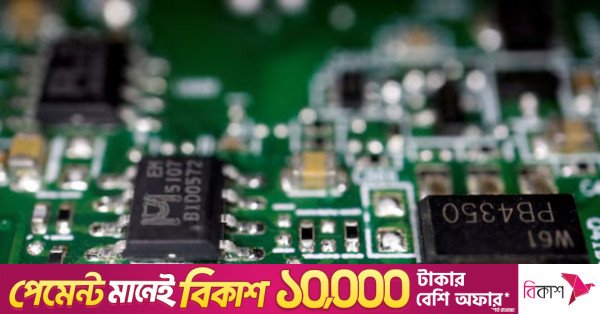
The global semiconductor industry is entering a period of unprecedented expansion, fuelled by soaring demand for artificial intelligence (AI), high-performance computing and advanced electronics.
As countries across Asia race to strengthen their positions in global chip supply chains, industry leaders say Bangladesh’s semiconductor ambitions have reached a decisive stage where implementation, rather than policy announcements, will determine success.
Following the long-term tax incentives announced in the FY2026-27 budget, the Silicon River USA Roadshow that concluded in June, and the two-day Bangladesh Electronics, AI and Robotics (BEAR) Summit 2026, which begins today, they say the country’s next challenge is no longer attracting attention but building a globally competitive semiconductor ecosystem.

“The next two years will determine whether Bangladesh becomes a serious semiconductor destination,” said Syed Almas Kabir, former president of the Bangladesh Association of Software and Information Services (BASIS).
According to him, investors will now look for tangible progress beyond policy measures, including operational semiconductor design centres employing 200 to 300 engineers, internationally certified Assembly, Testing, Marking and Packaging (ATMP) facilities, faster regulatory approvals and partnerships with global semiconductor companies.
The urgency is reflected in the rapid growth of the global market. The World Semiconductor Trade Statistics (WSTS) forecasts the industry will expand to $1.51 trillion in 2026, driven by AI infrastructure, high-bandwidth memory and advanced computing, before approaching $1.9 trillion in 2027.
India has committed more than $13 billion under its semiconductor programme, while Vietnam aims to train 50,000 semiconductor design engineers by 2030.
Against that backdrop, Bangladesh’s ambitions are comparatively modest. The Bangladesh Investment Development Authority (Bida) aims to increase semiconductor exports from around $8 million to $1 billion by 2030.
Industry leaders say reaching that target will depend less on introducing new incentives than on how quickly the country develops skilled talent, research capability and testing infrastructure.
From policy support to industrial expansion
The government has extended customs duty, VAT and tax concessions on semiconductor design software, Electronic Design Automation (EDA) tools, testing equipment and advanced packaging machinery until 2031, providing companies with greater certainty for long-term investment.
Sirajul Alam Khan, founder and chief executive of Siliconova, said the budget measures, Silicon River USA Roadshow and the upcoming BEAR Summit have strengthened investor confidence and raised Bangladesh’s profile as a semiconductor design destination.
He said the initiatives are expected to attract outsourcing projects, foreign investment and technology partnerships with global semiconductor companies.
At the same time, he said sustained growth will require a dedicated semiconductor research fund, easier access to EDA tools and semiconductor intellectual property, technology-focused financing and stronger public-private partnerships to help companies commercialise advanced technologies and expand into semiconductor packaging and testing.
Building the workforce
While policy support has improved, industry leaders believe Bangladesh’s biggest challenge remains developing specialised human capital.
The country produces around 13,000 electrical and electronic engineering graduates and 26,000 computer science graduates each year.
However, Professor Dr ABM Harun-ur-Rashid of Buet’s Department of Electrical and Electronic Engineering and a member of Bida’s National Semiconductor Taskforce said most graduates require nearly a year of specialised Very Large Scale Integration (VLSI) training before becoming industry-ready.
Bangladesh also lacks experienced engineers capable of leading complex semiconductor projects, he added.
“The industry needs engineers with 10 to 15 years of experience who can lead teams and deliver sophisticated projects. That experience gap cannot be filled overnight,” Harun said.
He called for a sustainable talent development model involving government, universities and industry. He said this should include dedicated VLSI programmes, industry-aligned curricula, wider access to commercial EDA tools, faculty development initiatives and the establishment of a National Centre of Excellence for VLSI Design.
The next milestone: Testing and packaging
While Bangladesh has established a presence in semiconductor design through companies such as Siliconova, Ulkasemi, Neural Semiconductor and Prime Silicon Technology, industry leaders say the next stage is to build internationally competitive testing and packaging capabilities.
Almas Kabir said Bangladesh should establish internationally certified ATMP facilities, introduce a single-window regulatory system for investors, and secure at least two foreign investment partnerships with global semiconductor companies.
It should also prioritise developing semiconductor engineers, strengthening university-industry collaboration and expanding testing and packaging infrastructure, he added.
Harun described Outsourced Semiconductor Assembly and Testing (OSAT) and advanced packaging as the natural next phase of Bangladesh’s semiconductor journey.
He said the country should aim to establish 50 VLSI design companies, three semiconductor testing facilities and two packaging industries by 2030, while attracting at least one global semiconductor company to establish a design centre in Bangladesh.
Building a complete ecosystem
MA Jabbar, president of the Bangladesh Semiconductor Industry Association (BSIA), said extending incentives until 2031 gives investors greater confidence to make long-term commitments, but the next phase must focus on developing the broader ecosystem.
He identified talent development, shared design infrastructure, advanced testing facilities, packaging capability, research funding, stronger intellectual property protection and closer collaboration between industry and academia as the sector’s immediate priorities.
Jabbar and Sirajul Alam both called for a National Semiconductor Research and Development Fund, startup support programmes, technology-focused financing, shared design infrastructure and faster regulatory approvals to accelerate commercialisation and attract investment.
Industry leaders said the Silicon River USA Roadshow and the National Semiconductor Symposium & BEAR Summit 2026 have increased Bangladesh’s visibility among global semiconductor companies, investors and diaspora professionals, creating opportunities for research collaboration, technology transfer and foreign investment.
They cautioned, however, that international interest must now be matched by execution.
Investors, they said, will ultimately assess Bangladesh on the availability of skilled engineers, internationally certified testing and packaging facilities, research capability and an efficient regulatory environment.
About The Author