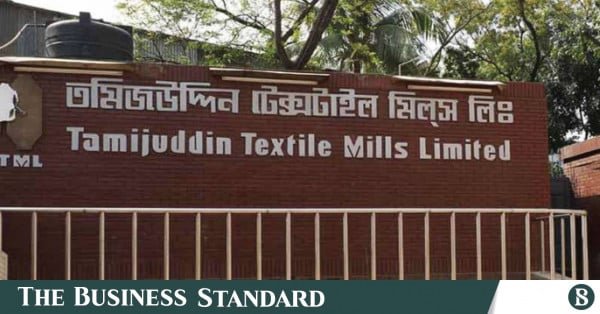
Tamijuddin Textile Mills PLC, a listed textile company, has suspended its manufacturing operations in Gazipur indefinitely amid escalating labour unrest, but failed to disclose the development to the stock exchanges within the required timeframe, in a potential breach of securities regulations.
The company issued an “Urgent Notice” at its factory on 13 July, announcing the closure under Section 13(1) of the Bangladesh Labour Act, 2006. The provision allows employers to declare an indefinite layoff during an illegal strike or work stoppage, commonly known as a “no work, no pay” situation.
However, despite the significant impact of a complete production shutdown, the company had not informed the Dhaka Stock Exchange (DSE) or Chittagong Stock Exchange (CSE) until this afternoon (16 July).

Market analysts said the failure to disclose such a price-sensitive development violates the DSE Listing Regulations and the Bangladesh Securities and Exchange Commission’s (BSEC) rules on insider trading. Under these regulations, listed companies are required to immediately disclose any event that could affect their operations, financial performance or share prices.
When contacted, Tamijuddin Textile Mills Company Secretary Gazi Mohammad Ali Hossain told The Business Standard, “I have heard reports of the factory closure, but I have not received any official documents or formal confirmation from the plant yet.”
According to industrial police, the unrest began after workers demanded payment of additional arrears, bonuses and other financial benefits.
In its internal notice, the company alleged that workers had “unlawfully” stopped production, staged a strike at the factory gate and created a situation that threatened the safety of lives and property.
The notice said production would remain suspended until a “favourable environment” was restored for reopening the factory.
Located at the BSCIC Industrial Estate in Konabari, Gazipur, the factory employs 1,615 workers, according to the company’s latest audit report. Its chairman, Chowdhury Mohammed Hanif Shoeb, also serves as chairman of Citizen Bank.
Tamijuddin Textile, established in 1971, was nationalised in 1973 before returning to private ownership in 1985. After years of trading on the over-the-counter (OTC) market, the company returned to the main trading board in June 2021.
The company’s share price has drawn significant investor attention since its relisting, rising from Tk13.20 in 2021 to Tk135 today.
The shutdown comes amid weaker revenue performance. In the first nine months of the 2025-26 fiscal year (July-March), the company’s turnover declined 9% year-on-year to Tk275 crore.
Although net profit increased slightly to Tk13.49 crore during the period, with earnings per share (EPS) at Tk4.08, the indefinite production halt is expected to affect the company’s year-end financial performance.
Tamijuddin Textile has an annual production capacity of 1.38 crore kilogrammes of yarn from its 70,728 spindles.
About The Author