Highlights:
- Govt to brief foreign envoys tomorrow on Bangladesh’s LDC graduation extension bid.
- Dhaka seeks global support ahead of the 22 July ECOSOC vote.
- Bangladesh wants to delay LDC graduation until November 2029.
- Govt to present reform roadmap to justify the extension request.
- Proposal to go to the UN General Assembly if approved by ECOSOC.
- Officials cite global and domestic economic challenges behind the request.
- Govt warns premature graduation could hurt exports and trade benefits.
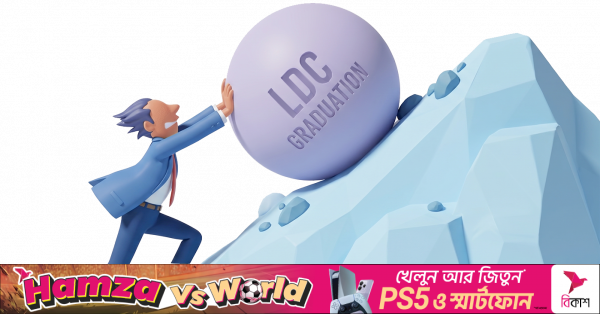
The government will brief foreign ambassadors in Dhaka tomorrow (2 July) as part of a diplomatic campaign to secure international backing for Bangladesh’s proposal to defer its graduation from the UN’s Least Developed Country (LDC) category ahead of a crucial vote at the United Nations Economic and Social Council (Ecosoc) on 22 July.
At a meeting with foreign ambassadors at the NEC Conference Centre in Sher-e-Bangla Nagar, the government will explain the need for additional preparation time and present a time-bound action plan, according to officials at the Economic Relations Division (ERD).

Commerce Minister Khandakar Abdul Muktadir, Finance and Commerce Adviser to the Prime Minister Rashed Al Mahmud Titumir, and State Minister for Planning Zonayed Saki are expected to attend.
ERD officials said Bangladesh will urge all 54 Ecosoc member states to support its proposal. If approved, the recommendation will go to the UN General Assembly for final endorsement at its September session, where it could be put to a vote.
The outreach follows the UN Committee for Development Policy (CDP)’s recommendation on 2 June supporting Bangladesh’s request for a “shorter extension”, although it did not specify a timeframe. Officials said the extension could be one to three years. Bangladesh had sought a three-year extension until 24 November 2029.
The recommendation followed Bangladesh’s formal application on 18 February and a subsequent letter from Prime Minister Tarique Rahman to the UN Secretary-General on 6 April.
Case for an extension
The government argued that although Bangladesh comfortably exceeds the thresholds under all three LDC graduation criteria, a combination of global and domestic shocks has disrupted its transition preparations.
It cited the lingering effects of the Covid-19 pandemic, the Russia-Ukraine war, conflicts in the Middle East, disruptions to global energy and food markets, tighter global financial conditions and slowing international trade.
Domestically, it pointed to irregularities in the financial sector, the political transition following the July 2024 mass uprising, and the continued fiscal burden of hosting forcibly displaced Rohingya people from Myanmar.
According to the government, these factors have contributed to macroeconomic instability, slower GDP growth, high inflation, declining investment, a weaker tax-to-GDP ratio, pressure on foreign exchange reserves, lower imports of capital machinery and industrial raw materials, slower job creation, and governance challenges in the banking sector and capital market.
The government said policy priorities had shifted towards crisis management and economic stabilisation, preventing full implementation of key measures under its Smooth Transition Strategy (STS).
“The five-year transition period was largely consumed by crisis management, economic stabilisation and ensuring resilience, rather than implementing the planned preparatory reforms,” it said.
It also warned that uncertainty over the post-LDC trade regime – including possible loss of the European Union’s GSP+ preferences for ready-made garments, potential US tariffs, changing bilateral trade arrangements and evolving global trade rules – could weaken export competitiveness, particularly given Bangladesh’s dependence on garment exports and existing energy and infrastructure constraints.
UN assessment
While confirming that Bangladesh comfortably meets all graduation criteria, the CDP concluded that external uncertainties justify granting additional preparation time.
CDP Chairman José Antonio Ocampo said the extension would allow Bangladesh to accelerate structural reforms, strengthen the financial sector, boost domestic resource mobilisation, expand productive capacity, diversify the economy and better prepare the private sector for the post-LDC environment.
The committee also recommended continued international support – including concessional financing, technical assistance, LDC-specific support measures and stronger trade negotiation capacity – during both the extended preparation period and after graduation.
If approved by the UN General Assembly, the extension would give Bangladesh additional time to implement its Smooth Transition Strategy before preferential trade benefits and other international support measures are phased out.
About The Author