Responding to a tabled starred question from BNP lawmaker Mst Farida Yeasmin (Reserved Women’s Seat-6) in Parliament, the minister said 15 of the 25 state-owned textile mills under the Bangladesh Textile Mills Corporation (BTMC) have been selected for operation under the PPP model.
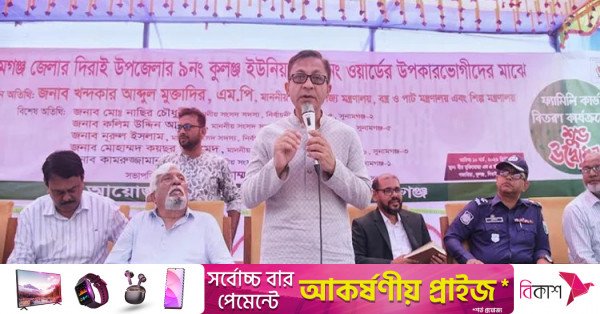
Commerce, Industries, Textiles and Jute Minister Khandaker Abdul Muktadir, MP, spoke at the Family Card distribution programme among beneficiaries at Sunamganj. Photo: BSS
“>

Commerce, Industries, Textiles and Jute Minister Khandaker Abdul Muktadir, MP, spoke at the Family Card distribution programme among beneficiaries at Sunamganj. Photo: BSS
Textiles and Jute Minister Khandakar Abdul Muktadir today (29 June) said the government has taken initiatives to revive a number of state-owned textile and jute mills through public-private partnerships (PPP), leasing arrangements and industrial development projects as part of its election manifesto commitments.
Responding to a tabled starred question from BNP lawmaker Mst Farida Yeasmin (Reserved Women’s Seat-6) in Parliament, the minister said 15 of the 25 state-owned textile mills under the Bangladesh Textile Mills Corporation (BTMC) have been selected for operation under the PPP model.
He said agreements have already been signed with selected private partners for four textile mills, and the handover process has been completed. Production has resumed at two of those mills, while work is underway to operationalise the remaining ones.

In addition, two textile mills have been leased out to private operators, with agreements signed and the transfer process completed, he said.
The minister said 10 of the 22 industrial plots developed for a Textile Village at Chittaranjan Cotton Mills in Narayanganj have already been allocated. One investor has established a modern knitting and garments factory on an allocated plot and has commenced production.
He also said initiatives have been taken to reopen Darowani Textile Mills Ltd in Nilphamari and Magura Textile Mills Ltd in Magura under the PPP model.
Referring to the jute sector, Muktadir said production at 25 state-owned jute mills under the Bangladesh Jute Mills Corporation (BJMC) was suspended in 2020 following a government decision. The current government has since taken steps to reopen the closed mills in line with its election manifesto.
So far, 14 jute mills have been leased to private operators, of which nine have resumed production, he said.
The leasing process for another five mills is in its final stage, and the government expects them to become operational under private management by December 2026, he added. The remaining six mills are also undergoing the leasing process.
Of the five mills excluded from leasing, the minister said Latif Bawany Jute Mills Ltd and Karim Jute Mills Ltd, both located within the Dhaka South City Corporation area, are being processed for declaration as industrial zones through the Bangladesh Economic Zones Authority (BEZA).
About The Author