Six-year-old Adil Rahman received his first dose of a life-changing medicine on 15 June, offering new hope after years of struggling with cystic fibrosis, a rare genetic disease that affects the lungs and digestive system.
Since starting treatment with “Triko”, a Beximco Pharma drug for the disease, Adil’s condition has begun to improve and his appetite has been increasing – as a result, he is feeling better than before, according to his family.
For Adil’s father, businessman Md Mostafizur Rahman Munshi, the moment marked the end of a long and difficult journey.

The first signs of the disease appeared when he was only a few months old. He suffered from persistent coughing and oily stools, symptoms that initially seemed like common childhood health problems.
When Adil was three years old, a Bangladeshi physician raised the possibility that he might have cystic fibrosis. To confirm it, his family travelled to New Delhi where genetic sequencing tests revealed that he had the rare inherited disorder.
Cystic fibrosis causes thick, sticky mucus to build up in the lungs and digestive system, leading to severe respiratory and digestive complications. Without effective treatment, the disease can significantly reduce life expectancy.
Globally, an estimated 160,000 people are living with it, while another 80,000 cases are believed to remain undiagnosed, particularly in low- and middle-income countries.
Although the exact number of cystic fibrosis patients in Bangladesh remains unknown, physicians estimate that nearly 2,000 people may be living with the disease.
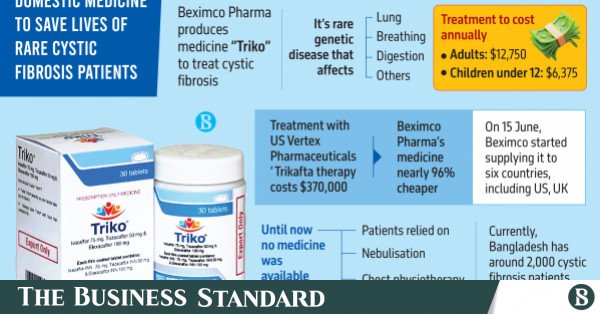
For years, Adil’s treatment was limited to managing symptoms. He relied on nebulisation, chest physiotherapy, digestive enzymes and vitamin supplements because no disease-specific medicine was available in Bangladesh.
His father knew about Trikafta, the breakthrough cystic fibrosis therapy developed by US-based Vertex Pharmaceuticals but it was expensive.
“I knew there was a medicine called Trikafta, but it costs around $370,000 per year. That was simply impossible for a family like ours to bear,” Mostafizur told TBS.
According to the New York Times reports, Trikafta has transformed the lives of many patients by improving lung function. However, its high cost and limited availability have restricted access for thousands of patients worldwide.
Mostafizur contacted international organisations and pharmaceutical companies and even considered moving abroad to access government-supported treatment programmes.
Although Adil enrolled in school at the age of four, frequent infections often forced him to stay home or spend days in the hospital.
After receiving three doses of Triko so far, Adil has returned to school and is showing encouraging signs of improvement.
“We can already see changes. His appetite has increased and he is doing better,” his father said.
Its affordability has also eased a financial burden as Adil’s treatment will cost roughly Tk120,000 per year, compared with hundreds of thousands of dollars for the original drug, he said, adding that physicians prescribe how many doses a patient will take annually.
Beximco Pharma says Triko has been priced at $12,750 annually for adults and $6,375 for children under 12, making it nearly 96% cheaper than the originator medicine.
The dramatic cost reduction has been made possible by Bangladesh’s patent exemptions as a least-developed country under World Trade Organization rules.
“Because Bangladesh is classified as a least developed country, we are exempt from certain patent restrictions, allowing us to manufacture the medicine at a much lower cost,” said Rabbur Reza, chief executive officer of Beximco Pharma.
Highlighting the company’s access and affordability philosophy, he said, “If a medicine exists but patients who need it cannot get it, then the medicine has little value. If we can improve the lives of a few hundred or a few thousand patients, that itself is a major achievement.”
The initiative began in October 2022 after a series of virtual meetings with cystic fibrosis patients and their families from around the world, Reza said.
“Those meetings were highly emotional. Parents from the US, UK, India and South Africa told us their children were dying and asked why we could not help,” the Beximco Pharma boss said.
The company spent years building technical capabilities and conducting laboratory testing to ensure the medicine matched the quality and effectiveness of the original product, he said.
Rather than following a traditional export model, Beximco plans to supply the medicine directly to patients. Foreign patients will be able to obtain the treatment through government-approved named-patient programmes or by visiting Bangladesh with a valid prescription.
On 15 June, the company formally handed over Triko to cystic fibrosis patients and patient representatives from six countries, including the US and UK through an event in Tongi.
Reza recalled receiving a message from the mother of a South African patient who had lived with cystic fibrosis for 18 years and required hospitalisation every few months.
After starting treatment, the patient told his mother for the first time in his life: “I am hungry.”
About The Author