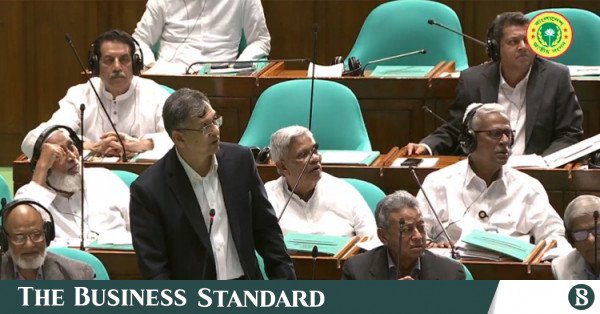
Home Minister Salahuddin Ahmed today (18 June) firmly rejected claims that the current parliament is full of loan defaulters, saying no sitting lawmaker can be classified as a loan defaulter, as all MPs contested the parliamentary election after meeting the legal eligibility requirements.
“Those who are here, none of them is a loan defaulter,” he said while participating in a debate over whether remarks made by an independent lawmaker, Rumeen Farhana, describing parliament as a “parliament of loan defaulters” should be expunged from the official record.
The minister said everyone should show due respect to all members of the House.

According to the Representation of the People Order (RPO) and other relevant rules, anyone declared as a loan defaulter by a court becomes disqualified to be a candidate in the election.
Salahuddin said some lawmakers might have debts, but that should not be confused with being a loan defaulter. “Someone may be indebted, not loan defaulters,” he said.
He said some lawmakers, who faced allegations of loan default, were elected after being cleared of such allegations by the court.
When the High Court or the Supreme Court disposes of a case and declares a person a legitimate candidate, that person is no longer a loan defaulter, the minister added. “Someone may be loanee while going to do business. But they are being defined as loan defaulters. It is a defamatory statement. It should be expunged.”
BNP lawmaker AKM Fazlul Haque Milan also raised a point of order, objecting to the use of the phrase “parliament of loan defaulters.”
He said the current parliament was formed through a credible and acceptable election following years of political struggle and sacrifice and lawmakers should avoid making remarks that undermine the dignity of the House.
“Loan defaulters cannot contest parliamentary elections. So, how can this be called a parliament of loan defaulters?” Milan asked, urging the chair to expunge the expression from the official record.
Deputy Speaker Kayser Kamal, who was presiding over the session, said the matter will be examined before any decision is taken.
“We will examine the statement. If it is found in the record and deemed appropriate for expunction, it will be expunged,” he said.
Then opposition Chief whip Nahid Islam took the floor and said it was not really a statement that should be expunged.
He said such concerns over loan defaulters had been raised both before and after the election.
Nahid said he had previously mentioned in parliament the amount of defaulted loans linked to several lawmakers, although he did not disclose their names.
“If a political party nominates loan defaults and brings them to parliament, that responsibility lies with the party. People may naturally describe it as a parliament of loan defaulters,” he said.
Earlier, highlighting the banking sector of the country, independent lawmaker Rumeen Farhana said the country’s non-performing loans currently stand at Tk6.44 lakh crore. Including rescheduled, written-off and court-stayed loans, distressed loans amount to nearly Tk11 lakh crore – around 60% of total loans.
“Loan defaulters are standing in this parliament and the total amount of non-performing loans in Bangladesh is Tk6.44 lakh crore.”
Rumeen further cited Transparency International Bangladesh (TIB), saying that MPs collectively owe around Tk11,356 crore to banks.
She also referred to irregularities in loan rescheduling ahead of elections and court interventions that have delayed inclusion in credit information reports.
About The Author