Expressway expansion, rail modernisation and climate adaptation projects feature prominently in the government’s long-term plans, according to the prime minister
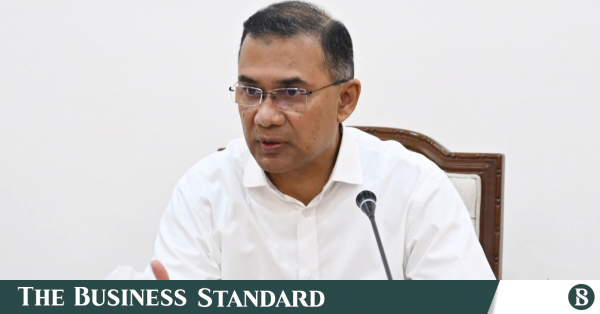
File photo of Prime Minister Tarique Rahman. Photo: PMO
“>

File photo of Prime Minister Tarique Rahman. Photo: PMO
Prime Minister Tarique Rahman has outlined a series of long-term initiatives aimed at modernising Bangladesh’s transport infrastructure, transforming agriculture into a technology-driven and climate-resilient sector, and strengthening the country’s capacity to cope with the impacts of climate change.
The plans were detailed in written replies to lawmakers’ questions during the budget session of the parliament today (17 June).
Although the prime minister was not present in the House, his responses were tabled in parliament.

Speaker Hafiz Uddin Ahmed presided over the session.
Responding to a question from Cumilla-10 lawmaker Md Mobasher Alam Bhuiyan, the prime minister said the government has prioritised the development of road and rail connectivity in line with its electoral commitments.
He said an expressway network would be developed gradually across the country’s national highways. To reduce pressure on roads, the government also plans to expand multimodal transport systems, strengthen axle-load control and smart monitoring mechanisms, improve road safety, and construct ring roads and radial road networks to ease traffic congestion in Dhaka.
The prime minister said initiatives have been taken to connect the under-construction Dhaka-Ashulia Elevated Expressway with the Dhaka Elevated Expressway. Feasibility studies are also underway to establish a link with the Dhaka-Mawa Expressway.
He added that several major infrastructure projects are either under implementation or in preparation, including new bridges over the Meghna and Jamuna rivers, a second Padma Bridge at the Paturia-Daulatdia point, and the proposed Dhaka-Chattogram Elevated Expressway.
On the railway sector, the prime minister said the government has decided to introduce electric traction on the country’s major rail routes to reduce travel time and ensure a safer and more environmentally friendly transport system.
Under the Railway Master Plan, Bangladesh Railway will be developed as the backbone of the national transport network, with rail services gradually expanded to all districts and major cities, he said.
According to the prime minister, 24 projects have been identified under short-, medium- and long-term plans extending to 2045. Efforts are also underway to convert the entire railway network into a dual-gauge system to facilitate uninterrupted passenger and freight movement.
Responding to another question from Tangail-6 lawmaker Md Robiul Awal, the prime minister said Bangladesh remains one of the world’s most disaster-prone countries due to its geographical location, high population density, extensive river systems and coastal characteristics.
He noted that climate change is intensifying the frequency and severity of disasters such as cyclones, storm surges, floods, flash floods, river erosion, droughts, excessive rainfall, lightning strikes, heatwaves and salinity intrusion, affecting livelihoods, agriculture, infrastructure, the environment and the broader economy.
The prime minister said climate adaptation has been given priority in the government’s election manifesto. Key initiatives include the Padma Barrage Project, the Teesta Master Plan, riverbank protection measures, flood control programmes and efforts to reduce salinity in agricultural land.
He said the first phase of the Padma Barrage Project, approved at a cost of Tk34,347 crore, is expected to improve water security, irrigation facilities, drainage systems and environmental balance. The project is also projected to generate 113 megawatts of hydropower and contribute an additional 0.45 percentage points to GDP growth.
The prime minister further said that excavation and re-excavation programmes for rivers, canals and water bodies across the country are continuing to increase surface water use, improve agricultural productivity and ensure environmental sustainability.
As part of climate adaptation efforts, the government has undertaken a programme to plant 250 million trees over the next five years. Tree plantation campaigns and tree fairs at divisional, district and upazila levels will also continue, he added.
About The Author