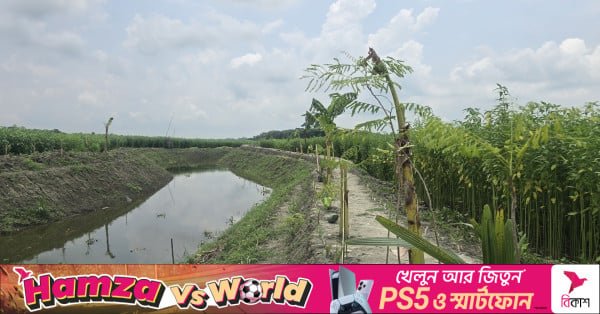
Three canal restoration projects in Faridpur’s Saltha upazila are beginning to revive agriculture and fisheries in one of the country’s key onion- and jute-producing regions, raising hopes of easing long-standing problems of irrigation shortages, waterlogging and water scarcity.
Under the government’s canal restoration programme, around 6.5 kilometres of waterways are being re-excavated across the upazila. Work on the canal from the Senhati Al-Makka Mosque to the Senhati river confluence in Atghar Union is nearly complete.
Meanwhile, restoration of the canal from Teli Saltha Switch Gate to Notkhola Bridge and another from Radhukhali Bridge in Ramkantapur union to the residence of Saeed Matubbar in Teli Saltha has reached 70 to 80% completion, according to the upazila administration.

The projects are expected to improve monsoon drainage, ensure irrigation during the dry season and boost agricultural and fisheries production in an area where reliable water is central to both cultivation and livelihoods.
Alongside the restoration work, green belts are being developed along canal banks, with palm trees and other saplings being planted. Encouraged by the progress, the administration has already sought approval from the relevant ministry to re-excavate 18 more canals across the upazila.
For residents, however, the significance of the projects goes beyond infrastructure. Saltha’s agriculture depends heavily on water, but many canals gradually became nearly defunct due to encroachment and neglect, leaving farmers struggling with irrigation and jute retting while fishers watched once-productive waterways dry up.
“Thousands of farmers in this region suffered from water shortages for crop production and jute retting,” said Siddiq Mia, a member of Atghar Union Parishad. “The canal restoration has created hope among farmers, fishers and residents alike.”
That optimism is shared by farmers such as Ashraf Sheikh of Senhati, who believes the restored canals will significantly reduce irrigation costs, ensure water availability for onion cultivation and ease long-standing difficulties in jute retting.
The benefits are expected to extend beyond farming. “Many years ago, I used to catch fish in this canal,” said fisher Gopi Halder. “As the canal died, the water flow disappeared, and so did the fish. Now the water will return, and hopefully the fish will too.”
Another resident, Nayan Tara Khatun, recalled that the canal was once the lifeline of the area before years of neglect rendered it unusable. “Now we hope our struggles for water will finally end,” she said.
Saltha Upazila Nirbahi Officer (UNO) Md Dabir Uddin said contractors had been instructed to maintain quality standards and complete the projects on schedule.
“These canals are extremely important for the people and agriculture of Saltha,” he said. “This is a major onion and jute-producing area, and both crops require substantial water. Farmers also faced difficulties with jute retting. We expect many of those challenges to be reduced after the restoration.”
He added that canal-bank afforestation would continue alongside the restoration work and that the administration had applied for the restoration of 18 additional canals. If approved, he said, the projects could bring a significant transformation to agriculture and daily life across the upazila.
About The Author