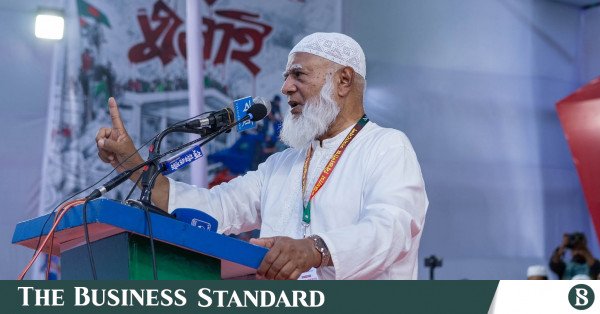
Jamaat-e-Islami Ameer and opposition leader Shafiqur Rahman today (13 June) warned that the BNP-led government would face consequences if it failed to implement what he described as the “people’s verdict” expressed through the referendum.
“Time is very limited and it’s running out. If there is no change within this period, they must be prepared to face the consequences,” Shafiqur said while addressing a divisional rally organised by the 11-party alliance at Chattogram’s Laldighi Maidan.
Calling on the government to accept the outcome of the referendum and respond to public demands, he said issues such as rising commodity prices and public hardship required urgent attention.

“If the government does not voluntarily accept the referendum verdict and public demands, it will eventually be compelled to do so, just as it was forced to pass the caretaker government bill in 1996,” he said. “Accept it peacefully. Do not push people onto the streets.”
Rejecting what he described as threats of imprisonment and execution against opposition activists, Shafiqur said Jamaat members were prepared to endure imprisonment and sacrifice their lives for the country.
“Remember, neither prison bars nor those holding the keys are permanent. Times change,” he said.
Referring to recent remarks by Prime Minister Tarique Rahman during visits to different districts, the Jamaat chief alleged an increasing concentration of power within the government.
He claimed the country had effectively been left with “a minister who is an expert on all subjects and runs every ministry”, adding that even key government functions were increasingly dependent on a small circle of decision-makers.
Shafiqur also accused the prime minister of providing misleading information during a recent visit to Cox’s Bazar by claiming opposition parties had objected to proposed tax increases on narcotics and intoxicants in the budget.
“The office of the prime minister is a state institution. It is embarrassing and harmful for the nation when inaccurate and false information repeatedly comes from that position,” he said.
He further alleged that opposition lawmakers were not being given adequate opportunities to speak in parliament.
“We have moved to the people’s parliament, the streets, to raise public concerns,” he said.
Shafiqur also alleged that extortion had increased despite expectations that an elected government would curb such practices.
“Corruption has now been nationalised,” he claimed.
Addressing the rally, Opposition Chief Whip and National Citizen Party (NCP) Convener Nahid Islam criticised the proposed national budget, alleging that it lacked measures to curb corruption, financial irregularities and bank-related misconduct.
“The prime minister may be upset by our criticism of the budget, but why should we praise it?” Nahid said. “There is no mechanism in this budget to stop corruption, looting and the takeover of banks.”
“How much of the budget will actually be spent on public welfare and how much will end up in the pockets of ruling party leaders and activists remains unclear,” he added.
Describing the budget as detached from economic realities, Nahid claimed its implementation would require substantial foreign borrowing.
“Without ensuring good governance, transparency and reforms, corruption and looting cannot be stopped,” he said.
Nahid also alleged that efforts were underway to return Islami Bank to the control of the S Alam Group.
“The people of Bangladesh know who rode in S Alam’s vehicles to receive receptions and who continues to protect them. The public will not accept this occupation,” he said.
Referring to the alleged assault of national cricketer Nayeem Hasan by members of the Detective Branch (DB) of police, Nahid said reforms in the police, Anti-Corruption Commission and judiciary remained necessary.
“Even yesterday (12 June), a cricketer in Chattogram was picked up and tortured by DB police. Since police reforms have not taken place, oppression against ordinary people has resumed,” he alleged.
“If the government chooses the path of authoritarianism again, the people, too, will be forced to pursue the path of mass uprising.”
Nahid also condemned the reported killing of a Bangladeshi national along the Moulvibazar border shortly after the arrival of India’s new high commissioner.
“We want to state clearly that friendship cannot be built with barbed wire and bullets,” he said.
Presiding over the rally, Liberal Democratic Party Chairman Col (retd) Oli Ahmad said law and order remained a major public concern.
“Mothers, sisters and daughters do not feel safe leaving their homes or attending schools and colleges. The government must act firmly to protect people from criminals,” he said.
Among others, the rally was addressed by Chattogram-15 MP Shahjahan Chowdhury, Jamaat-e-Islami Assistant Secretary General Muhammad Shahjahan, NCP Chief Coordinator Nasiruddin Patwary, National Democratic Party spokesperson Rashed Prodhan, Amar Bangladesh Party General Secretary Asaduzzaman Fuad, Bangladesh Development Party Chairman AKM Anwarul Islam, and 11-party alliance coordinator and Jamaat Assistant Secretary General Hamidur Rahman Azad.
About The Author