The country’s peak electricity demand during summer and irrigation periods reaches around 18,000 megawatts, he said.
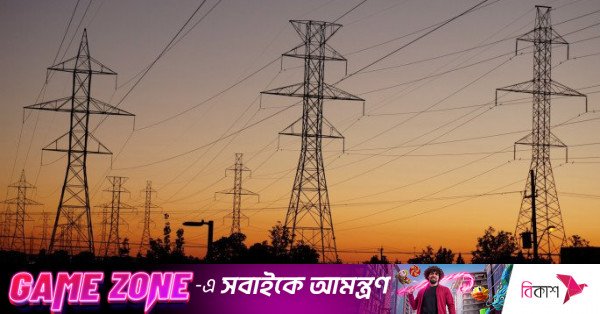
File photo of power lines and transmission towers. Representational image: Collected
“>

File photo of power lines and transmission towers. Representational image: Collected
Power, Energy and Mineral Resources Minister Iqbal Hassan Mahmood today (7 June) told parliament that Bangladesh is currently meeting its electricity demand without any overall shortage, although temporary disruptions may occur during peak summer and irrigation seasons.
Responding to a question from Cumilla-9 lawmaker Abul Kalam, the minister said the country’s peak electricity demand during summer and irrigation periods reaches around 18,000 megawatts.
While current generation capacity is sufficient, he acknowledged that occasional interruptions occur during peak hours due to limitations in primary fuel supply, transmission and distribution infrastructure, maintenance activities, and adverse weather conditions.

“In such cases, supply quality cannot always be maintained according to demand,” he said.
During the question-and-answer session, Jashore-4 lawmaker Mohammad Golam Rasul raised concerns over reported load-shedding in rural areas lasting five to seven hours, as well as power shortages in the Nowapara industrial zone.
In response, the minister said Bangladesh is not currently facing any electricity deficit and argued that disruptions caused by storms, falling trees or transmission faults should not be classified as load-shedding.
“Load-shedding means a shortage of electricity. There is no electricity shortage in Bangladesh at present,” he said.
Responding to a query from reserved seat MP Nilofar Chowdhury Moni, the minister said the country’s grid-based power generation capacity stands at 28,919 megawatts.
He added that the government is prioritising both fossil fuels and renewable energy to meet rising demand, with 32 power plants under construction having a combined capacity of 7,928 megawatts, and 15 renewable energy projects with a combined capacity of 665 megawatts currently under tender, expected to be operational by 2030.
He further stated that 100% of the population has already been brought under electricity coverage, and the government is working to ensure uninterrupted and quality electricity supply for all by 2030.
Responding to another question from Jamaat MP Golam Rasul, the minister said rising temperatures have significantly increased electricity demand, but the government has taken advance planning measures to manage the situation.
He said production planning has been aligned with projected demand for 2026, alongside coordinated efforts to ensure adequate fuel supply, including gas, coal and liquid fuels.
He added that maintenance schedules for gas-, coal- and liquid fuel-based power plants have been completed in a planned manner to keep them ready for maximum output, and that no load-shedding is required due to production shortages.
Replying to BNP MP Khairul Kabir Khokon, the minister said private investors are allowed to set up renewable energy power plants and either use existing distribution infrastructure or sell electricity directly to large or bulk consumers.
He said the country currently has 26 renewable energy plants with a combined capacity of 1,172 megawatts, while another 15 projects totalling 665 megawatts are under tender and expected to join the national grid by 2029.
Responding to a question from Dhaka-1 MP Khondaker Abu Ashfak, he said current electricity demand ranges between 16,500 and 17,500 megawatts, while production stands between 15,500 and 17,200 megawatts depending on conditions.
Addressing concerns about a potential prolonged heatwave across South Asia raised by Sherpur-1 MP Rashedul Islam Rashed, the minister said the government is prepared to handle any such situation, though limited load-shedding may be necessary in certain areas if required.
Replying to Khulna-2 MP Jahangir Hossain Helal, the minister said electricity generated from the Rampal power plant is fed into the national grid.
He added that two gas-based power plants in Rupsha remain shut due to gas shortages, but efforts are underway to supply gas from Bhola to resume operations.
“Once these plants are operational, we expect no electricity shortage in Khulna,” he said.
On electrification in remote areas, including char regions, Bogura-1 MP Kazi Rafiqul Islam was informed that while grid expansion in such areas is costly, gradual electrification is being planned.
For remote hilly areas and Khasi punjis, Moulvibazar-4 MP Mujibur Rahman Chowdhury was told that the government is focusing on solar energy and battery-based power systems.
Finally, responding to concerns raised by Patuakhali-2 MP Shafiqul Islam, the minister said preventing transformer theft in the rural electrification network is difficult, calling on local communities to remain vigilant, while assuring that delays in transformer supply would be investigated.
About The Author