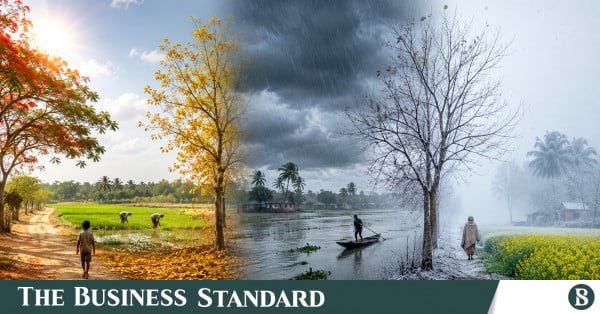
Bangladesh has long been celebrated as the land of six seasons. For generations, summer, monsoon, autumn, late autumn, winter and spring shaped the rhythm of life, influencing agriculture, culture, food habits and festivals.
Each season arrived with its own colours and traditions.
Today, however, that seasonal diversity appears to be fading. While the six-season calendar remains an important part of the country’s heritage, many people feel that only three seasons now dominate everyday life – summer, monsoon and winter.

Summer has become longer and hotter, monsoon more unpredictable and often extreme, while winter, though shorter than before, remains the third clearly recognisable season.
The distinct characteristics of autumn, late autumn and spring are becoming increasingly difficult to identify.
Across the country, unusual weather patterns are becoming more common. Rainfall often arrives outside its expected period, prolonged heat persists beyond traditional seasonal boundaries, and sudden storms frequently disrupt daily life.
What was once a familiar cycle of six distinct seasons is gradually turning into a pattern marked by uncertainty.
Climate experts point to global climate change as a major reason behind this transformation. Rising temperatures and changing atmospheric conditions are altering long-established weather systems, making seasonal transitions less clear than they were in previous decades.
As a result, Bangladesh’s famed seasonal variety is slowly losing its distinct character.
The consequences are particularly visible in agriculture, the backbone of the country’s rural economy. Farmers have traditionally relied on seasonal patterns to determine planting and harvesting schedules.
When rainfall arrives unexpectedly or temperatures fluctuate beyond normal levels, crops become vulnerable to significant damage.
This challenge is especially evident during the Boro rice season. Farmers spend months preparing their fields and nurturing their crops, only to face the risk of untimely rain, thunderstorms or hailstorms shortly before harvest.
Such weather events can wipe out months of labour and investment, threatening both livelihoods and food security.
In the country’s haor regions, concerns are even greater. Residents remain haunted by memories of devastating flash floods that have submerged vast areas of cropland in recent years.
Whenever early rainfall intensifies, fears of another disaster quickly return. Rising water levels in rivers and wetlands often signal danger for communities whose livelihoods depend on seasonal agricultural cycles.
Fruit growers are also feeling the impact. Mango orchards, particularly in northern districts, have repeatedly suffered losses from hailstorms and irregular weather conditions. Promising harvests can be damaged within hours, leaving farmers uncertain about their income and future production.
Scientists warn that such disruptions may become more frequent as global temperatures continue to rise. Even small increases in average temperature can intensify extreme weather events, including floods, droughts, storms and heatwaves.
These changes affect not only agriculture but also water resources, public health, infrastructure and the overall economy.
Ironically, Bangladesh contributes only a small share of global greenhouse gas emissions, yet it remains among the countries most vulnerable to climate-related impacts. Its low-lying geography, dense population and dependence on climate-sensitive sectors such as agriculture and fisheries make it particularly exposed to environmental changes.
Environmentalists argue that adaptation must become a national priority. Improved weather forecasting, climate-resilient crops, stronger flood protection systems and sustainable environmental management are increasingly essential.
At the same time, they stress that meaningful progress requires global cooperation, since the causes of climate change extend far beyond national borders.
The story of Bangladesh’s changing climate is therefore also the story of its changing seasons. While the country still officially celebrates six seasons, daily experience increasingly revolves around three dominant ones – summer, monsoon and winter.
These seasons now define much of the nation’s climate, while autumn, late autumn and spring struggle to maintain their traditional identities.
For a country whose literature, songs and cultural heritage have long been inspired by six unique seasons, the gradual loss of that seasonal richness is more than an environmental concern.
It is a reminder that climate change is not only altering weather patterns but also reshaping a cherished part of Bangladesh’s identity. Whether future generations will experience the six seasons in the way their ancestors once did remains an increasingly urgent question.
About The Author