Sohel had voluntarily agreed to have his confession recorded by Dhaka Metropolitan Magistrate Aminul Islam under Section 164 of the Code of Criminal Procedure (CrPC) on 20 May
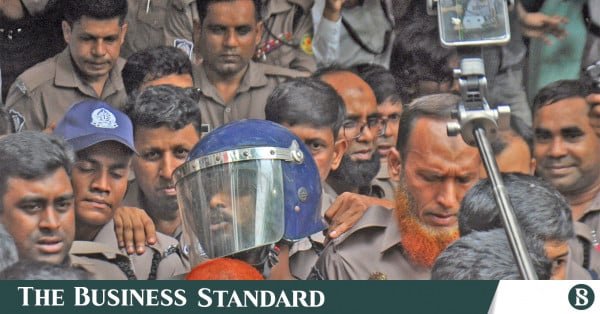
Sohel Rana, the main accused in a case filed over the rape and murder of child Ramisa Akter, is pictured among police officers on the premises of a tribunal in Dhaka on 1 June 2026. Photo: Focus Bangla
“>

Sohel Rana, the main accused in a case filed over the rape and murder of child Ramisa Akter, is pictured among police officers on the premises of a tribunal in Dhaka on 1 June 2026. Photo: Focus Bangla
The original confessional statement of Sohel Rana, the main accused in the eight-year-old Ramisa Akter rape and murder case, was read out in court yesterday (4 June) during the closing argument before the judge fixed the date for the verdict.
Following his arrest, Sohel had voluntarily agreed to have his confession recorded by Dhaka Metropolitan Magistrate Aminul Islam under Section 164 of the Code of Criminal Procedure (CrPC) on 20 May, a day after raping and killing the child.
Special Public Prosecutor Azizul Rahman Dulu presented the statement during the closing arguments at the Dhaka Metropolitan Child Violence Prevention Tribunal last afternoon.


According to case documents, the brutal crime took place inside a flat on the third floor of a five-storey building adjacent to Millat Camp in Pallabi Section 11 of the capital on 19 May. Ramisa’s family resided in the neighbouring flat.
Following an intense seven-hour manhunt launched after the crime came to light, police apprehended the 30-year-old prime accused from Fatullah in Narayanganj.
His wife, Swapna Akter, 26, who helped him escape when Ramisa’s family and neighbours forced their way into the couple’s flat, was detained by law enforcement from the crime scene earlier that morning.
Over the past few days, Sohel has made various claims, including his innocence, in and outside the courtroom. His wife also claimed she was innocent.
Sohel at one point even pointed finger at a local man named Dollar, claiming Dollar raped and killed the child and promised to give him Tk2 lakh, which police said was an attempt to mislead the investigation, obstruct the trial, and fuel rumours.
The confession
According to the confessional statement, the accused admitted to the crime, detailing how he targeted the minor girl, carried out the assault, and subsequently dismembered her body in an attempt to hide the evidence.
Translation of the statement recorded in Bangla is as follows:

“My name is Sohel Rana. I live as a tenant in a third-floor flat of that building. There are three flats on that floor, occupied by three families. In the morning, everyone usually leaves the house for work.
“I have a drug addiction. When our neighbour’s eight-year-old daughter, Ramisa, came outside their flat, I called her over. As soon as she walked in, I forced her into the bathroom and attempted to rape her. When she started screaming, I tightly pressed my hand over her mouth. I then bound her mouth with a scarf and raped her.
“When she lost consciousness, I thought she was dead and got a knife. I wanted to dump the dead body. I then severed her head from her body. Following that, I attempted to cut off her hands.
“At that moment, the child’s mother, who was searching for her, noticed her daughter’s shoes left outside my door and started knocking and calling out. I panicked. I then used a sewing wrench to break the grill on the window and fled.”

During the trial over the past two weeks, the prosecution tried to prove the crimes of Sohel and his wife while the defence argued that the charge sheet was largely based on confessional statements and questioned aspects of the investigation, including no forensic examination of the knife allegedly used in the killing.
The prosecution during the closing today sought the death penalty for both accused.
Meanwhile, the defence further argued that Sohel had been under the influence of drugs at the time of the incident and requested a sentence of life imprisonment instead of death. Regarding Swapna, they contended that witness testimony did not directly link her to the murder and sought punishment, if any, under provisions related to concealing evidence rather than for the killing itself.
Following the conclusion of the arguments, the tribunal fixed 7 June to deliver the verdict.
About The Author