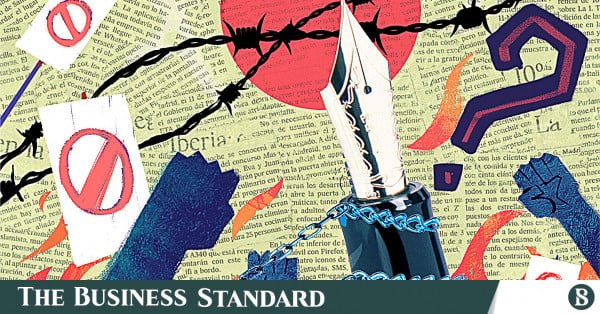
The Committee to Protect Journalists (CPJ) has urged the government of Prime Minister Tarique Rahman to take concrete steps to improve press freedom in Bangladesh, saying journalists continue to face detention, prosecution, surveillance, attacks and intimidation despite successive political transitions.
In a statement issued yesterday (2 June) as the BNP-led government completed 100 days in office, CPJ said Bangladesh has had three governments in less than two years: the Awami League administration led by Sheikh Hasina, the interim government headed by Muhammad Yunus, and the current BNP government, which assumed office in February 2026.
According to CPJ, journalists have faced repression under each administration, often because of their perceived links to the government that had most recently lost power. The organisation also referred to a recent report by The Daily Star, which alleged that police are conducting background checks and profiling journalists across the country.

CPJ Asia-Pacific Programme Coordinator Kunal Majumder said every political transition in Bangladesh has seen authorities use laws and institutions against journalists believed to support former governments.
He said the current administration had promised a different approach, but meaningful progress remained limited after its first 100 days in office.
Majumder said the government should begin by releasing imprisoned journalists, withdrawing politically motivated cases, ending political retaliation against the press, protecting journalists from mob violence, stopping smear campaigns and reforming laws that enable repression.
CPJ outlined 10 recommendations which it said would help restore press freedom and ensure equal treatment of journalists regardless of their perceived political affiliation.
The organisation’s first recommendation was to end the use of the criminal justice system against journalists.
According to CPJ, dozens of journalists whose reporting was viewed as favourable to the Hasina government have been detained or charged since August 2024. It said authorities often use First Information Reports (FIRs) naming hundreds of people or unidentified individuals and later implicate journalists in those cases. CPJ also criticised the practice of filing multiple cases against individual journalists, making it difficult for them to secure bail.
The organisation highlighted the cases of Ekattor TV journalists Farzana Rupa, Shakil Ahmed and Mozammel Babu, as well as Bhorer Kagoj editor Shyamal Dutta, who have remained detained since August or September 2024.
CPJ noted that the High Court granted bail to Rupa and Ahmed in most cases on 11 May, but both remain in detention because of other pending cases.
The organisation also referred to a meeting on 28 May, when an Editors’ Council delegation submitted a list of 282 journalists facing what it described as politically motivated cases. According to CPJ, Information Minister Zahir Uddin Swapon later said the prime minister had expressed solidarity with the council and directed authorities to take necessary measures regarding the lawsuits against journalists.
CPJ said such an acknowledgement should be followed by action. It called for a review of all cases against journalists, an end to opposition to bail in cases linked to journalistic work, and a halt to the practice of filing multiple and mass cases against media workers.
The organisation also expressed concern about the use of the International Crimes Tribunal (ICT) against journalists.
According to CPJ, at least 25 journalists are under ICT investigation, in some cases on allegations of genocide or crimes against humanity linked to their coverage during the Hasina era.
CPJ cited the cases of Rupa and Babu, who were ordered to appear before the tribunal on 14 May over allegations that their reporting on the 2013 Hefazat-e-Islam rally at Shapla Chattar contributed to crimes against humanity.
The organisation argued that international legal precedents concerning media liability involved direct and sustained incitement to mass violence rather than editorial decisions about controversial events.
CPJ called on the government to ensure the tribunal is not used to punish journalism. It also urged an independent review of all ICT cases involving journalists and the introduction of safeguards to prevent atrocity-related charges from being applied to journalistic work.
The organisation further called for accountability for crimes committed against journalists under all administrations.
According to CPJ, journalists have been killed, attacked, surveilled and arbitrarily detained under both the Hasina government and the interim administration. It said accountability should not depend on political circumstances and urged impartial investigations into all such incidents.
CPJ also raised concerns about violence targeting journalists and media organisations.
It referred to attacks during unrest in December 2025, when the offices of Prothom Alo and The Daily Star were attacked and set on fire. According to the organisation, journalists were temporarily trapped inside the buildings, and both newspapers were forced to suspend print and online publication.
CPJ also mentioned incidents involving Somoy TV and attacks on reporters covering protests. It said it documented at least 10 incidents of violence and harassment against journalists covering political events in 2025. Most of those incidents, it said, involved members or affiliates of the BNP and its student wing, Chhatra Dal.
The organisation urged the government to condemn such violence, investigate attacks promptly and hold perpetrators accountable regardless of political affiliation.
CPJ also called for legal reforms.
It criticised the Cyber Protection Act, 2026, saying it retains vague definitions and weak oversight mechanisms that existed in previous cyber laws. The organisation urged the government to replace or substantially amend the law and dismiss politically motivated cybercrime cases against journalists.
The statement also called for reforms to the Anti-Terrorism Act, 2009, the Special Powers Act, 1974, and the Official Secrets Act, 1923.
CPJ cited the arrest of journalist Anis Alamgir under the Anti-Terrorism Act in December 2025 over television commentary and social media posts. It also referred to the arrest of journalist Rozina Islam under the Official Secrets Act in 2021.
The organisation further urged the government not to adopt the draft National Broadcast Commission Ordinance and National Media Commission Ordinance in their current forms. Instead, it called for the implementation of recommendations made by the Media Reform Commission established under the interim government.
CPJ also recommended repealing or amending laws and surveillance provisions that it said have been used to silence journalists. It called for reforms to the accreditation system after the Press Information Department revoked the accreditation of 168 journalists following Hasina’s departure from office in 2024.
The organisation additionally urged the government to introduce safeguards against Strategic Lawsuits Against Public Participation, commonly known as SLAPPs, and to ensure any future data protection framework includes strong protections for journalism.
In its final recommendation, CPJ called for an end to the smearing and vilification of journalists.
The organisation said journalists in Bangladesh are frequently labelled as “pro-India”, “anti-Islam”, “traitors” or agents of former governments by political actors, state-aligned media and online groups.
According to CPJ, such rhetoric undermines journalists’ credibility, threatens their safety and discourages independent reporting.
The organisation urged the government to ensure no state institution is used to smear journalists or question their loyalty to the country or to Islam.
CPJ also called on the government to repeatedly and publicly affirm that independent journalism is protected under Bangladesh’s Constitution and international human rights commitments, and to ensure accountability for those who incite violence against journalists through vilification.
About The Author