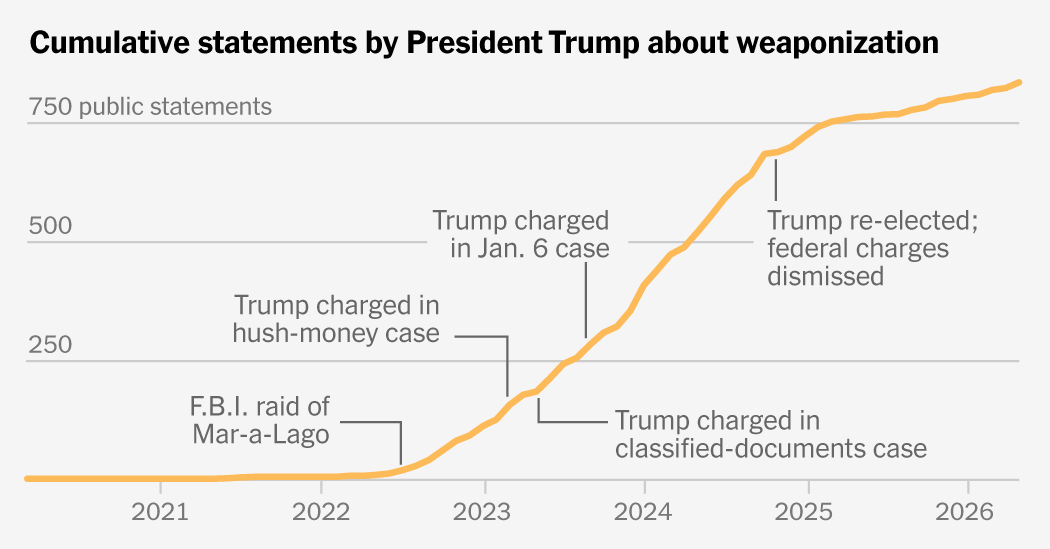
President Trump’s claims that he and his allies have been victims of “weaponization” by the government under Democratic presidents have risen steadily since 2022, according to a New York Times analysis. He has used words like “weaponized” and “weaponization” more than 800 times in public statements and posts on Truth Social.
Cumulative statements by President Trump about weaponization
These statements became more frequent as federal investigations involving Mr. Trump increased in 2022, when he was not in office. His claims in the statements are broadly similar. He says without evidence that he and his allies have been “treated so unfairly” by a “weaponized justice system” staffed by “Joe Biden’s hand-picked crooks,” which he says has targeted him for political reasons.
Many of the people Mr. Trump has said are victims of weaponization faced enough evidence against them that they were convicted at trial or pleaded guilty. His defenses of them, by contrast, have often relied on conspiracy theories, and some Republican officials have balked at his efforts to excuse or reward them.
In exchange for ending a case Mr. Trump had filed against the Internal Revenue Service over the leak of his tax information, the Justice Department announced a $1.776 billion fund in May for people who claimed to have been victimized by the federal government. Mr. Trump called it the “anti-weaponization fund.”
While administration officials insisted that anyone could apply for a payment from the fund and that it was not partisan, Mr. Trump has generally only used the term to refer to his allies.
Last Friday, a federal judge barred the government from taking steps to begin the fund, and on Monday, Mr. Trump appeared to be backing off his plan. Todd Blanche, the acting attorney general, said during a congressional hearing on Tuesday that the fund would not move forward.
Mr. Trump’s campaign to portray prosecutions of his allies as weaponization has come even as he has sought to use the Justice Department to punish his own perceived enemies. His attempts to bend the traditionally insulated federal law enforcement system to his will have led to the resignations of prosecutors, a loss of faith by grand juries and rebukes from judges.
Abigail Jackson, a White House spokeswoman, said in a statement that “there is no one more qualified to speak about government weaponization than President Trump – who has been a victim of repeated weaponization perpetrated against him by his political opponents.” She added that Mr. Trump “has taken many steps to right the wrongs of past weaponization, hold the perpetrators accountable, and to ensure that no one again is ever a victim of the severe weaponization he has experienced.”
Here’s a look at some of the people Mr. Trump has said are victims of weaponization.
Changpeng Zhao, the billionaire founder of the cryptocurrency exchange Binance, pleaded guilty to money-laundering violations in 2023 and served four months in federal prison.
“This man was treated really badly by the Biden administration. And he was given a jail term. He’s highly respected. He’s a very successful guy.”
– President Trump on Changpeng Zhao
Scott Jenkins, a former sheriff, was sentenced to 10 years of prison on federal bribery charges for accepting campaign contributions in exchange for making people auxiliary deputy sheriffs in his department.
Trevor Milton, a major Republican donor, was convicted of defrauding investors by lying about the supposed technical achievements of Nikola, the electric truck company he founded.
“They say the thing that he did wrong was he was one of the first people that supported a gentleman named Donald Trump for president.”
– President Trump on Trevor Milton
Ross Ulbricht, the founder of the dark-web market Silk Road, was sentenced to life in prison for his role in what prosecutors described as “the kingpin of a worldwide digital drug-trafficking enterprise.”
Juan Orlando Hernández, the former president of Honduras, was sentenced to 45 years in prison for conspiring to import cocaine into the United States and of possessing and conspiring to possess “destructive devices,” including machine guns.
Crimes related to the attack on the Capitol on Jan. 6, 2021
Nearly 1,600 people were convicted of or facing prosecution for a wide range of crimes related to the events of Jan. 6. The most serious of these included violent offenders who went after the police with baseball bats, wooden planks and bear spray. Lesser charges included disorderly conduct and trespassing.
“There’s never been a group of people in this country, outside of maybe one instance that I can think of, but I won’t get into it, that were treated more horribly than the people of J6.”
– President Trump on Jan. 6 defendants
Peter Navarro, a senior White House trade adviser, was found guilty of contempt of Congress for defying a subpoena from the House select committee investigating Jan. 6.
Crimes related to elections or political activism
Dinesh D’Souza, a right-wing filmmaker, pleaded guilty to making campaign contributions in the names of other people, a violation of federal campaign finance laws.
Michael T. Flynn twice pleaded guilty to lying to the F.B.I. about his conversations with a Russian diplomat.
“These Radical Left Lunatics unleashed a relentless storm of lies, FAKE charges, and dirty FBI ‘tricks’ during the Russia, Russia, Russia Hoax to try and crush Mike’s Spirit — But this Great American Hero was INNOCENT.”
– President Trump on Michael T. Flynn
Tina Peters, the former clerk of Mesa County, Colo., was sentenced to nine years in prison after being found guilty of tampering with voting machines under her control in a failed attempt to prove that they had been used to rig the 2020 election.
Anti-abortion activists were convicted for their roles in blockading an abortion clinic.
Jeff Fortenberry, a former representative from Nebraska, was convicted in 2022 of lying to authorities investigating illegal campaign contributions. In 2023, an appeals court panel reversed the decision, saying he had been tried in the wrong venue. In 2024, he was charged again, and the case was dropped last year.
“Jeff and his family were forced to suffer greatly due to the illegal Weaponization of our Justice System by the Radical Left Democrats.”
– President Trump on Jeff Fortenberry
Stephen K. Bannon was convicted for contempt of Congress for refusing to testify to the House committee that investigated Jan. 6. He also pleaded guilty to a single felony county of defrauding donors who had sought to help build a wall at the southern border. In 2021, Mr. Trump pardoned Mr. Bannon in a similar federal case.
“They wanted to silence him, but they’ll never silence him, but they wanted to silence him. Oh, this is pure weaponization.”
– President Trump on Stephen K. Bannon
Rod R. Blagojevich, a former governor of Illinois, was sentenced in 2011 to prison on multiple corruption convictions, including trying to sell or trade the Illinois Senate seat that became vacant when Barack Obama went to the White House.
“He was set up by a lot of bad people, some of the same people that I had to deal with.”
– President Trump on Rod R. Blagojevich
Roger J. Stone, a longtime informal adviser to President Trump, was convicted of obstructing a congressional investigation into Mr. Trump’s 2016 campaign and possible ties to Russia.
Walt Nauta, a personal aide to Mr. Trump, was one of Mr. Trump’s co-defendants in the classified-documents case brought by the former special counsel Jack Smith.
Henry Cuellar, a Texas representative, was indicted by a federal grand jury on bribery charges.
“Being an expert on Political Weaponization, based on what the Biden Losers had done to me, and without having ever met Henry Cuellar, and in particular because of the magnificence of the letter drawn by his daughters asking me to help ‘Mom and Dad,’ I gave him and Mrs. Cuellar a full and unconditional Pardon.”
– President Trump on Henry Cuellar
Tulsi Gabbard said she was put on a “domestic terror watch list” by the Biden administration as punishment for critical comments she made about Vice President Kamala Harris, though senior U.S. officials disputed that account. Mr. Trump has referred to this episode as weaponization.
Rudolph W. Giuliani’s efforts were key to Trump allies’ attempt to overturn the 2020 election. In a civil case, he was ordered to pay $148 million to two former Georgia election workers who said he had destroyed their reputations with lies that they tried to steal the 2020 election from Mr. Trump.
Mike Lindell, the chief executive of MyPillow, who spread baseless conspiracy theories about the 2020 presidential election, was ordered to pay $2.3 million in damages for defaming a former employee of Dominion Voting Systems.
Some worked for Mr. Trump during his first or second administration, or both.
“I have just learned that the ‘Thugs’ from the Department of Injustice will be Indicting a wonderful man, Walt Nauta, a member of the U.S. Navy, who served proudly with me in the White House.”
– President Trump on Walt Nauta
Many have questioned the results of the 2020 presidential election.
“Peter experienced the vicious Weaponization of the ‘Justice’ System, but never gave up, never backed down, and never wavered from what he knew to be true — The 2020 Presidential Election was RIGGED and STOLEN!”
– President Trump on Peter Navarro
A number have been pardoned, or their cases were dismissed by the Justice Department.
And in some cases, Mr. Trump has tried to distance himself, claiming he doesn’t really know them even in the context of issuing a pardon or a supportive statement.
“I know nothing about the guy, other than I hear he was a victim of weaponization by government.”
– President Trump on Changpeng Zhao
As is so often the case with Mr. Trump, he views the experiences of others through the prism of his own.
“I was told that he was a victim, just like I was,” Mr. Trump said about Mr. Zhao, who had admitted to money-laundering violations that allowed terrorists and other criminals to move money on Binance. (In seeking his pardon, Mr. Zhao hired lawyers and lobbyists with ties to the Trump administration and struck a deal with World Liberty Financial, the Trump family’s cryptocurrency start-up.)
He commiserated over the fact that Mr. Lindell was being forced to pay damages. “They did that with me, too, but at least I knew what I was getting into,” Mr. Trump said of Mr. Lindell. “He was just a guy that said, ‘Jesus, this election was so crooked. It was so rigged.’”
And why did he pardon Mr. Hernández, the former leader of Honduras? Because, according to the president, “he was treated like the Biden administration treated a man named Trump.”
About The Author