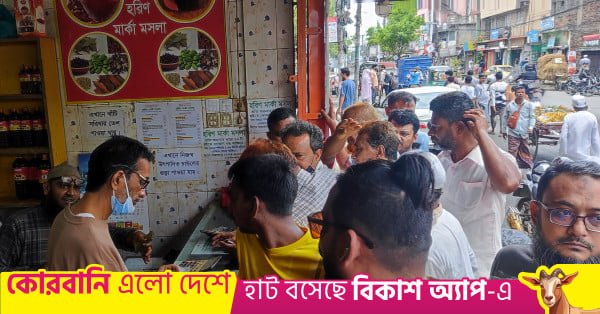
Now over four decades old, the market is crowded with buyers as spice traders struggle to keep up with the seasonal surge.
While trade continues year-round, the pre-Eid rush turns Bibirhat into a dense and lively hub of activity, marked by constant movement and long queues. Photo: TBS
“>

While trade continues year-round, the pre-Eid rush turns Bibirhat into a dense and lively hub of activity, marked by constant movement and long queues. Photo: TBS
As Eid-ul-Adha approaches, Chattogram’s festive rhythm extends beyond cattle markets into kitchens, where traditional cooking takes shape around rich spice blends and expertly prepared meat dishes. At the heart of this culinary chain lies the historic Bibirhat Spice Market, driving the flavours of Eid feasts.
Now over four decades old, the market is crowded with buyers as spice traders struggle to keep up with the seasonal surge. While trade continues year-round, the pre-Eid rush turns Bibirhat into a dense and lively hub of activity, marked by constant movement and long queues.
“The Eid rush is expected as everyone prepares special meals, but supply remains sufficient,” said Nurul Azim, proprietor of Deer-branded spices, noting that stock levels are steady despite rising demand.

For many in Chattogram, Eid-ul-Adha flavours begin with mezbani cooking, where slow preparation and layered spice profiles define richly cooked beef dishes. This culinary identity is closely tied to the historic Bibirhat Spice Market, best known for its 22-ingredient mezbani masala that sits at the heart of the region’s festive cuisine.
Locals say meat prepared with this blend rarely needs additional seasoning, as it delivers a depth and balance refined over generations. That enduring trust continues to draw buyers from across the region in the days leading up to Eid.
Buyers like Rifat Hossain say Bibirhat’s spices are unmatched by any other market. Backed by long-standing trust and consistent quality, they continue to rely on it year-round, with no real alternative during Eid-ul-Adha.
Eid cooking, they note, goes beyond preparing meals for oneself—it is also about ensuring a generous and satisfying spread for guests.
Building on this tradition, traders report a sharp rise in demand for spices while prices remain largely stable, with several items even cheaper than last year.
“Mezbani masala remains the most in-demand item ahead of Eid,” said Moktar Hossain, adding that Hatazari chilli continues to see strong demand, with cumin slightly cheaper while red chilli remains comparatively high.
Market sources note Hatazari sweet chilli at Tk540 per kg, Raypur mixed chilli at Tk460, regular chilli at Tk460, and turmeric from Khagrachhari between Tk330 and Tk360.
Coriander powder is priced at Tk280 per kg, mixed spice at Tk600, fine cumin at Tk960, sweet cumin at Tk360, and Radhuni spice at Tk700 per kg.
The signature Bibirhat mezbani garam masala ranges from Tk1,200 to Tk1,360, while white pepper stands at Tk1,800 per kg and black pepper at Tk1,600. Cardamom powder sells at Tk500 per 100 grams, cinnamon at Tk60, and cloves at Tk160.
About The Author