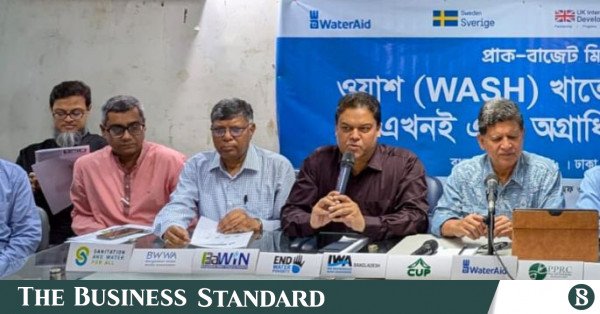
Funding for Bangladesh’s Water, Sanitation and Hygiene (WASH) sector has dropped by 40% over the past three years, raising serious concerns about the country’s progress toward Sustainable Development Goal (SDG) 6, according to civil society organisations.
A coalition of more than 900 organisations raised the alarm in findings released by the Network of WASH Networks today (20 May), warning that the continued decline in allocations could undermine decades of development gains in the sector.
A joint budget analysis by WaterAid and the Power and Participation Research Centre (PPRC) showed that WASH funding under the Annual Development Programme (ADP) fell from Tk18,728 crore in FY2022-23 to Tk10,901 crore in FY2025-26.

Experts said the shrinking allocation reflects a growing mismatch between overall development spending and investment in essential water and sanitation services, despite rising public health needs.
The report highlighted that only 55% of the population has access to safely managed drinking water, compared to 71% in urban areas and 48% in rural areas, based on MICS 2025 estimates.
It also found major disparities in budget distribution, with nearly two-thirds of WASH funds concentrated in urban areas and WASAs. Dhaka WASA alone received around 29% of the total allocation.
Hard-to-reach areas such as char, haor, coastal and hilly regions received only 10.22% of the budget, while faecal sludge management remains severely underfunded, particularly in rural Bangladesh.
International Water Association (IWA) representative Mohammad Zobair Hasan said the current spending pattern is undermining Bangladesh’s National Adaptation Plan (2023–2050) amid growing climate pressures.
The coalition urged the government to increase WASH funding, ensure equitable distribution, prioritise rural and vulnerable areas, and strengthen sanitation infrastructure in schools and communities.
About The Author