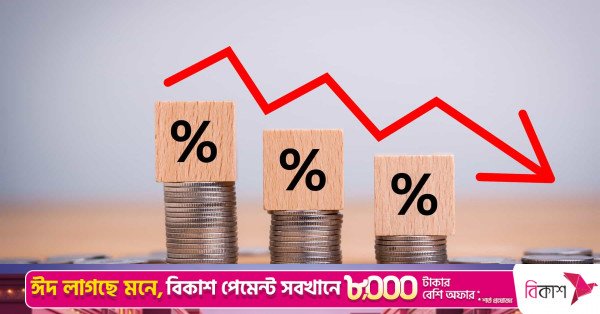
Private sector credit growth had been declining steadily in recent months, falling from 6.58% in November 2025 to 6.20% in December, and then to 6.03% in both January and February 2026, before dropping sharply in March.
Infographics: TBS
“>

Infographics: TBS
The country’s private sector credit growth fell to a historic low of 4.72% in March this year, reflecting weak business confidence, slowing investment and mounting uncertainty in the economy.
Economists and bankers said political uncertainty eased somewhat after the February election, but the deeper problems discouraging investment and new business activity remain unresolved.
In addition, the fuel crisis emerged as another contributing factor in March, leading to a sharp slowdown in bank lending growth compared with previous levels, they said.
Private sector credit growth had been declining steadily in recent months, falling from 6.58% in November 2025 to 6.20% in December, and then to 6.03% in both January and February 2026, before dropping sharply in March, central bank sources confirmed.

Outstanding loans to the private sector stood at Tk23.35 lakh crore in March 2026, according to Bangladesh Bank data.
Speaking to The Business Standard, Mustafizur Rahman, distinguished fellow at Centre for Policy Dialogue, said, “The major trend indicates that it is not increasing. Both necessary and sufficient factors are at work here.”
“The necessary factor is political stability, which has improved somewhat after the election. But the sufficient factors – such as the cost of doing business, inflation, logistics policies and several other issues – have not seen any major changes.”
He said the energy crisis added further pressure in March. “These problems already existed, and energy became an additional challenge. Inflation, the cost of doing business and other factors have created uncertainty,” he added.
The Bangladesh Bank has been publishing private sector credit growth data since 2003. A review of the data shows March recorded the lowest growth in the past 24 years.
A deputy managing director of a private bank told TBS that many businesses shut down after the fall of the Awami League government, while others are operating far below capacity.
He said several factories owned by large business groups, including Nassa Group, Beximco Group and Gazi Group, had closed, reducing demand for bank borrowing. “When factories were operational, they imported capital machinery. But even the firms still running have reduced production by 60-70%,” he said.
Bankers question BB’s policy direction
Several managing directors of private banks told TBS they remain unclear about the central bank’s policy direction in dealing with the current economic challenges.
Bankers said lending decisions depend heavily on broader policy clarity, including interest rates, exchange rates and inflation trends. They explained that when businesses seek loans for new investments or ventures, banks assess the overall policy environment, borrowing costs and the likely movement of the US dollar before approving financing.
One private bank managing director said the governor had spoken about lowering lending rates, but questioned how feasible that would be at a time of high inflation.
He also criticised Bangladesh Bank for holding the dollar exchange rate at Tk122.75 despite pressure on the local currency. Another MD said the central bank’s decision to cap trade finance interest rates at 3% during a crisis period had created concerns.
He noted that the cost of foreign borrowing currently stands at SOFR plus 2.5%, while the additional cap on UPAS financing – a foreign currency-based import financing system – would further limit financing opportunities.
“If financing through UPAS becomes difficult, banks will have to lend in local currency at interest rates of 12-13%. The central bank believes this will increase credit growth, which is why rates on trade finance have been lowered. But this decision is not correct – it is a mistake,” he said.
Another bank MD said businesses and banks remained uncertain about the central bank’s main priority – whether it was controlling inflation, lowering interest rates or boosting GDP growth.
“There were expectations that many new projects would emerge after the election, but that has not happened,” he said.
He added that the government’s heavy borrowing from banks because of a revenue shortfall could further increase interest rates and crowd out private sector borrowers. “There is also uncertainty over where the exchange rate will stand in the next six months,” he said.
Another bank MD said many large corporate firms had sought policy support from the central bank, signalling financial distress. “When companies need policy support, banks become less willing to finance them. It also becomes very difficult for those firms to make new investments or expand business operations,” he said.
Banks shift towards government securities
With demand for private sector loans weakening, banks have increasingly turned to treasury bills and bonds for income.
A senior official at a private bank said lenders were moving towards safer government securities amid weak private investment.
At the same time, the government has been borrowing heavily from banks through treasury bills and bonds, including an additional Tk10,000 crore outside the regular borrowing calendar during the October-December quarter.
Limited opportunities for private investment have allowed banks to earn nearly 11% interest on what are effectively risk-free government securities. For many conventional banks, a growing share of income now comes from this segment.
Despite concerns at the start of 2025 over rising deposit rates, high inflation, political uncertainty and weak loan demand, stronger private banks have posted higher profits largely through earnings from government securities rather than loan expansion.
Bangladesh Bank data showed the government collected Tk33,000 crore through treasury bills in March this year. In April, the amount rose 39% month-on-month to Tk46,000 crore.
Of that amount, Tk32,800 crore was used to repay liabilities from previously issued treasury bills, leaving the government’s net borrowing through treasury bills at Tk13,200 crore in April.
About The Author