To explain the situation, a senior official explained that if the government estimates a project, product or service will cost Tk100, some contractors are now offering to complete it for as little as Tk20 or Tk50 under the revised law and new rules
TBS Illustration
“>

TBS Illustration
Highlights:
- Tender reforms triggered unusually low bids in government procurements
- Contractors now underbid drastically to secure or influence contracts
- Authorities suspect collusion between contractors and dishonest officials
- Genuine bidders offering realistic prices are increasingly excluded from tenders
- Experts warn reforms alone cannot stop entrenched procurement manipulation
- Bangladesh’s public procurement spending now approaches $30 billion annually
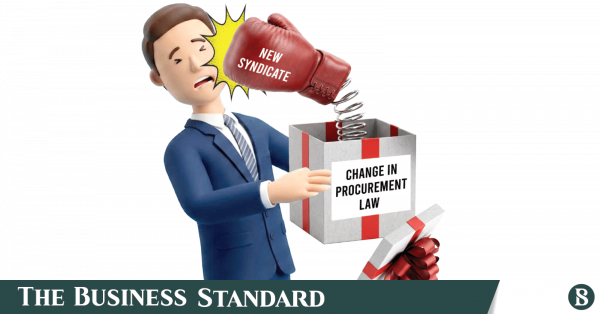
The interim government’s attempt to ensure more competition in public procurement through sweeping amendments to tender rules has instead given rise to a new form of cartel-like practice among contractors — everyone competing to be the ‘lowest bidder’.
The Public Procurement Act (PPA) was amended during the interim era with introduction of the Public Procurement Rules (PPR)-2025 by removing the minimum bidding price threshold aiming to break entrenched contractor cartels and curb manipulation in open tenders for government purchases.

However, since the new framework took effect on 28 September last year, officials say a section of contractors started submitting bids quoting abnormally low prices – in some cases less than half the government’s estimated cost – either to secure contracts for themselves or help preferred firms win the tenders.
Infograph: TBS
“>

Infograph: TBS
To explain the situation, a senior official explained that if the government estimates a project, product or service will cost Tk100, some contractors are now offering to complete it for as little as Tk20 or Tk50 under the revised law and new rules.
“Once awarded contracts as the lowest bidders, they are likely to seek repeated cost revisions after work begins. Meanwhile, genuine bidders offering realistic prices are being pushed out of the process,” he said.
The Bangladesh Public Procurement Authority (BPPA) has described the practice as “collusive conduct” and “professional misconduct” by contractors. Its officials suspect collusion between contractors and dishonest officials within procurement entities.
“Such practices are reducing the chances of genuine bidders securing work, while excessively low-priced contracts are also creating serious risks in project implementation,” BPPA Chief Executive Officer (Secretary) SM Moin Uddin Ahmed said in a circular on 4 May.
Suspicious bidders would be summoned to explain how they offered so low prices, he told The Business Standard on Saturday.
Analysts say the tender reforms were intended to curb collusive bidding and promote fair competition in public procurement, but such measures may fail to achieve the desired results without broader safeguards to prevent manipulation in the bidding process.
Amendments in PPA, PPR
The government first enacted the PPA in 2006 to bring transparency to public procurement, followed by the PPR in 2008 to implement the law.
Under the framework, contractors and suppliers were allowed to submit bids within a range of 10% above or below the official cost estimate prepared by the procuring entity. Any bid beyond that range was automatically rejected.
However, amid widespread allegations of irregularities and corruption in public procurements during the Awami League administration, the interim government issued an ordinance in May last year amending, replacing and scrapping 20 sections of the procurement law.
The government later revised nearly all provisions of the PPR as well to align with the ordinance and introduced the PPR-2025, which came into force in September last year.
Rule 143(2) of the PPR-2025 states that the bidder submitting the lowest evaluated financial proposal will receive a full score of 100, while other bidders will receive proportionately lower scores based on how much higher their offers are. The rules also state that contracts will be awarded to bidders securing the highest combined technical and financial scores.
‘Collusive conduct’
Since the amended PPA and the new PPR came into force, government agencies have floated a total of 1,876 tenders through 11 May this year.
In the circular, BPPA said reviews of multiple cases suggested that some bidders were colluding to manipulate tender evaluations by submitting “artificial and unrealistic” bids quoting much lower prices than officially estimated costs.
“Where cost estimates are prepared rationally based on prevailing market prices, such bids are clearly unrealistic and unacceptable,” the circular said.
Speaking to TBS on Saturday, BPPA’s Moin Uddin said suspicious bidders would be summoned to explain their offers. “If their explanations were deemed unsatisfactory, authorities could cancel the tenders and take legal action under existing rules.”
He added that the rules do not set any fixed percentage below the government’s estimated cost to trigger automatic scrutiny. “It will depend on the nature of the procurement, prevailing market prices and whether the bidder can supply at the proposed rate.”
Moin Uddin added that suspicious tenders could often be identified simply by examining the quoted prices. “In some cases, it is obvious that bidders are submitting abnormally low prices either to win contracts themselves or to help others secure work through collusion.”
Such practices had been classified as “collusive conduct” under the PPR-2025, he added.
Rule 149(C) of the PPR defines “collusive conduct” as any conspiracy or arrangement between two or more parties aimed at restricting genuine competition by reducing the number of bids or keeping prices at non-competitive levels, either with or without the knowledge of the procuring entity or through the involvement of its employees.
‘System has become predictable’
Zahid Hussain, former lead economist at the World Bank’s Dhaka office, said the procurement system has become predictable and easily coordinated by a small group of contractors, resulting in delays, cost revisions and weak competition.
He said the reforms are a sensible step, as they reduce predictability that enables collusion and bring the system closer to standards of transparency and fair competition.
“However, procedural reforms alone are not enough,” he said. “Cost estimates are often politically influenced. Low bids may only appear low against unrealistic benchmarks.”
He added that evaluation committees also often operate under political and local pressure, making it difficult to reject implausible bids. In many areas, the same group of contractors continues to dominate the market.
Unless these structural issues are addressed, he warned, the reforms risk changing the form of coordination without changing the outcome.
Iftekharuzzaman, executive director of Transparency International Bangladesh (TIB), told TBS that no measure, however well intentioned, will deliver the desired results without broader reforms to prevent manipulation of procurement rules.
“Otherwise it will be business as usual of undue concentration and politically connected capture of public contracting, with only a change in who takes turns,” he added.
Govt procurement reaches $30b
As Bangladesh’s economy expands, government spending on procurement and development projects has risen sharply, with a large share of purchases made through open tenders.
In the BPPA’s FY25 annual report, published during the interim government’s tenure, then planning adviser Wahiduddin Mahmud said both the budget and procurement volumes were increasing each year, with annual public purchases now estimated at nearly $30 billion.
The secretary of the Implementation Monitoring and Evaluation Division (IMED) wrote in the same report that around 45% of the national budget and 85% of the Annual Development Programme (ADP) expenditure are spent through the public procurement system.
During the previous Awami League government, rising procurement costs prompted then public administration minister Syed Ashraful Islam to propose a central procurement authority to handle all ministry purchases through a single office.
He wrote to the then finance minister, but the proposal did not materialise.
Public procurement and contractor appointments are widely regarded as among the most corruption-prone areas in Bangladesh. The White Paper Committee formed by the interim government also identified major irregularities and corruption in the sector.
About The Author