EU says FTA and investment protection talks could begin soon.
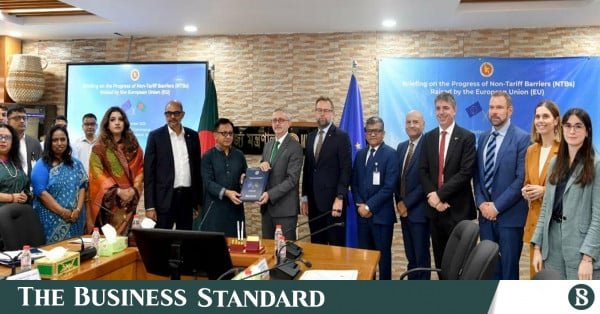
Commerce Minister Khandakar Abdul Muktadir, EU Ambassador and Head of Delegation Michael Miller, and other government and EU officials attend a briefing at the Commerce Ministry in Dhaka on Sunday on progress in resolving non-tariff barriers raised by the European Union. Photo: Collected
“>

Commerce Minister Khandakar Abdul Muktadir, EU Ambassador and Head of Delegation Michael Miller, and other government and EU officials attend a briefing at the Commerce Ministry in Dhaka on Sunday on progress in resolving non-tariff barriers raised by the European Union. Photo: Collected
Bangladesh has resolved 48 of 61 non-tariff barriers identified in bilateral trade with the European Union (EU), while work is underway to address the remaining 13, Commerce Minister Khandakar Abdul Muktadir said today (6 September).
He disclosed the information at a joint press briefing at the Commerce Ministry in Dhaka following a meeting with officials of the EU Delegation to Bangladesh.
EU Ambassador Michael Miller, Adviser to the Finance and Planning Ministry Rashed Al Mahmud Titumir, State Minister for Foreign Affairs Shama Obaid, State Minister for Planning Zonayed Abdur Rahim Saki and senior officials of the commerce and foreign ministries attended the briefing.

The commerce minister said the EU had earlier raised concerns over several non-tariff barriers affecting bilateral trade. Of the 61 issues identified, 48 have been resolved, while efforts are continuing to address the remaining 13.
He said an EU delegation led by the bloc’s ambassador had raised several specific trade-related obstacles in March after the government took office.
Since then, coordinated efforts involving the National Board of Revenue (NBR) and the agriculture, fisheries and livestock, and shipping ministries, among others, had helped resolve most of the issues.
Among the barriers addressed were complications over licence renewals for 100% foreign-owned logistics companies, an increase in the annual limit for importing commercial samples from $10,000 to $20,000, and customs valuation issues involving scanning smart cards used for export traceability.
The minister also said Bangladesh had formally sought EU support for its proposal to defer graduation from the least developed country (LDC) category by three years.
He expressed hope that the EU would support the proposal and that it would eventually be approved.
Muktadir said the issue is expected to come up for a decision at the 81st session of the United Nations General Assembly this month.
He said Bangladesh had therefore sought EU cooperation in support of the proposal.
The minister added that recommendations from the UN Committee for Development Policy (CDP) and the Economic and Social Council (ECOSOC) regarding the deferment proposal had been positive.
Preparations are also advancing for talks with the EU on a free trade agreement (FTA) and an investment protection agreement.
EU Ambassador and Head of Delegation Michael Miller said the European Commission had responded positively to Bangladesh’s formal proposals for both agreements.
He said joint technical discussions could begin as early as this week once the necessary approvals from EU member states are completed.
Miller said a transparent, stable and competitive business environment would be necessary to deepen economic cooperation between Bangladesh and the EU.
He added that both sides would benefit from greater transparency and fair competition in public procurement.
The ambassador also expressed hope that discussions on Airbus procurement would move forward as part of efforts to expand aviation and trade cooperation between Bangladesh and the EU.
Responding to a question on imports from the United States, the commerce minister said Bangladesh makes import decisions based on national interest, economic rationale and public need.
He said government procurement decisions involving energy, including LNG, and foodgrains are approved after considering competitive prices, product quality and wastage rates.
Bangladesh’s trade policy is not driven by the influence of any particular country, he said, adding that the country’s economic interests and public welfare remain the main considerations behind such decisions.
About The Author