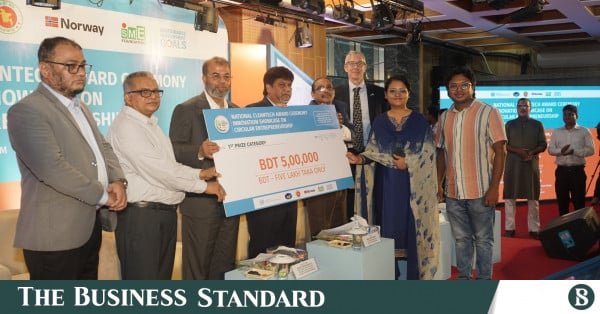
Twenty-five cleantech innovators from across Bangladesh were honoured today (9 July) for developing environmentally sustainable business solutions, as the government and development partners intensified efforts to tackle plastic pollution, promote circular economy practices and accelerate green entrepreneurship.
The innovators received recognition at the National Cleantech Award Ceremony and Innovation Showcase, jointly organised by the United Nations Industrial Development Organisation (Unido), the SME Foundation and the Department of Environment (DoE) at the Bangladesh Institute of Management (BIM) in Dhaka.
The programme is part of the Integrated Approach Towards Sustainable Plastics Use and Marine Litter Prevention in Bangladesh project, implemented by the Department of Environment with technical support from Unido and funding from the Government of Norway.

The initiative aims to reduce plastic pollution by promoting resource efficiency, sustainable recycling, innovation, entrepreneurship, policy support and public engagement.
Speaking at the event, State Minister for Environment, Forest and Climate Change Shaikh Faridul Islam said Bangladesh must embrace green technology and environmentally friendly innovations to ensure a livable future for coming generations.
He said the technologies showcased at the event demonstrated strong innovation but stressed the need to increase production capacity and lower costs so that more industries, particularly the ready-made garment sector, can adopt them.
The state minister also called for stronger research, policy support, commercialisation and financial assistance for innovators, noting that many promising ideas fail to reach the market due to limited access to funding.
He further urged greater use of agricultural and industrial waste, including banana fibre and other natural materials, to produce environmentally friendly products, while emphasising the effective utilisation of climate funds to accelerate green technology development.
Jérôme Stucki, unit chief of Circular Economy and Resource Efficiency at Unido, said, Unido aims to broaden the concept of the circular economy beyond waste management by encouraging sustainable product design from the beginning of the production process.
“We need to move away from today’s largely linear economic model, which consumes resources and generates waste, towards a circular economy that promotes eco-design, longer product life, reuse, repair and recycling, keeping resources in productive use for as long as possible,” he said.
Following mentoring, business refinement and final evaluation, 25 innovators were selected for financial support under the Accelerator Support Fund. The top three innovators received Tk5,00,000 each, the next seven received Tk3,00,000 each, while the remaining 15 innovators were awarded Tk2,00,000 each.
Among the top winners was GoodDo, a Bangladeshi startup producing wooden educational toys made from natural materials. The toys are designed to enhance children’s cognitive development, motor skills and creativity while providing a safe and environmentally friendly alternative to conventional plastic toys.
Hasibul Hasan, founder and CEO of GoodDo, told The Business Standard that developmental toys play an important role in children’s intellectual and psychological growth.
“Our goal is to make environmentally friendly and child-safe educational toys accessible to more families across the country,” he said.
Speaking at the programme, SME Foundation Managing Director Anwar Hossain Chowdhury said plastic pollution continues to worsen because of increasing plastic consumption and inefficient waste management. Citing the World Bank’s 2020 report, he said Bangladesh generates around 977,000 tonnes of plastic waste annually, but only 31% is recycled. In Dhaka alone, around 646 tonnes of plastic waste are generated every day, while only 37% is recycled.
He said the government’s target of halving plastic use by 2030 would be supported by initiatives such as the Cleantech Accelerator Programme, which also contributes to achieving SDG 9 (Industry, Innovation and Infrastructure) and SDG 12 (Responsible Consumption and Production).
The programme was chaired by Industries Secretary Abdur Naser Khan and attended by senior government officials, development partners, financial institutions, investors, entrepreneurs and technical experts, including Department of Environment Director General Dr Md Lutfor Rahman and Bangladesh Institute of Management (BIM) Director General Md Salim Ullah.
About The Author