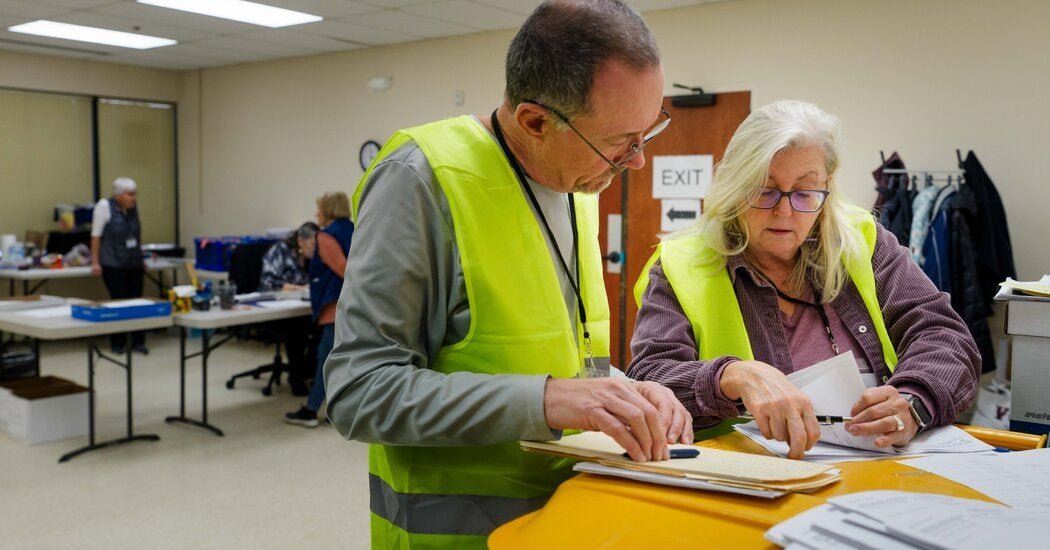
Fewer than 2,000 votes separated the candidates for Senate in Mississippi on Thursday, causing a raft of lawyers, campaign operatives and legal observers to descend on county election offices to watch officials count ballots in the contest between Senator Cindy Hyde-Smith and her challenger, Scott Colom.
If he prevails, Mr. Colom, a Democratic district attorney, would be the state’s first Black senator since Reconstruction. As of Thursday afternoon, he held a lead of 1,813 votes over Ms. Hyde-Smith, a Republican serving her first term.
In an election when Democrats broke through conservative strongholds to gain majorities in the House and Senate, Mississippi and Alaska are the only remaining states where the Senate races do not yet have a clear victor.
That there is suspense at all in Mississippi, which has not sent a Democrat to the Senate in more than four decades, has stunned Democrats and Republicans.
“I’m glad that the country is starting to see what Mississippi values look like and what Mississippi’s potential is,” said Mr. Colom, as he spoke to reporters in Jackson.
On social media, Ms. Hyde-Smith’s campaign said she would remain in the Senate, given that “we believe thousands of votes remain to be counted from dozens of Republican counties, and we are confident those votes will reinforce her path to victory.”
The outcome of the race appears to hinge on what the state has said is an unknown number of affidavit ballots, cast by voters who were either listed as inactive or without proper identification. On Thursday, Michael Watson, the secretary of state, said roughly 3,300 absentee-by-mail ballots were also still outstanding. To count, they must be received within five business days of Nov. 3.
He did not provide a number for the uncounted affidavit ballots, but said that 6,936 affidavit ballots had been processed. The deadline for counties to certify their election results to the state is Nov. 13.
Unlike most states, Mississippi law does not allow for a recount of votes in a statewide election.
In Jackson, the state capital, on Thursday, lawyers, reporters, poll watchers and, at one point Mr. Colom’s wife, milled among the tables in the cramped Hinds County Election Commission headquarters. The commission members had been going through ballots since 7 a.m., working steadily but with little acknowledgment of the intense national scrutiny.
“I hope they put a pep in their step,” said June Hardwick, a lawyer who supported the Colom campaign.
Jermal Clark, one of the commissioners, said they had to ensure that they were being thorough and that they were following the law. “To me, everything is going well,” he said. “It’s just congested.”
Republicans were not taking chances.
On Thursday, Republican lawyers wrote to election commissioners to demand “the immediate separation, secure custody, and preservation of all affidavit ballots.” Mr. Colom’s legal team responded with their own letter, calling it a request for “unlawful and extraordinary measures” and warning that it risked leading to the unlawful identification of voters.
Mike Hurst, the chairman of the Mississippi Republican Party and the general counsel of the Republican National Committee, said that lawyers aligned with national Republicans and Ms. Hyde-Smith’s campaign “will be ready, if necessary, to avail ourselves of every legal option at our disposal, if there is evidence that the law has been violated.”
“We’ve never seen this before in Mississippi — we’ve never seen this volume of affidavit ballots around this state,” Mr. Hurst said. He added, “This race is far from being over.”
Some Mississippi organizers said it was possible that some of that increase in affidavit ballots might trace back to last July, when the secretary of state’s office announced it would use data from Experian, the credit reporting agency, to help maintain the state’s voter rolls.
As part of that change, registered voters identified as having a new address were labeled “inactive” until they returned a confirmation card with their new address. Anyone who showed up to vote this year and was marked “inactive” had to fill out an affidavit ballot.
Cassandra Welchlin, the executive director of the Mississippi Black Women’s Roundtable, said her organization was helping to organize rides for students to get to courthouses and ensure their ballot was counted and would be launching ads to remind voters to follow up on their affidavit and mail-in ballots.
“Is it a little nerve-wracking? Yes,” Ms. Welchlin said. “Because we want to make sure that every vote is counted.”
Mr. Colom, a district attorney with deep roots in the state, mounted a relentless campaign, energizing the state’s Black voters and coaxing white Democrats and disenchanted conservatives to buy into his message of “Mississippi Matters.”
Ms. Hyde-Smith saw more than $1 million pour in during the campaign’s last stretch from national groups. President Trump also held a rally in Corinth for Ms. Hyde-Smith and urged Republicans to vote.
Mr. Colom used Ms. Hyde-Smith’s words against her, making a campaign ad out of her suggestion that voters could choose alternative proteins as meat prices climbed. The tagline “Pick another protein? Pick another senator” became his campaign’s rallying cry in the final days before the election.
Jimmie E. Gates contributed reporting from Jackson, Miss.
About The Author