Jamaat chief contrasts the two events, citing military grievances and public support.
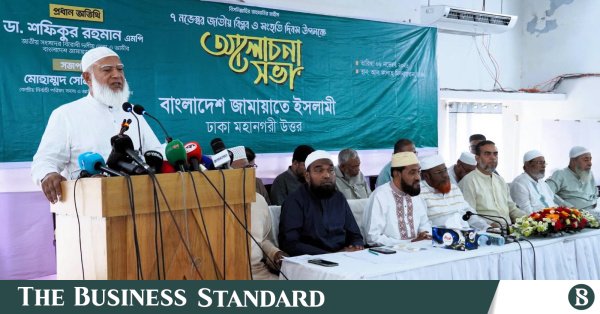
Jamaat-e-Islami Ameer Shafiqur Rahman spoke as the chief guest at a discussion organised by Jamaat’s Dhaka North city unit at Al-Falah Auditorium in the capital on 6 November 2026. Photo: Bangladesh Jamaat-e-Islam Facebook Page
“>

Jamaat-e-Islami Ameer Shafiqur Rahman spoke as the chief guest at a discussion organised by Jamaat’s Dhaka North city unit at Al-Falah Auditorium in the capital on 6 November 2026. Photo: Bangladesh Jamaat-e-Islam Facebook Page
Jamaat-e-Islami Ameer Shafiqur Rahman today (6 November) said that the events of 15 August 1975 were an act of revenge by disgruntled military officers, while the 7 November uprising was a soldiers-led revolution backed by the people.
He made the remarks as the chief guest at a discussion organised by Jamaat’s Dhaka North city unit at Al-Falah Auditorium in the capital at 10:30am today, marking National Revolution and Solidarity Day.
Jamaat Secretary General and former MP Mia Golam Porwar attended the programme as a special guest, while Dhaka North Ameer Mohammad Selim Uddin presided over the discussion.

Shafiqur said the 15 August incident had been driven primarily by resentment among military officers who felt ridiculed, disregarded and humiliated by the government.
He claimed the general public had no involvement in the incident.
By contrast, he described 7 November as a soldiers-led uprising that received widespread popular support, following a counter-coup by Brigadier Khaled Mosharraf on 3 November.
“The revolution was carried out by the soldiers, while the people expressed solidarity. The people of this country openly extended their full support to the revolution,” he said.
Allegations against the post-independence government
The Jamaat chief alleged that after assuming power in 1972, the then government banned almost all Islamic organisations in the country despite their active participation in the 1970 election.
He claimed that the government had assured voters before the election that it would not undermine the Quran and Sunnah, but adopted the opposite position after taking office.
Despite securing overwhelming public support, the government soon lost confidence in the people, he alleged.
Shafiqur said that although the country already had the army, police, Ansar and other security forces, the government established a special force out of concern over the consequences of its own actions.
He alleged that the Rakkhi Bahini was given sweeping powers without effective mechanisms for judicial scrutiny or accountability.
According to him, the force killed 34,000 people, including at least 10,000 freedom fighters.
Referring to the killing of freedom fighter Siraj Sikder without trial, he criticised the statement made by the then prime minister in Parliament following the incident, describing it as evidence of disregard for the justice system and the rule of law.
He further alleged that murder, torture, looting and violations of people’s dignity went unpunished, while opposition voices were suppressed and public frustration mounted over the activities of people close to the ruling establishment.
He also cited an incident in which a serving army officer allegedly lost his job after seeking justice over the abduction of his wife.
Shafiqur claimed that people close to those in power were involved in bank looting and various irregularities.
He also alleged that concerns over immoral activities centred around a suite at Hotel Sheraton had prompted some parents to stop sending their daughters to colleges and universities.
Rakkhi Bahini and one-party rule
Shafiqur also accused the post-independence government of misappropriating relief supplies sent from abroad for the people, alleging that large quantities were sold outside the country instead of being properly distributed.
Recalling a statement by the then prime minister in response to questions about relief distribution, he said the leader had remarked that eight crore blankets had arrived for a population of seven crore, yet he himself had not received one.
The Jamaat chief accused the government of dismantling democratic institutions through corruption, looting of national resources, deprivation of people’s rights and extrajudicial killings before introducing the one-party Baksal system.
He said constitutional provisions had been introduced to keep Sheikh Mujibur Rahman as head of state for as long as he remained alive.
Although the government had come to power through a multiparty election, it subsequently abolished multiparty democracy, he alleged, adding that the establishment of one-party rule on 25 January 1975 had effectively brought democracy to an end.
Military resentment and the 7 November uprising
Shafiqur said resentment within the military over perceived humiliation and disregard was among the factors that contributed to the events of 7 November.
He recalled that a series of power shifts and political upheavals followed the 15 August incident and continued until 3 November, when Brigadier Khaled Mosharraf staged a counter-coup.
Ziaur Rahman remained confined until 6 November, he said. Early the following day, soldiers organised themselves and freed him.
According to Shafiqur, when soldiers took to the streets with tanks, people emerging from mosques after prayers welcomed them with chants of Takbir.
The chants subsequently spread among the wider public, he said.
Similar scenes unfolded in several major cities outside Dhaka, he added.
The Jamaat chief said the soldiers had led the revolution, while the people had expressed solidarity with them.
He argued that this popular support was what gave the day its significance as National Revolution and Solidarity Day.
About The Author