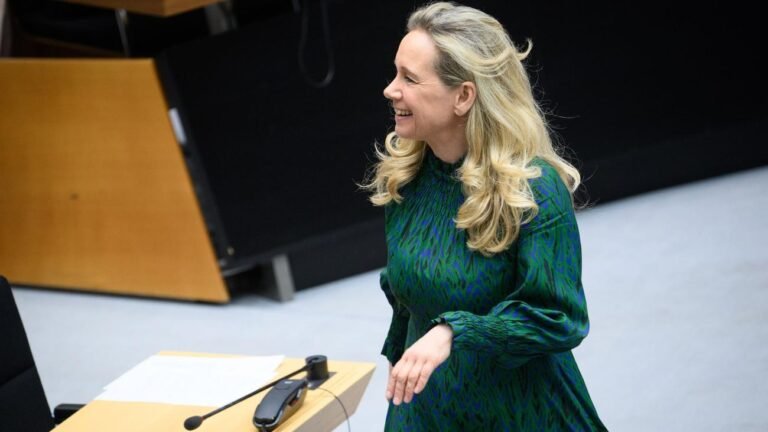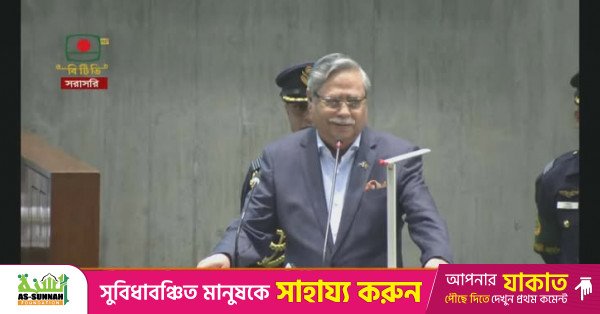
President Mohammad Shahabuddin today (12 March) referred to Ziaur Rahman as the “proclaimer of independence” during his address at the first session of the Jatiya Sangsad, amid protests and a walkout by MPs from the Jamaat alliance.
The head of state delivered the speech in the afternoon at the maiden session of the 13th parliament.
During the speech, he also repeatedly referred to the previous Awami League government as “fascist,” saying the administration had turned Bangladesh into a “champion of corruption.”

He said the country was later able to get rid of the stigma of being a global corruption champion due to “strict measures” taken by the BNP government.
The speech took place amid protests by lawmakers from the Jamaat alliance, some of whom staged a walkout during the session.
Noting that sustainable development cannot be achieved without the political and economic empowerment of the people, the president said the government is, therefore, committed to ensure the establishment and practice of democratic rights in every aspect of state governance.
He said, despite inheriting a fragile economic situation, the incumbent government led by Prime Minister Tarique Rahman is moving forward with determination to build a just, humane, self-reliant and democratic Bangladesh.
Stating that the newly formed Government faces formidable challenges, particularly in the areas of poverty alleviation, combating corruption and maintaining law and order, Mohammed Shahabuddin said the path ahead may be difficult, yet with genuine political will, no obstacle is insurmountable.
“If both the ruling and opposition parties work in consensus, the nation can rapidly achieve its desired goals. I believe the government will successfully advance the country toward its intended objectives,” he added.
Today’s inaugural session of the 13th Parliament marks a moment of profound significance in the history of Bangladesh, the president said, adding this solemn House now commences its journey with representatives elected through a peaceful, free, fair and impartial election.
The president extended his warm greetings and congratulations to Prime Minister Tarique Rahman of the newly formed government, Speaker, Deputy Speaker and all Members of Parliament (MPs).
He extended his sincere congratulations to all political parties that participated in the 13th JS polls, and to all those who were involved in its organisation and conduct, providing tireless efforts, including the Election Commission, the field administration, the law-enforcement agencies and the dedicated public servants of the Republic, in ensuring a free, fair and credible electoral process.
Speaker Hafiz Uddin Ahmed Bir Bikram of the 13th national parliament chaired the session.
The president said the participation of all political parties and candidates who contested the election, as well as the spontaneous and enthusiastic engagement of the people of Bangladesh together is equally commendable as they have set a bright and enduring example for the future.
At the outset of his speech, the president respectfully recalled with deep respect late president Ziaur Rahman, Bir Uttam, the Proclaimer of Independence, and the contribution of late BNP Chairperson Begum Khaleda Zia, three-time elected former Prime Minister of Bangladesh, for her outstanding leadership towards the march of parliamentary democracy in Bangladesh, and all martyrs who contributed to the historic struggle for the country’s independence.
“In the history of democracy in Bangladesh, the mass uprising of students and people in July and August 2024 will forever remain as a defining chapter. Students and people, farmers and workers, teachers, journalists, intellectuals, expatriates and people from every walk of life joined together in a united movement, alongside pro-democracy political parties, resulting in the fall of the then fascist Government on 5 August 2024,” he told the House.
The president said a new democratic Bangladesh, free from subservience and oppression, has begun its journey through the blood and sacrifice of thousands of martyrs.
He said the scale of sacrifice during that historic uprising was immense, as more than one thousand people were martyred. At least thirty thousand individuals, including women, men and children, were injured or permanently disabled. More than five hundred people tragically lost their eyesight.
The head of the state said the government is committed to establish the rule of law as the current administration is working to ensure effective independence of the judiciary, reduce case backlogs, eliminate harassment in the delivery of justice, modernize judicial services to prevent corruption, enact legislation for judicial appointments, establish a Judicial Commission, and maintain continuity in the Supreme Judicial Council system.
“A zero-tolerance policy against terrorism, extremism, and militancy will be upheld… and a national consensus will be built to eliminate these threats through legal, social and preventive measures,” he added.
The president said the country’s independence, sovereignty, territorial integrity, national interest, national security, and the welfare of its people will take precedence above all.
A special emphasis will be placed on economic, trade, and migration diplomacy, and effective diplomatic measures will be adopted to diversify exports, explore new markets, and protect customs and trade benefits, he added.
The president highlighted the various development activities and plans of the incumbent government in all sectors, including agriculture, education, health, economy, business and commerce, banking, administration, innovation, skilled human resource development, digital economy, and information and communication technology industry.
Recalling the contribution of Begum Khaleda Zia with due respect, he said, “During the tenure of former Prime Minister Begum Khaleda Zia, free education for girls was introduced.
“In continuation of that initiative, free education for girls up to Grade XII and stipend programs up to the bachelor’s (pass) level and equivalent are currently in operation. The present government has undertaken plans to create opportunities for free education for women at the postgraduate level as well,” he added.
Mentioning that the global economy is currently passing through an unstable period, the president said, compared to FY 2023-24, the overall macroeconomic situation of the country in FY 2024-25 has been relatively more stable. Several indicators, including remittances, have begun to show positive trends.
According to the final estimates of the Bangladesh Bureau of Statistics, he said the GDP growth rate for FY 2024-25 stood at 3.49%. During this period, per capita national income reached USD 2,769. The government expects the economic situation to strengthen further in FY 2025-26.
The president said that, amidst global conflicts, domestic inflation, and a low revenue-to-GDP ratio, the economy faces multiple challenges. Point-to-point inflation declined from 9.94% in January 2025 to 8.58% in January 2026.
It is expected that the downward trend in inflation will continue in the coming months, he said.
“In the past year, exports of jute and jute goods amounted to $470 million in FY 2024-25, exports increased by 8.60% to reach $48.30 billion. During the same period, remittance inflow rose by 26.83% to $30.329 billion. As of 19 February 2026, foreign exchange reserves stood at $34.78 billion, and the exchange rate was Tk122.30 per dollar,” he said.
The president said the current government will formulate effective policies to ensure good governance in the banking sector, control inflation, rationalise interest rates, and restore public confidence. An Economic Reforms Commission will be established for this purpose.
He said measures will be taken to ensure discipline, oversight, and transparency in financial institutions, enhance capacity and empower the Bangladesh Bank, and abolish the Financial Institutions Division. Immediate measures will be taken to stop political interference in the banking sector, review problems of high non-performing loans and bring those responsible to justice, and resolve institutional weaknesses.
The president said a Capital Market Reforms Commission will be formed to reform the capital market, while a special investigation commission will be established to investigate irregularities in the capital market over the past fifteen years.
About The Author