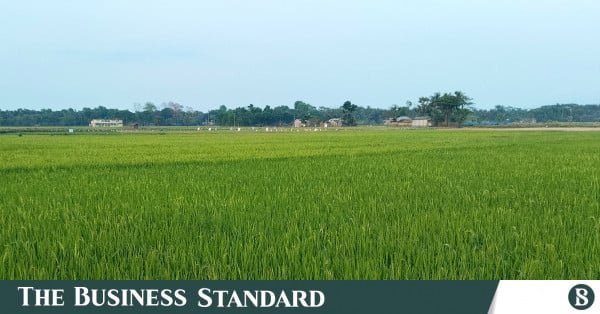
Amal Kumar’s hands tell the story before he does. Calloused from four decades of working eight bighas of land in Kaliganj upazila, they shake slightly as he gestures towards the field he planted with Boro rice this season.
The stalks stand stunted and pale, where they stand at all. Roughly a quarter of them have simply browned and died where they were transplanted.
“I will spend Tk120,000 on this crop, from seedbed to cutting,” he says, not looking up from the withered rows. “I am not sure the rice in the field will cover even half of it.”

The reason is written in the soil itself. The Khajabaria area of Kaliganj, part of Satkhira’s coastal belt on Bangladesh’s south-west frontier, recorded soil salinity of 25 dS/m (deciSiemens per metre) this Boro season. The government’s normal tolerable limit for agriculture is 7.5 dS/m.
The salt-tolerant rice varieties that scientists proudly introduced to farmers like Amal Kumar are designed to survive up to 12 dS/m. The math is brutal and simple: the land is more than twice as salty as the best seeds Bangladesh has ever grown.
The miracle that wasn’t enough
For years, Bangladesh’s answer to coastal salinity was a story of scientific triumph.
Researchers at the Bangladesh Rice Research Institute (BRRI), working in collaboration with the International Rice Research Institute (IRRI) and supported by USAID and the Bill & Melinda Gates Foundation, developed varieties such as BRRI dhan67, dhan97, and dhan99 that can survive saline conditions that would otherwise kill ordinary paddy.
Tested across three consecutive Boro seasons in salinity hotspots such as Kaliganj, Koyra, and Debhata, they were observed to survive at levels of 8–16 dS/m. Officials at the Department of Agricultural Extension called them a lifeline for the coastal belt.
But the climate had other plans.
A recent study by BRRI’s Satkhira office found that soil salinity in coastal areas, which measured just 4.1 dS/m in 2022, has surged to 25 dS/m in some locations — a near sixfold increase in four years.
The Satkhira office of the Soil Resources Development Institute corroborates the trend. In Shyamnagar upazila alone, salinity readings doubled from 3.9 dS/m in January 2021 to 8.12 dS/m by early this year. And that is considered moderate.
“Currently, our most resilient salt-tolerant varieties are rated to withstand up to 12 dS/m,” says Md Abu Bakar Siddique, Senior Scientific Officer at BRRI’s Genetic Resources and Seed Division.
“When levels surge to 20–25 dS/m, rice cultivation becomes effectively impossible. While a plant might survive a very brief spike and recover if fresh water is introduced, sustained exposure at these levels is lethal. The salinity profile is highly volatile — we are chasing a moving target where the level varies not just from place to place, but from month to month.”
The physics of salt
To understand why the crisis is accelerating so sharply, it helps to understand what is happening underground.
Md Mamunur Rashid, Principal Scientific Officer and Head of BRRI’s Regional Station in Satkhira, points to capillary action: without sufficient rainfall, saline water from the lower water table rises to the surface through soil capillaries and remains trapped there, concentrating into a brine far exceeding what standard seasonal measurements suggest.
Romana Akter, Senior Scientific Officer at BRRI’s Satkhira office, explains what this means for the plant.
“It becomes a battle of density,” she says. “When salinity peaks, the concentration in the soil becomes higher than the concentration inside the plant. Instead of the roots drinking from the earth, the salt-heavy soil actually pulls water out of the plant. The rice doesn’t just stop growing — it dehydrates from the inside out.”
On the worst days, the soil does not just look dry; it looks frosted. A fine, white crystalline powder settles on the ridges of the furrows, a visible reminder that the enemy is coming from below as much as from the sea.
Climate change is the engine behind all of it.
Sardar Shariful, Assistant Director of the Bangladesh Department of Environment in Satkhira, points to two reinforcing forces: rising seas pushing tidal intrusion further inland, and the Farakka Barrage’s reduction of the dry-season Ganges flow that historically kept saltwater at bay.
Successive cyclones — Amphan, Yaas and Remal — have punched saltwater through embankments and deeper into agricultural land. To the south, wealthy gher owners sometimes cut those very embankments to let the tide in for their shrimp — effectively poisoning the soil of neighbours who still cling to the dream of a harvest.
Across 1.53 lakh hectares
The scale is staggering. Of Satkhira’s 2.26 lakh hectares of arable land, at least 1.53 lakh hectares — including 73,000 hectares already converted to shrimp farming — have been affected by varying degrees of salinity. Rice acreage has been declining for fifteen years.
Aus cultivation plunged from 12,265 hectares in 2010 to 6,610 hectares last year. Farmers across Kaliganj, Debhata, Assasuni, and Shyamnagar describe the same experience: rice that germinates, browns, and dies mid-season, with 20-30% of plants simply perishing.
The salt does not stop at the field’s edge. A 2021 UNDP survey found that 73% of people in five coastal upazilas of Khulna and Satkhira were already consuming unsafe, saline drinking water. Health researchers at icddr,b found that women in the coastal plains were 1.3 times more likely to miscarry than women living inland — a difference attributed to salt levels in their drinking water.
Kajoli Begum, a Satkhira resident now living on an embankment after losing her home to repeated flooding, puts the exhaustion plainly, “Every year we rebuild, and every year the river returns. We don’t know how long we can keep starting over.”
A World Bank study projects that by 2050, salinity could threaten agriculture, drinking water, and food security across 148 upazilas in 19 coastal districts.
The race in the lab
Against this timeline, BRRI has not been standing still. In February 2026, the Ministry of Agriculture approved six new rice varieties, including BRRI dhan117 — short-duration, salt-tolerant, and blast disease-resistant. Its life cycle of 129 to 135 days is the key selling point for the coastal belt. “BRRI dhan117’s biggest advantage is its short duration,” says Rashid. “It can be harvested before the salinity peaks.” When you cannot outrun the salt in terms of tolerance, you try to outrun it in terms of time.
When levels surge to 20–25 dS/m, rice cultivation becomes effectively impossible. While a plant might survive a very brief spike and recover if fresh water is introduced, sustained exposure at these levels is lethal. The salinity profile is highly volatile — we are chasing a moving target where the level varies not just from place to place, but from month to month.
Md Abu Bakar Siddique, Senior Scientific Officer, Genetic Resources and Seed Division, BRRI
Rashid is also careful not to paint a picture of total collapse. “Despite the high salinity levels, we haven’t seen a massive collapse in total yield,” he says. “Interestingly, wide hybrid varieties are showing resilience. It seems the local ecosystem and the farmers themselves are becoming acclimatised — they are learning to adapt.” The crisis is real, but it is not a cliff-edge. It is a slow erosion, which in some ways makes it harder to mobilise against.
The Director General of BRRI Mohammad Khalequzzaman has called salinity the institute’s highest priority.
With the six new approvals, BRRI has now developed 127 rice varieties, of which 39 are classified as stress-tolerant. But even the institute’s scientists hedge their promises: dhan117’s operational ceiling sits at around 12–14 dS/m at the seedling stage, dropping under sustained exposure.
The trajectory of salinity in Satkhira is not measured in single digits. The government’s agricultural extension service has been advising coastal farmers to plant earlier — reducing the window of salt exposure.
But Saiful Islam, Deputy Director of the DAE in Satkhira, is frank about the limits of the strategy: “We are buying time,” he says.
Adapting without a net
Farmers are not waiting. Many have moved towards sunflower cultivation, salt-tolerant vegetables, and, above all, shrimp ghers — saline aquaculture enclosures that require and perpetuate the very salinity that is killing the rice.
The irony is that shrimp farms cut embankments to let seawater in, raise salinity in adjacent fields, drive neighbouring rice farmers out, and expand the saline footprint further. It is a feedback loop that policy has struggled to interrupt. “If you bind the four legs of a cow and then slaughter it, what could the cow do then?” one Satkhira farmer told researchers from Springer’s Food Security journal. “Our situation is the same.”
When the official varieties falter, a shadow market takes over. Along the border, sacks of uncertified Indian seed — known locally as ‘Rod Miniket’ — are traded quietly, as farmers bypass government recommendations in a high-stakes gamble on anything that survives the brine.
Rashid confirms it, “The variety is proving quite profitable for the farmers.” It is not BRRI-approved, not the product of local field trials, and not backed by extension services. “It is simply something that works, and farmers found it themselves. When it benefits the farmer, we don’t raise a flag there,” he adds.
Back in Kaliganj, Anwar Hossain puts it with careful optimism. “We lost hope when our fields became too saline for growing paddy,” he says. “With salt-tolerant rice varieties, we can now at least grow something again.” Whether Dhan117 sustains that hope — or whether the salt keeps outpacing the science — is the question these coastal people are living inside.
A moving target
The fundamental problem is not that Bangladesh lacks scientific ambition. It is that the climate is accelerating faster than the breeding cycle. A new rice variety takes years to develop, trial, and release. The salinity in Kaliganj went from 4.1 dS/m to 25 dS/m in four years. These are not timescales that agricultural science, structured around decade-long research pipelines, can easily match.
Rashid’s 600 to 700 demonstration plots across the region this Boro season reflect the effort to compress that gap, bringing the lab directly to farmers’ fields. But the tolerance ceiling for the best available varieties is 12 dS/m. The current readings in Satkhira’s worst-affected areas are more than double that. The miracle seeds are not failing. They are simply being asked to survive in a world they were never designed for.
When Amal Kumar walks back towards his pale-stalked field, he does not talk about varieties or salinity levels or research timelines. He talks about the loan he took for seeds and fertiliser, and what he will tell the bank when the harvest comes up short again.
“The land used to give,” he says. “Now it takes.”
About The Author